
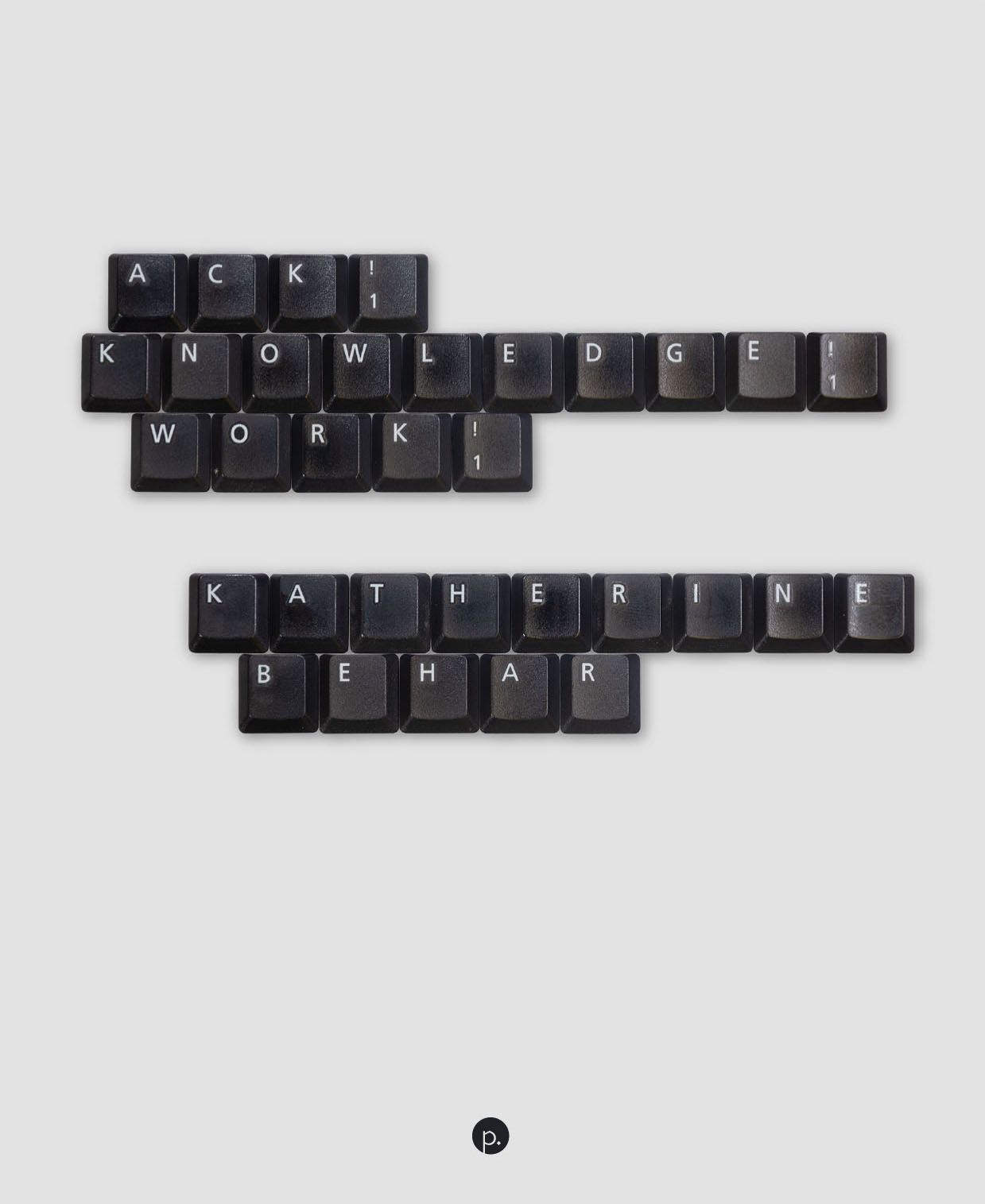
| Title | Ack! Knowledge! Work! |
|---|---|
| Contributor | Katherine Behar(opens in new tab)(author) |
| DOI | https://doi.org/10.53288/0551.1.00(opens in new tab) |
| Landing page | https://punctumbooks.com/titles/ack-knowledge-work/(opens in new tab) |
| License | https://creativecommons.org/licenses/by-nc-sa/4.0/(opens in new tab) |
| Copyright | Katherine Behar |
| Publisher | punctum books |
| Publication place | Earth, Milky Way |
| Published on | 2026-09-01 |
| Long abstract | Katherine Behar’s artworks bring automation technologies into visibility, highlighting in particular how such technologies “work” to make work invisible. Motifs of human absence run throughout Behar’s robotic installations, sculptures, and video works and that absence is matched by material footprints of nonhuman over-productivity. The result is an abundance of slippages between knowledge work, white-collar class identification, natural intelligence, artificial intelligence, and office culture. Contrary to the prevailing values we might associate with these subjects, evidence emerges in these intersections that all “autonomous” behavior turns on collective maintenance. This simultaneously opens automation processes to absurdity and humor, and allows robotics to incorporate kinship and care. Connecting contemporary theory and art, Ack! Knowledge! Work! documents and expands upon Behar’s solo exhibition presented at the Beall Center for Art + Technology(opens in new tab) in southern California. Behar is known as both a conceptual, multimedia artist and a critical theorist, and this volume brings art and theory together with plates from the exhibition, essays by well-known scholars of new media and computing Kris Paulsen, Jennifer Rhee, and Scott Richmond, and short texts by Behar, curator Jesse Colin Jackson, and creative technologist Fee Christoph, all of which illuminate the predominant theme of the exhibition: the interplay between automation, AI, labor, robotics, and technology in the still-human workspace, with an emphasis on collaborating with technology rather vying against it in a “race for the bottom.” |
| Language | English (Original) |
| THEMA |
|
| BISAC |
|
| Keywords |
|
Contributors
Katherine Behar
(author)Katherine Behar is an interdisciplinary artist and writer exploring issues of gender, race, class, and labor in contemporary digital culture. She is known for projects that mix low and high technologies to create hybrid forms that are by turns humorous and sensuous. Behar is a 2023 Creative Capital Awardee in Technology. Her comprehensive survey exhibition and catalog, Data’s Entry | Veri Girişi, was presented by Pera Museum in 2016. Additional solo exhibitions include Shelf Life (2022), a site-specific installation at Trinity College, Backups (2019), appearing at Framingham State University, and E-Waste (2014), premiering with catalog at University of Kentucky and traveling to Boston Cyberarts Gallery. Her robotic installation Anonymous Autonomous received work-in-progress solo exhibitions at Robert Morris University (2018) and University of Michigan (2019). Since 2005, she has collaborated with Marianne M. Kim in the performance art duo Disorientalism, which studies how technologized work, junk culture, and consumerism mediate race and gender. Behar’s books include Object-Oriented Feminism (University of Minnesota Press, 2016), And Another Thing: Nonanthropocentrism and Art(opens in new tab) (punctum books, 2016), and Bigger Than You: Big Data and Obesity(opens in new tab) (punctum books, 2016). Her writing has been translated into Turkish, Portuguese, Russian, Lithuanian, and Spanish and she is Professor of New Media Arts at Baruch College, City University of New York.