
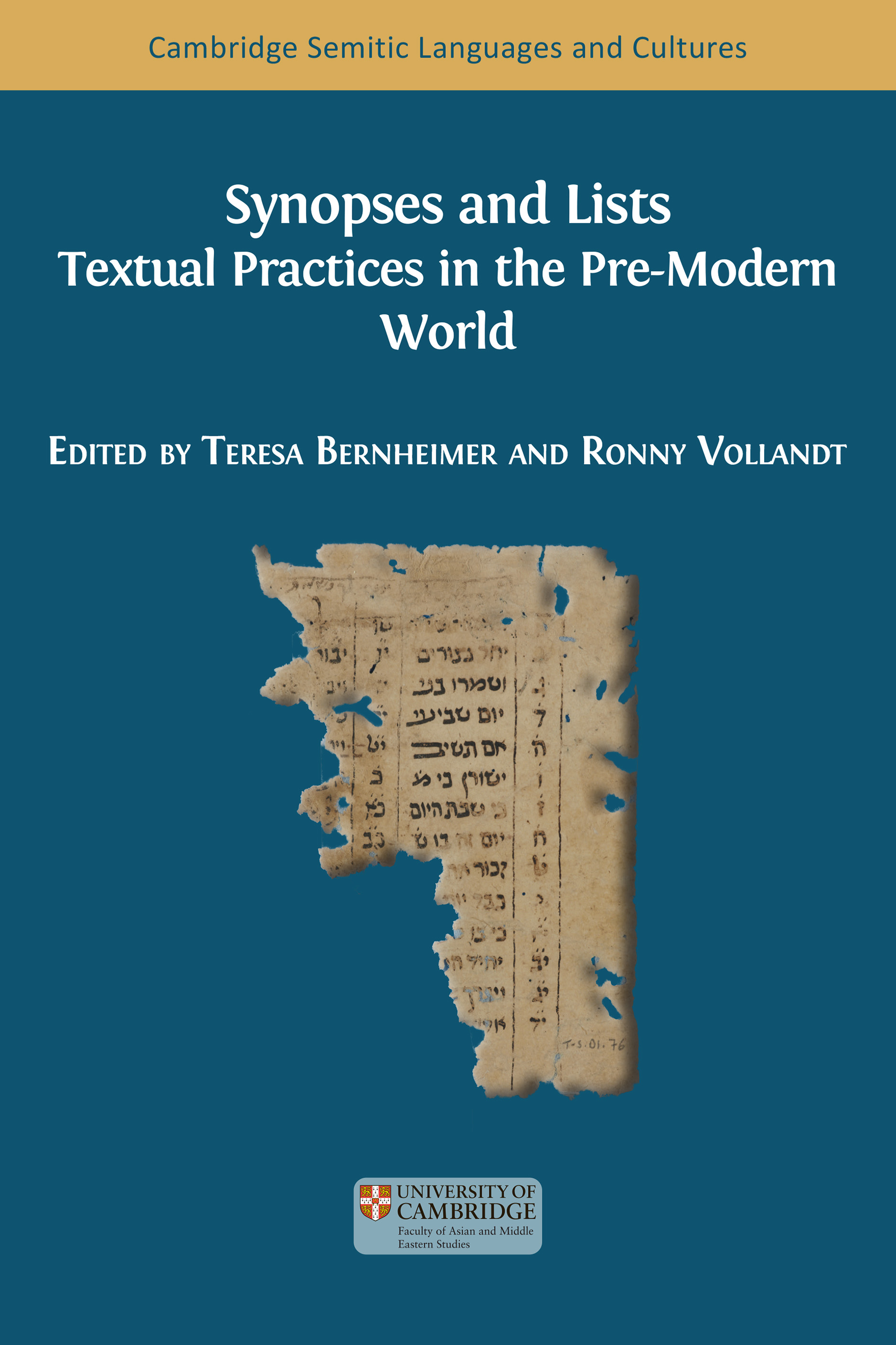
| Title | Synopses and Lists |
|---|---|
| Subtitle | Textual Practices in the Pre-Modern World |
| Contributor | Teresa Bernheimer(opens in new tab)(editor) |
| Ronny Vollandt(opens in new tab)(editor) | |
| DOI | https://doi.org/10.11647/OBP.0375(opens in new tab) |
| Landing page | https://www.openbookpublishers.com/books/10.11647/OBP.0375(opens in new tab) |
| License | http://creativecommons.org/licenses/by-nd/4.0/(opens in new tab) |
| Copyright | Teresa Bernheimer; Ronny Vollandt |
| Publisher | Open Book Publishers |
| Publication place | Cambridge, UK |
| Published on | 2023-12-19 |
| Series |
|
| ISBN | 978-1-80511-118-4 (Paperback) |
| 978-1-80064-916-3 (Hardback) | |
| 978-1-80511-148-1 (PDF) | |
| Short abstract | Textual practices in pre-modern societies cover a great range of representations, from the literary to the pictorial. Among the most intriguing are synopses and lists. While lists provide a complete enumeration of ideas, people, events, or terms, synopses juxtapose one against the other. To understand how they were planned, produced, and consumed, is to gain insight into the practices of what one can call management of knowledge in a time before our own. |
| Long abstract | Textual practices in pre-modern societies cover a great range of representations, from the literary to the pictorial. Among the most intriguing are synopses and lists. While lists provide a complete enumeration of ideas, people, events, or terms, synopses juxtapose one against the other. To understand how they were planned, produced, and consumed, is to gain insight into the practices of what one can call management of knowledge in a time before our own. The present volume is the product of two workshops held in 2019 and 2021 as part of the research focus Textual Practices in the Pre-Modern World: Texts and Ideas between Aksum, Constantinople, and Baghdad, which was generously supported and funded by the Centre for Advanced Study (CAS) at Ludwig-Maximilians-Universität (LMU), Munich. Aiming to understand how synopses and lists function in the literatures of the great intellectual traditions of late antiquity—the ancient Near East, ancient philosophy, and the three monotheistic religions Judaism, Christianity, and Islam—the volume offers a historical and transcultural perspective on synopses and lists, highlighting the centrality of these textual practices to allow storing, retrieving, selecting, and organising this knowledge. Both make deliberate – yet not always explicit – choices as to what is included and excluded, thereby creating lasting hierarchies and canons. |
| Print length | 408 pages (xxii+386) |
| Language | English (Original) |
| Dimensions | 156 x 29 x 234 mm | 6.14" x 1.14" x 9.21" (Paperback) |
| 156 x 32 x 234 mm | 6.14" x 1.26" x 9.21" (Hardback) | |
| Weight | 772g | 27.23oz (Paperback) |
| 753g | 26.56oz (Hardback) | |
| Media | 28 illustrations |
| OCLC Number | 1415825306 |
| LCCN | 2023512116 |
| THEMA |
|
| BIC |
|
| BISAC |
|
| LCC |
|
| Keywords |
|
Contents
- Teresa Bernheimer
- Ronny Vollandt
- Enrique Jiménez
- Lennard Lehmhaus
- Liv Ingeborg Lied
- Peter Tarras
- Matthew Monger
- Teresa Bernheimer
- Martin Wallraff
- Rebecca Ullrich
- Maroussia Bednarkiewicz
- Marilena Maniaci
Contributors
Teresa Bernheimer
(editor)Teresa Bernheimer (D.Phil Oxford 2007) is postdoctoral fellow at LMU Munich on the project Beyond Conflict and Coexistence. The Entangled History of Jewish-Arab Relations funded by the German Federal Ministry of Education and Research (BMBF). She is a historian of the Middle East with a particular interest in the formation of Islam in the context of late antiquity and beyond, on which she has published several books and articles. From 2019-2022 she was spokesperson of the CAS LMU research group Textual Practices in the Pre-Modern World: Texts and Ideas between Aksum, Constantinople, and Baghdad, together with Ronny Vollandt.
Ronny Vollandt
(editor)Ronny Vollandt is Professor of Judaic Studies at Ludwig-Maximilians-Universität in Munich and director of the Munich Research Centre for Jewish-Arabic Cultures (www.lmu.de/jewisharabiccultures/(opens in new tab)). Among his main research interests is the intercommunal transmission of knowledge, also the topic of his ERC Consolidator grant MAJLIS. The Transformation of Jewish Literature in Arabic in the Islamicate World (2021–2026). From 2019-2022 he was spokesperson of the CAS LMU research group Textual Practices in the Pre-Modern World: Texts and Ideas between Aksum, Constantinople, and Baghdad, together with Teresa Bernheimer.