
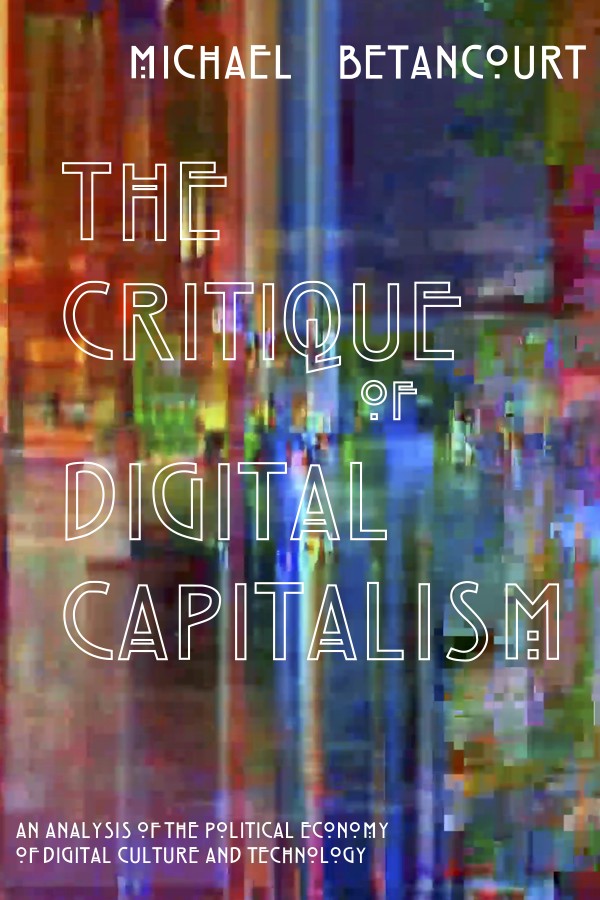
| Title | The Critique of Digital Capitalism |
|---|---|
| Subtitle | An Analysis of the Political Economy of Digital Culture and Technology |
| Contributor | Michael Betancourt (author) |
| DOI | https://doi.org/10.21983/P3.0125.1.00(opens in new tab) |
| Landing page | https://punctumbooks.com/titles/the-critique-of-digital-capitalism/(opens in new tab) |
| License | https://creativecommons.org/licenses/by-nc-sa/4.0/(opens in new tab) |
| Copyright | Betancourt, Michael |
| Publisher | punctum books |
| Publication place | Brooklyn, NY |
| Published on | 2016-01-07 |
| ISBN | 978-0-692-59844-3 (Paperback) |
| Long abstract | Anything that can be automated, will be. The “magic” that digital technology has brought us — self-driving cars, Bitcoin, high frequency trading, internet of things, social networking, mass surveillance, the 2009 housing bubble — has not been considered ideologically. The Critique of Digital Capitalism identifies how digital technology has captured contemporary society in a reification of capitalist priorities. The theory proposed in this book is the description of how digital capitalism as an ideologically “invisible” framework is realized in technology. Written as a series of articles between 2003 and 2015, it provides a broad critical scope for understanding the inherent demands of capitalist protocols for expansion without constraint (regardless of social, legal or ethical limits) that are increasingly being realized as autonomous systems no longer dependent on human labor or oversight and implemented without social discussion of their impacts. The digital illusion of infinite resources, infinite production, and no costs appears as an “end to scarcity,” whereby digital production supposedly eliminates costs and makes everything equally available to everyone. This fantasy of production without consumption hides the physical costs and real-world impacts of these technologies. The critique introduced in this book develops from basic questions about how digital technologies directly change the structure of society: why is “Digital Rights Management” not only the dominant “solution” for distributing digital information, but also the only option being considered? During the burst of the “Housing Bubble” in 2009, why were the immaterial commodities being traded of primary concern, but the actual physical assets and the impacts on the people living in them generally ignored? How do surveillance (pervasive monitoring) and agnotology coincide as mutually reinforcing technologies of control and restraint? If technology makes the assumptions of its society manifest as instrumentality — then what ideology is being realized as the digital computer? This final question animates the critical framework this analysis proposes. Digital capitalism is a dramatically new configuration of the historical dynamics of production, labor and consumption that results in a new variant of historical capitalism. This contemporary, globalized network of production and distribution depends on digital capitalism’s refusal of established social restraints: existing laws are an impediment to the transcendent aspects of digital technology. Its utopian claims mask its authoritarian result: the superficial “objectivity” of computer systems are supposed to replace established protections with machinic function — the uniform imposition of whatever ideology informs the design. However, machines are never impartial: they reify the ideologies they are built to enact. The critical analysis of capitalist ideologies as they become digital is essential to challenging this process. Contesting their domination depends on theoretical analysis. This critique challenges received ideas about the relationship between labor, commodity production, and value, in the process demonstrating how the historical Marxist analysis depends on assumptions that are no longer valid. This book therefore provides a unique, critical toolset for the analysis of digital capitalist hegemonics. |
| Print length | 262 pages |
| Language | English (Original) |
| Dimensions | 127 x 203 mm | 5" x 8" (Paperback) |
| THEMA |
|
| BIC |
|
| BISAC |
|
| Keywords |
|
Contributors
Michael Betancourt
(author)Michael Betancourt(opens in new tab) is a theorist, historian, and artist concerned with digital technology and capitalist ideology. His essays have been translated into Chinese, French, Greek, Italian, Japanese, Persian, Portuguese, and Spanish, and published in journals such as CTheory, Semiotica, and Leonardo. He has been exhibiting internationally since 1993. His book, The History of Motion Graphics: From Avant-Garde to Industry in the United States was published in 2013. His monograph, Beyond Spatial Montage: Windowing, or, the Cinematic Displacement of Time, Motion, and Space, concerned with juxtaposed and composited imagery onscreen, was published by Focal Press.