
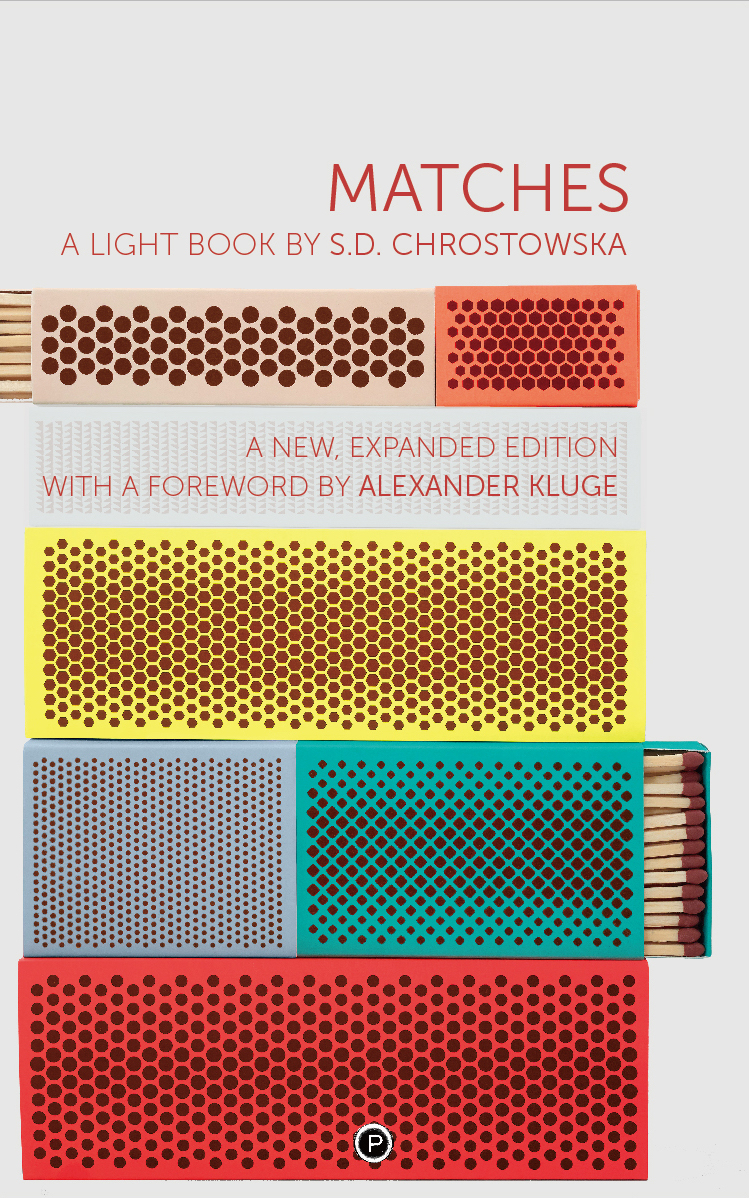
| Title | Matches |
|---|---|
| Subtitle | A Light Book |
| Edition | 2nd Edition |
| Contributor | S.D. Chrostowska (author) |
| DOI | https://doi.org/10.21983/P3.0251.1.00(opens in new tab) |
| Landing page | https://punctumbooks.com/titles/matches-a-light-book/(opens in new tab) |
| License | https://creativecommons.org/licenses/by-nc-sa/4.0/(opens in new tab) |
| Copyright | Chrostowska, S.D. |
| Publisher | punctum books |
| Publication place | Earth, Milky Way |
| Published on | 2019-04-16 |
| ISBN | 978-1-950192-21-2 (Paperback) |
| 978-1-950192-22-9 (PDF) | |
| Long abstract | The match: little stick tipped with combustible stuff, sparked by friction; typically comes in a book or a box or a bundle (the point being: never alone). The highly portable match lighting more or less when required was a great nineteenth-century innovation. Before, we had only Danger and Poison matches, and countless match-induced accidents and suicides. We still have not engineered mischief out of the match. One little lucifer, God’s little helper, lit in the company of its sisters and brothers will, if we let them, afford us a miniature inferno. Are we responsible for the recklessness of thought? There will always be match tricks to go very wrong. How many times have we amused ourselves in the schoolyard, lighting up the whole passel of ideas within our reach, getting us in trouble? And now that we are older, we can strike anywhere. We count on sparks to leap long distances virtually, to pass most swiftly from point to point instead of smouldering. No sooner do we bring a flame to something flammable than it spreads — even as its conductors are already charring and curling up. Let us congratulate ourselves for remaking the transport of ideas. And for this new refrain: What matters is what’s on fire. Through the prism of criticism, the modalities of thinking form a spectrum: on one end, systematic exposition, on the other, the fragment. It is the latter, fragmentary approach that distinguishes Matches—an investigation that does not focus on a single theme developed in all its aspects but, rather, on a constellation of themes in art, literature, philosophy, science, social and political thought, as well as the human in relation to history and nature. S.D. Chrostowska pursues here in performative fashion her research into the history of critique from the Enlightenment onward. Her choice of the fragment—in the tradition of writing represented by Gracián, Chamfort, Lichtenberg, and, closer to us, Nietzsche, Adorno, and Benjamin—does not, however, stem from an attempt to comprehend the contemporary world, which can only be done after the fact. Instead, served by an expressive and incisive style, Matches foregrounds the necessary elements for a critique of our time, capturing them in their contradictory and complementary relations. It situates itself under the sign of the future, reviving the spirit of utopia, reminding us that the last word need not belong to the present. |
| Print length | 560 pages |
| Language | English (Original) |
| Dimensions | 127 x 203 mm | 5" x 8" (Paperback) |
| LCCN | 2019937768 |
| THEMA |
|
| BIC |
|
| BISAC |
|
| Keywords |
|
| Funding |
Contributors
S.D. Chrostowska
(author)S.D. Chrostowska is Professor of Humanities and Social & Political Thought at York University in Canada. Author of Literature on Trial (UTP, 2012) and Permission (Dalkey Archive, 2013), she also coedited Political Uses of Utopia (Columbia University Press, 2017).