
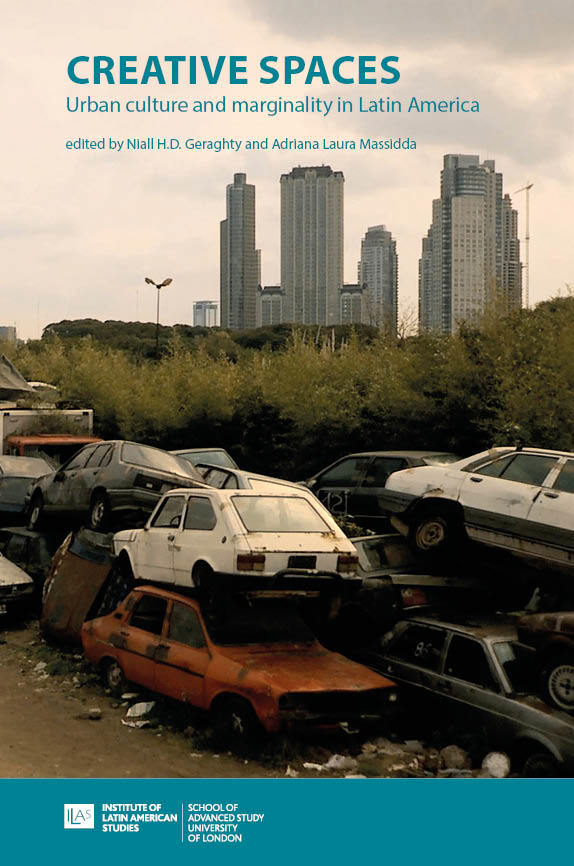
| Title | Creative Spaces |
|---|---|
| Subtitle | Urban Culture and Marginality in Latin America |
| Contributor | Niall H.D. Geraghty(opens in new tab)(editor) |
| Adriana Laura Massidda(opens in new tab)(editor) | |
| DOI | https://doi.org/10.14296/519.9781908857699(opens in new tab) |
| Landing page | https://uolpress.co.uk/book/creative-spaces/(opens in new tab) |
| License | https://creativecommons.org/licenses/by-nc-nd/4.0/(opens in new tab) |
| Copyright | Authors |
| Publisher | University of London Press |
| Publication place | London, GB |
| Published on | 2019-05-10 |
| ISBN | 978-1-908857-48-4 (Paperback) |
| 978-1-908857-69-9 (PDF) | |
| 978-1-908857-49-1 (EPUB) | |
| Short abstract | The essays within this collection reassess dominant theoretical notions of ‘marginality’ in Latin America and argue that, in contemporary society, it invariably allows for (if not leads to) the production of the new. Viewing them neither as spaces of deprivation nor romanticized spaces of opportunity, this volume analyses the production of new art forms, political organizations and subjectivities emerging from the urban margins in Latin America, neither condemning nor idealizing the effects they produce. |
| Long abstract | Creative Spaces: Urban Culture and Marginality is an interdisciplinary exploration of the different ways in which marginal urban spaces have become privileged locations for creativity in Latin America. The essays within the collection reassess dominant theoretical notions of ‘marginality’ in the region and argue that, in contemporary society, it invariably allows for (if not leads to) the production of the new. While Latin American cities have, since their foundation, always included marginal spaces (due, for example, to the segregation of indigenous groups), the massive expansion of informal housing constructed on occupied land in the second half of the twentieth century have brought them into the collective imaginary like never before. Originally viewed as spaces of deprivation, violence, and dangerous alterity, the urban margins were later romanticized as spaces of opportunity and popular empowerment. Instead, this volume analyses the production of new art forms, political organizations and subjectivities emerging from the urban margins in Latin America, neither condemning nor idealizing the effects they produce. To account for the complex nature of contemporary urban marginality, the volume draws on research from a wide spectrum of disciplines, ranging from cultural and urban studies to architecture and sociology. Thus the collection analyzes how these different conceptions of marginal spaces work together and contribute to the imagined and material reality of the wider city. |
| Print length | 272 pages |
| Language | English (Original) |
| Dimensions | 152 x 229 mm | 6" x 9" (Paperback) |
| Media | 21 illustrations |
| THEMA |
|
| BIC |
|
| BISAC |
|
| Keywords |
|
Contributors
Niall H.D. Geraghty
(editor)Niall H.D. Geraghty is Leverhulme Early Career Fellow and Lecturer in Latin American Cultural Studies at University College London. His research focusses on the intersections between critical theory, politics and contemporary Latin American cultural production. His current Leverhulme project involves a radical re-examination of the work of Argentine artist León Ferrari (1920–2013) which explores the interrelations between politics and religion in twentieth-century Argentina, and the potential correlations between contemporary philosophy and liberation theology.