
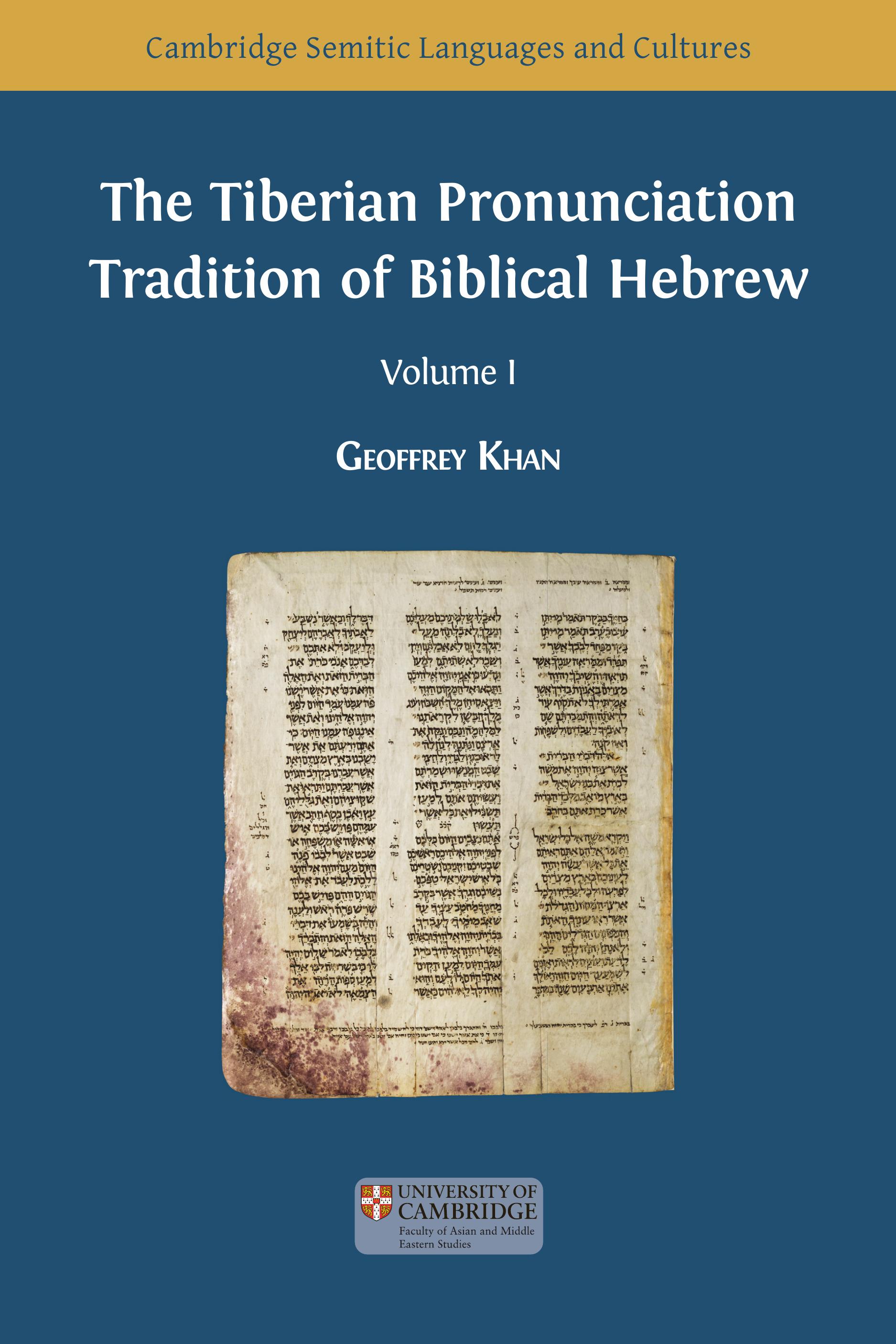
| Title | The Tiberian Pronunciation Tradition of Biblical Hebrew, Volume 1 |
|---|---|
| Contributor | Geoffrey Khan(opens in new tab)(author) |
| DOI | https://doi.org/10.11647/OBP.0163(opens in new tab) |
| Landing page | https://www.openbookpublishers.com/books/10.11647/obp.0163(opens in new tab) |
| License | http://creativecommons.org/licenses/by/4.0/(opens in new tab) |
| Copyright | Geoffrey Khan |
| Publisher | Open Book Publishers |
| Publication place | Cambridge, UK |
| Published on | 2020-02-20 |
| Book set | This book is part of a 2-volume set. The other volume in the set is: |
| ISBN | 978-1-78374-675-0 (Paperback) |
| 978-1-78374-676-7 (Hardback) | |
| 978-1-78374-677-4 (PDF) | |
| Short abstract | This book presents the current state of knowledge of the Tiberian pronunciation tradition of Biblical Hebrew and a full edition of one of the key medieval sources, Hidāyat al-Qāriʾ ‘The Guide for the Reader’, by ʾAbū al-Faraj Hārūn. There is also an accompanying oral performance of samples of the reconstructed pronunciation by Alex Foreman. |
| Long abstract | The form of Biblical Hebrew that is presented in printed editions, with vocalization and accent signs, has its origin in medieval manuscripts of the Bible. The vocalization and accent signs are notation systems that were created in Tiberias in the early Islamic period by scholars known as the Tiberian Masoretes, but the oral tradition they represent has roots in antiquity. The grammatical textbooks and reference grammars of Biblical Hebrew in use today are heirs to centuries of tradition of grammatical works on Biblical Hebrew in Europe. The paradox is that this European tradition of Biblical Hebrew grammar did not have direct access to the way the Tiberian Masoretes were pronouncing Biblical Hebrew. In the last few decades, research of manuscript sources from the medieval Middle East has made it possible to reconstruct with considerable accuracy the pronunciation of the Tiberian Masoretes, which has come to be known as the ‘Tiberian pronunciation tradition’. This book presents the current state of knowledge of the Tiberian pronunciation tradition of Biblical Hebrew and a full edition of one of the key medieval sources, Hidāyat al-Qāriʾ ‘The Guide for the Reader’, by ʾAbū al-Faraj Hārūn. There is also an accompanying oral performance of samples of the reconstructed pronunciation by Alex Foreman. It is hoped that the book will help to break the mould of current grammatical descriptions of Biblical Hebrew and form a bridge between modern traditions of grammar and the school of the Masoretes of Tiberias. |
| Print length | 761 pages (xv+746) |
| Language | English (Original) |
| Dimensions | 156 x 39 x 234 mm | 6.14" x 1.52" x 9.21" (Paperback) |
| 156 x 41 x 234 mm | 6.14" x 1.63" x 9.21" (Hardback) | |
| Weight | 2320g | 81.84oz (Paperback) |
| 2730g | 96.30oz (Hardback) | |
| OCLC Number | 1144100857 |
| LCCN | 2019452965 |
| BIC |
|
| BISAC |
|
| LCC |
|
| Keywords |
|
Contents
- Geoffrey Khan
- Geoffrey Khan
- Geoffrey Khan
- Geoffrey Khan
- Geoffrey Khan
- Geoffrey Khan