
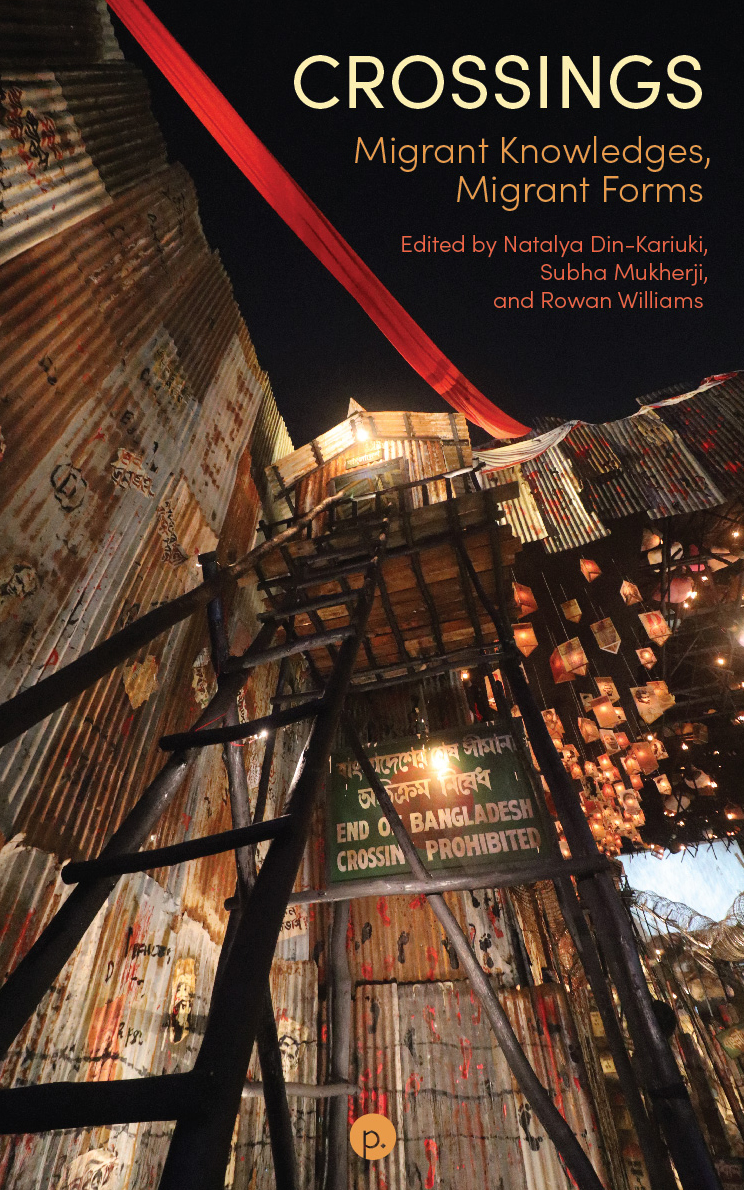
| Title | Crossings |
|---|---|
| Subtitle | Migrant Knowledges, Migrant Forms |
| Contributor | Natalya Din-Kariuki(opens in new tab)(editor) |
| Subha Mukherji (editor) | |
| Rowan Williams (editor) | |
| DOI | https://doi.org/10.53288/0417.1.00(opens in new tab) |
| Landing page | https://punctumbooks.com/titles/crossings-migrant-knowledges-migrant-forms/(opens in new tab) |
| License | https://creativecommons.org/licenses/by-nc-sa/4.0/(opens in new tab) |
| Copyright | Subha Mukherji, Natalya Din-Kariuki, Rowan Williams |
| Publisher | punctum books |
| Publication place | Earth, Milky Way |
| Published on | 2025-10-03 |
| ISBN | 978-1-68571-280-8 (Paperback) |
| 978-1-68571-281-5 (PDF) | |
| Long abstract | Crossings: Migrant Knowledges, Migrant Forms brings together activists, artists, scholars, and migrants with diverse histories to explore what the experience of migration does with, and to, knowledge, and how its own ways of knowing find expressive form. As the volume’s authors think about physical and imaginative crossings, and the traversals and transactions of knowledge they entail, the book itself crosses and complicates disciplinary and formal boundaries and the barriers between critical and creative intervention. Crucially, it brings together voices and forms emerging out of the experience of dislocation with responses to the encounters it generates. The volume’s discussions begin in the early modern world, and move freely across periods to dwell on the urgent experience of migrancy in our own times, while also responding to an urgent need to connect the local with the global experience of migrant knowledge and migrant aesthetics. Crossings stakes the claim that creative art, backed by humanities-based thinking, can meet the imaginative and ethical demands that the unknowable reality of mass displacement places on us, in a way that governments, institutions, and public discourse have calamitously failed to do. But aesthetic practice itself needs to be re-positioned if it is to rise to these political and human challenges, negotiating the points of friction between its own predilections and the matter of migration. Crossings offers “migrant forms” – art about migration, objects from migrant life shaped into artifacts, and migrant self-expressions – as the means of this imaginative re-orientation, and a tool for activating a radical alternative to economic models of social benefit*. Crossings* takes its place in an emergent ecology of migrant forms, both speaking to and participating in that ecology. |
| Print length | 562 pages |
| Language | English (Original) |
| Dimensions | 127 x 32 x 203 mm | 5" x 1.27" x 8" (Paperback) |
| Weight | 703g | 24.80oz (Paperback) |
| LCCN | 2025939388 |
| THEMA |
|
| BISAC |
|
| Keywords |
|
Contents
- Subha Mukherji
- Edmund de Waal
- Gillian Beer
- Natalya Din-Kariuki
- Anupam Basu
- John Gallagher
- Rosita D’Amora
- Jonathan Gil Harris
- Annabel Brett
- Brian Cummings
- Supriya Chaudhuri
- Olga Demetriou
- Efi Savvides
- Akid Hassan
- Valerie Forman
- Pip Williams
- Mohamed Sarrar
- Joe Murphy
- Joe Robertson
- Saifoudiny (Dine) Diallo
- Clelia Bartoli
- Marina Warner
- Valentina Castagna
- Nadina Christopoulou
- A.E. Stallings
- Aditi Anand
- Sue McAlpine
- Clair Wills
- Issam Kourbaj
- Simon Goldhill
- Subha Mukherji
- Regina M. Schwartz
- Rowan Williams
- Gabriel Josipovici
- Angela Leighton
- A.E. Stallings
- Rachel Spence
- Anthony Vahni Capildeo
- Yousif M. Qasmiyeh
- Bhanu Kapil
- Amit Chaudhuri
- Subha Mukherji
- T.M. Krishna
- Subha Mukherji
- Dragana Jurišić
- Susan Stockwell
- Carla Suthren
- Yota Batsaki
- Mina Gorji
- Claudia Roden
- Subha Mukherji
- Faraj Alnasser
- Subha Mukherji
- Faraj Alnasser
- Dragana Jurišić
- Subha Mukherji
- Jonathan Gil Harris
- Yousif M. Qasmiyeh
- Issam Kourbaj
- Natalya Din-Kariuki
- Saifoudiny (Dine) Diallo
- Rowan Williams
Contributors
Natalya Din-Kariuki
(editor)Natalya Din-Kariuki is from Nairobi. Migration has played an important part in her family’s history: her maternal grandfather was a stowaway on a dhow from India to Kenya in the 1930s. She is Assistant Professor in the Department of English and Comparative Literary Studies at the University of Warwick, where she works on the literary and intellectual history of the sixteenth and seventeenth centuries, with a particular focus on travel writing, transnational and transcultural encounters, and rhetoric and poetics. This work is published or forthcoming in journals, such as the Review of English Studies, Huntington Library Quarterly, and Textual Practice. She has held visiting fellowships at the University of Leeds, the Folger Institute, the University of Edinburgh, and the Newberry Library.
Subha Mukherji
(editor)Subha Mukherji was born in Kolkata, India where she grew up, and lives mainly in Cambridge in the UK. She is Professor of Early Modern Literature and Culture at the University of Cambridge and her interests and publications range across Renaissance English literature, early modern law and the theater, literary epistemologies, migration, and contemporary Indian art.
Rowan Williams
(editor)Rowan Williams was born in South Wales and taught Theology at Oxford, Cambridge, Bristol, and Yale. From 2002 to 2012, he was Archbishop of Canterbury, and from 2012 to 2020, Master of Magdalene College, Cambridge University. He has published widely on religion, literature, and politics, and was Chair of the charity Christian Aid for eight years. He now lives in Wales, and is Chair of the Peace Academy/Academi Heddwch. Recent books include, with Mary Zournazi, Justice and Love: A Philosophical Dialogue (Bloomsbury, 2020) and Collected Poems (Carcanet Press, 2021).
References
- (opens in new tab)
- (opens in new tab)
- (opens in new tab)
- (opens in new tab)
- (opens in new tab)
- (opens in new tab)
- (opens in new tab)
- (opens in new tab)
- (opens in new tab)
- (opens in new tab)
- (opens in new tab)
- (opens in new tab)
- (opens in new tab)
- (opens in new tab)
- (opens in new tab)
- (opens in new tab)
- (opens in new tab)
- (opens in new tab)
- (opens in new tab)
- (opens in new tab)
- (opens in new tab)
- (opens in new tab)
- (opens in new tab)
- (opens in new tab)
- (opens in new tab)
- (opens in new tab)
- (opens in new tab)
- (opens in new tab)
- (opens in new tab)
- (opens in new tab)