
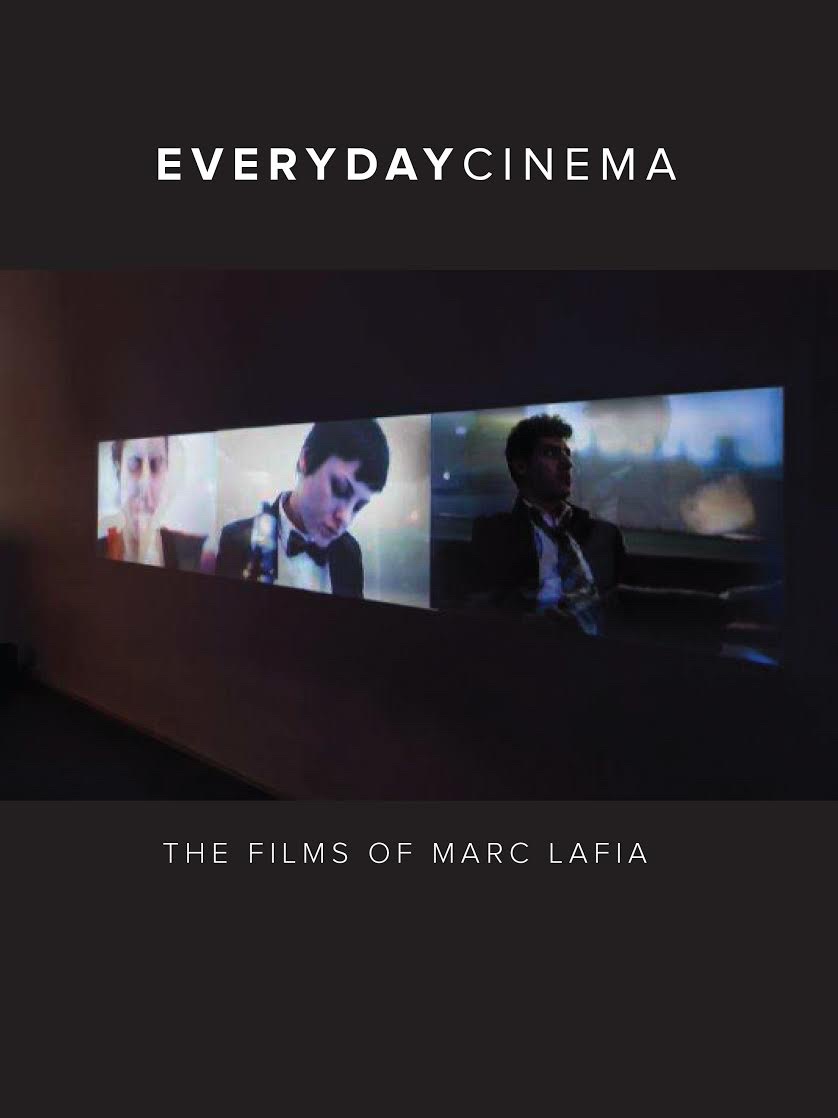
| Title | Everyday Cinema |
|---|---|
| Subtitle | The Films of Marc Lafia |
| Contributor | Marc Lafia (author) |
| DOI | https://doi.org/10.21983/P3.0164.1.00(opens in new tab) |
| Landing page | https://punctumbooks.com/titles/everyday-cinema-the-films-of-marc-lafia/(opens in new tab) |
| License | https://creativecommons.org/licenses/by-nc-sa/4.0/(opens in new tab) |
| Copyright | Lafia, Marc |
| Publisher | punctum books |
| Publication place | Earth, Milky Way |
| Published on | 2017-01-31 |
| ISBN | 978-0-9985318-0-9 (Paperback) |
| Long abstract | Everyday Cinema presents the films (eight features and numerous shorts, computational, and installation films) of Marc Lafia. In his many films (including Exploding Oedipus; Love and Art; Confessions of an Image; Revolution of Everyday Life; Paradise; Hi, How Are You Guest 10497; and 27) Lafia probes what it is to construct an image, to forge systems of representation, to see and represent ourselves. His work has been defined as a cinema of emergence, a cinema of the event, in which the very act of ubiquitous recording creates something new. Everyday Cinema is comprised of two parts, the first an in-depth look at his films and installations, project by project, providing background on how they came about, Lafia’s process and ideas. The second part features selected interviews and over two hundred film stills wherein Lafia puts forward a new sense of the possibility of the cinema. As we all relentlessly record ourselves and are recorded, we become part of the cinematic fabric of life, part of a spectacle of which we are both constituent and constitutive. This is what Lafia sets out to capture and examine. |
| Print length | 238 pages |
| Language | English (Original) |
| Dimensions | 191 x 254 mm | 7.50" x 10" (Paperback) |
| THEMA |
|
| BIC |
|
| BISAC |
|
| Keywords |
|
Contributors
Marc Lafia
(author)Over the last decade Marc Lafia has worked very much under the radar as an artist and filmmaker. In his two books, Image Photograph and Everyday Cinema, he gives account of his ideas of images and a cinema of intimacy, of the everyday, a cinema and photography wherein everything and everyone is already recorded and recording. Lafia’s accounting of life in the regime of the network, of instantaneous picture transmission, of a performative society putting on the spectacle of themselves to be liked and self-narrated, shows us a social fabric in a new relation to the image and recording. After years in Hollywood and Silicon Valley, in the heart of the old and new media, his works of net art began to emerge in the museum world in the late 1990s. His interest in emergence, the non-linear, and the perpetual archive, all unique to computation, now moves into the new social figuration and interpersonal relations resulting from social media. Lafia is perhaps our first cineaste whose work not only examines life in the condition of the network but records and narrates how we live and tell stories of our selves in a such a condition.