
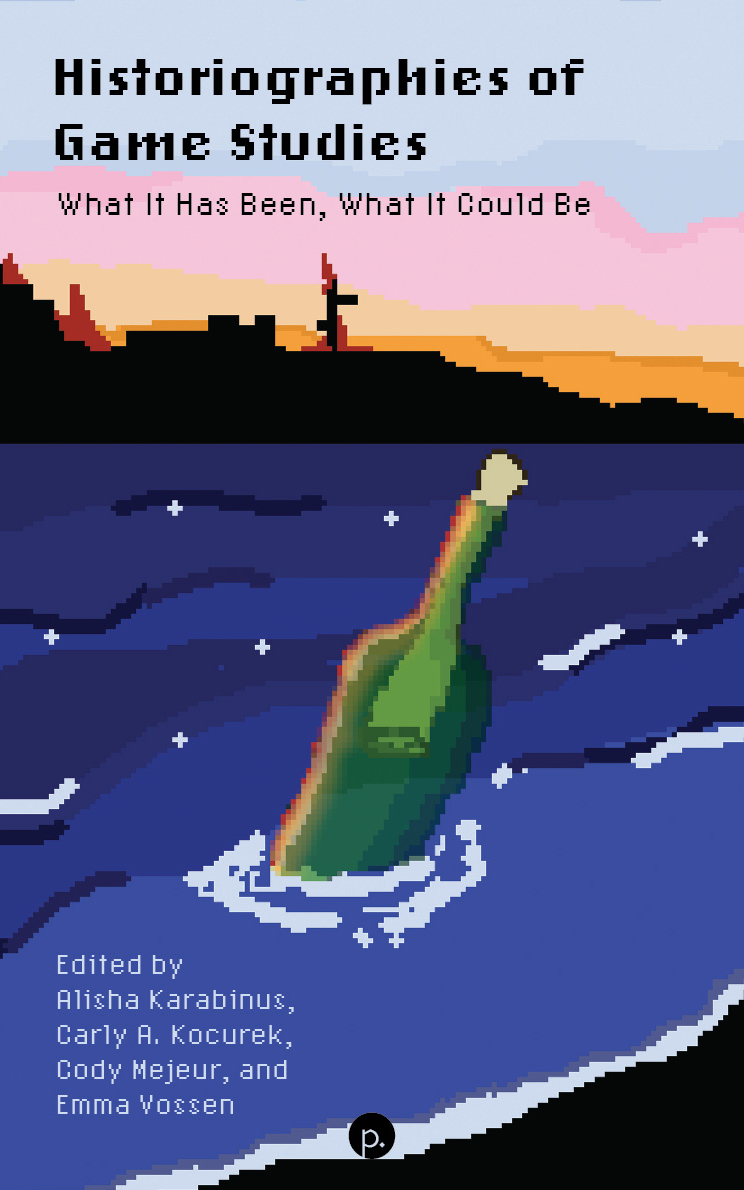
| Title | Historiographies of Game Studies |
|---|---|
| Subtitle | What It Has Been, What It Could Be |
| Contributor | Alisha Karabinus(opens in new tab)(editor) |
| Carly A. Kocurek(opens in new tab)(editor) | |
| Cody Mejeur(opens in new tab)(editor) | |
| Emma Vossen(opens in new tab)(editor) | |
| DOI | https://doi.org/10.53288/0441.1.00(opens in new tab) |
| Landing page | https://punctumbooks.com/titles/historiographies-of-game-studies-what-it-has-been-what-it-could-be/(opens in new tab) |
| License | https://creativecommons.org/licenses/by-nc-sa/4.0/(opens in new tab) |
| Copyright | Alisha Karabinus, Carly A. Kocurek, Emma Vossen, Cody Mejeur |
| Publisher | punctum books |
| Publication place | Earth, Milky Way |
| Published on | 2025-07-25 |
| ISBN | 978-1-68571-200-6 (Paperback) |
| 978-1-68571-201-3 (PDF) | |
| Long abstract | Historiographies of Game Studies offers a first-of-its-kind reflection on how game studies as an academic field has been shaped and sustained. Today, game studies is a thriving field with many dedicated national and international conferences, journals, professional societies, and a strong presence at conferences in disciplines like computer science, communication, media studies, theater, visual arts, popular culture, and others. But, when did game studies start? And what (and who) is at the core or center of game studies? Fields are defined as much by what they are not as by what they are, and their borderlands can be hotly contested spaces. In this anthology, scholars from across the field consider how the boundaries of game studies have been established, codified, contested, and protected, raising critical questions about who and what gets left out of the field. Over more than two dozen chapters and interviews with leading figures, including Espen Aarseth, Kishonna Gray, Henry Jenkins, Lisa Nakamura, Kentaro Matsumoto, Ken McAllister, and Janet Murray, the contributors offer a dazzling array of insightful provocations that address the formation, propagation, and cultivation of game studies, interrogating not only the field’s pasts but its potential futures and asking us to think deliberately about how academic fields are collectively built. |
| Print length | 780 pages |
| Language | English (Original) |
| Dimensions | 127 x 45 x 203 mm | 5" x 1.76" x 8" (Paperback) |
| Weight | 957g | 33.76oz (Paperback) |
| LCCN | 2025936417 |
| THEMA |
|
| BIC |
|
| BISAC |
|
| Keywords |
|
Contents
- Alisha Karabinus
- Carly A. Kocurek
- Cody Mejeur
- Emma Vossen
- Bianca Batti
- Emma Vossen
- Jennifer deWinter
- Gillian Smith
- Cody Mejeur
- Dennis Jansen
- Kirk M. Lundblade
- Jasper van Vught
- Joris Veerbeek
- Tobias Unterhuber
- Bo Ruberg
- Judd Ethan Ruggill
- Cameron Kunzelman
- Michael Lutz
- Jaroslav Švelch
- Liam Mitchell
- Carly A. Kocurek
- Sarah Christina Ganzon
- Outi Kaarina Laiti
- Laya Liebeseller
- Josh Rivers
- Stephanie C. Jennings
- Michael Anthony DeAnda
- Evan Torner
- Racquel M. Gonzales
- Lee W. Hibbard
- Justin Wigard
- betsy brey
- Adrienne Shaw
- victoria l. braegger
- Christopher A. Paul
- Samuel Poirier-Poulin
- Douglas Schules
- Alison Harvey
- Alisha Karabinus
Contributors
Alisha Karabinus
(editor)Alisha Karabinus (she/her) is Assistant Professor of Writing and Digital Studies at Grand Valley State University. She researches the intersections between games and rhetoric, and is currently at work on a project exploring professionalization and hobbies.
Carly A. Kocurek
(editor)Carly A. Kocurek (she/her) is Professor of Digital Humanities and Media Studies at the Illinois Institute of Technology. She researches the cultural history of video games with an emphasis on gender identity. Her books include Coin-Operated Americans: Rebooting Boyhood at the Video Game Arcade (Minnesota, 2015) and Brenda Laurel: Pioneering Games for Girls (Bloomsbury, 2017). Currently, she is researching the history and impact of the games for girls movement as part of a project funded by the National Science Foundation. Her articles have appeared in outlets including The American Journal of Play, Feminist Media Histories, Game Studies, Velvet Light Trap, and others.
Cody Mejeur
(editor)Cody Mejeur (they/them) is Assistant Professor of Game Studies at University at Buffalo, SUNY. Their work uses games to theorize narrative as an embodied and playful process that constructs how we understand ourselves, our realities, and our differences. They have published on games pedagogy, gender and queerness in games, and video game narratives and player experiences, and they are currently the game director for Trans Folks Walking, a narrative game about trans experiences. They are Director of the Amatryx Gaming Lab & Studio at UB and work with the LGBTQ Video Game Archive on preserving and visualizing LGBTQ representation. They are editor at One Shot: A Journal of Critical Games & Play, and served as Diversity Officer for the Digital Games Research Association.
Emma Vossen
(editor)Emma Vossen(opens in new tab) (she/her) is an Assistant Professor of Game Studies in the Department of Digital Humanities at Brock University, Canada. Her work focuses on the intersections of politics, identity, and technology, particularly in the context of digital games. She has been an outspoken and ongoing voice in the discussion around online radicalization, digital violence, and contemporary fascism since 2013. Many publications, including ABC News, CBC News, NBC News, Wired, Maclean’s Magazine, The Washington Post, University Affairs Magazine, Toxic Avenger Magazine, and Electronic Gaming Monthly, have interviewed her about her work. In 2016, CBC Ideas produced “The Dangerous Game: Gamergate and the ‘Alt-Right,'” a 40-minute radio documentary about her dissertation research, which was broadcast nationally. Vossen is an award-winning public speaker and the co-author and co-editor of the books Feminism in Play (Palgrace Macmillan, 2018) and the former editor-in-chief of First Person Scholar.
References
- (opens in new tab)
- (opens in new tab)
- (opens in new tab)
- (opens in new tab)
- (opens in new tab)
- (opens in new tab)
- (opens in new tab)
- (opens in new tab)
- (opens in new tab)
- (opens in new tab)
- (opens in new tab)
- (opens in new tab)
- (opens in new tab)
- (opens in new tab)
- (opens in new tab)
- (opens in new tab)
- (opens in new tab)
- (opens in new tab)
- (opens in new tab)
- (opens in new tab)
- (opens in new tab)
- (opens in new tab)
- (opens in new tab)
- (opens in new tab)
- (opens in new tab)
- (opens in new tab)
- (opens in new tab)
- (opens in new tab)
- (opens in new tab)
- (opens in new tab)
- (opens in new tab)
- (opens in new tab)
- (opens in new tab)
- (opens in new tab)
- (opens in new tab)
- (opens in new tab)
- (opens in new tab)
- (opens in new tab)
- (opens in new tab)
- (opens in new tab)
- (opens in new tab)
- (opens in new tab)
- (opens in new tab)
- (opens in new tab)
- (opens in new tab)
- (opens in new tab)
- (opens in new tab)
- (opens in new tab)
- (opens in new tab)
- (opens in new tab)
- (opens in new tab)
- (opens in new tab)
- (opens in new tab)
- (opens in new tab)
- (opens in new tab)
- (opens in new tab)
- (opens in new tab)
- (opens in new tab)
- (opens in new tab)
- (opens in new tab)
- (opens in new tab)
- (opens in new tab)
- (opens in new tab)
- (opens in new tab)
- (opens in new tab)
- (opens in new tab)
- (opens in new tab)
- (opens in new tab)
- (opens in new tab)
- (opens in new tab)
- (opens in new tab)
- (opens in new tab)
- (opens in new tab)
- (opens in new tab)
- (opens in new tab)
- (opens in new tab)
- (opens in new tab)
- (opens in new tab)
- (opens in new tab)
- (opens in new tab)
- (opens in new tab)
- (opens in new tab)
- (opens in new tab)
- (opens in new tab)
- (opens in new tab)
- (opens in new tab)
- (opens in new tab)
- (opens in new tab)
- (opens in new tab)
- (opens in new tab)
- (opens in new tab)
- (opens in new tab)
- (opens in new tab)
- (opens in new tab)
- (opens in new tab)
- (opens in new tab)
- (opens in new tab)
- (opens in new tab)
- (opens in new tab)
- (opens in new tab)
- (opens in new tab)
- (opens in new tab)
- (opens in new tab)
- (opens in new tab)
- (opens in new tab)
- (opens in new tab)
- (opens in new tab)
- (opens in new tab)
- (opens in new tab)
- (opens in new tab)
- (opens in new tab)
- (opens in new tab)
- (opens in new tab)
- (opens in new tab)
- (opens in new tab)
- (opens in new tab)
- (opens in new tab)
- (opens in new tab)
- (opens in new tab)
- (opens in new tab)
- (opens in new tab)
- (opens in new tab)
- (opens in new tab)
- (opens in new tab)
- (opens in new tab)
- (opens in new tab)
- (opens in new tab)
- (opens in new tab)
- (opens in new tab)
- (opens in new tab)
- (opens in new tab)
- (opens in new tab)
- (opens in new tab)
- (opens in new tab)
- (opens in new tab)
- (opens in new tab)
- (opens in new tab)
- (opens in new tab)
- (opens in new tab)
- (opens in new tab)
- (opens in new tab)
- (opens in new tab)
- (opens in new tab)
- (opens in new tab)
- (opens in new tab)
- (opens in new tab)
- (opens in new tab)
- (opens in new tab)
- (opens in new tab)
- (opens in new tab)
- (opens in new tab)
- (opens in new tab)
- (opens in new tab)
- (opens in new tab)
- (opens in new tab)
- (opens in new tab)
- (opens in new tab)
- (opens in new tab)
- (opens in new tab)
- (opens in new tab)
- (opens in new tab)
- (opens in new tab)
- (opens in new tab)
- (opens in new tab)
- (opens in new tab)
- (opens in new tab)
- (opens in new tab)
- (opens in new tab)
- (opens in new tab)
- (opens in new tab)
- (opens in new tab)
- (opens in new tab)
- (opens in new tab)
- (opens in new tab)
- (opens in new tab)
- (opens in new tab)
- (opens in new tab)
- (opens in new tab)
- (opens in new tab)
- (opens in new tab)
- (opens in new tab)
- (opens in new tab)
- (opens in new tab)
- (opens in new tab)
- (opens in new tab)
- (opens in new tab)
- (opens in new tab)
- (opens in new tab)
- (opens in new tab)
- (opens in new tab)
- (opens in new tab)
- (opens in new tab)
- (opens in new tab)
- (opens in new tab)
- (opens in new tab)
- (opens in new tab)
- (opens in new tab)
- (opens in new tab)
- (opens in new tab)
- (opens in new tab)
- (opens in new tab)
- (opens in new tab)
- (opens in new tab)
- (opens in new tab)
- (opens in new tab)
- (opens in new tab)
- (opens in new tab)
- (opens in new tab)
- (opens in new tab)
- (opens in new tab)
- (opens in new tab)
- (opens in new tab)
- (opens in new tab)
- (opens in new tab)
- (opens in new tab)
- (opens in new tab)
- (opens in new tab)
- (opens in new tab)
- (opens in new tab)
- (opens in new tab)
- (opens in new tab)
- (opens in new tab)
- (opens in new tab)
- (opens in new tab)
- (opens in new tab)
- (opens in new tab)