
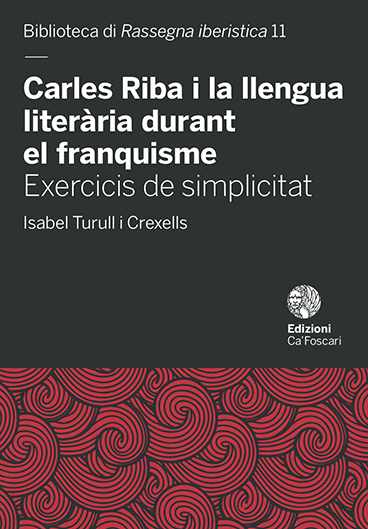
| Title | Carles Riba and the Literary Language During the Franco Regime |
|---|---|
| Subtitle | Exercises in Simplicity |
| Contributor | Isabel Turull i Crexells (author) |
| DOI | https://doi.org/10.30687/978-88-6969-309-0(opens in new tab) |
| Landing page | https://edizionicafoscari.it/en/edizioni4/libri/978-88-6969-310-6/(opens in new tab) |
| License | https://creativecommons.org/licenses/by/4.0/(opens in new tab) |
| Copyright | Isabel Turull i Crexells |
| Publisher | Edizioni Ca’ Foscari – Venice University Press |
| Publication place | Venice, Italy |
| Published on | 2018-12-17 |
| Series |
|
| ISBN | 978-88-6969-309-0 (Paperback) |
| 978-88-6969-309-0 (PDF) | |
| Short abstract | Carles Riba, one of the most relevant personalities in Catalan letters, not only as a poet but also as a linguist, has been considered a difficult writer. This book aims to examine how his theoretical preparation and his ideas in linguistics influenced his work in the particular case of some early stories in which he tries “uns utilíssims exercicis de simplicitat”. Carles Riba did not present his linguistic theories in a single text in a complete and articulated way but we can evaluate them in various papers he wrote and published up until his death in 1959. The first part of this work, after an introduction which sets the author in the context of European linguistics, is a review of the ideas that can be found in the collections of essays: Escolis i altres articles (1921), Els marges (1927), Per comprendre (1937), ... més els poemes (1957), and in a few other particularly interesting papers.This part focuses also on some of the controversies in which Carles Riba is involved as a linguist during the spanish dictatorship: especially his role on the publication of the second edition of Pompeu Fabra’s dictionary in 1954 and the consequences of the prologue he wrote for the volume. Joan Coromines considers an attack on the linguist Pompeu Fabra the negative comparison Riba proposes with the honnête homme: in our research we re-evaluate this consideration and analyse the historical and semantic value of this expression belonging to 17th-century French culture.The second part of this paper is a strictly linguistic analysis of three texts, chosen among Carles Riba’s works for children. The interest of those texts is in the author’s deliberate intent of using the most simple language, which enables us to determine what he considers the basic aspects of linguistic quality. Furthermore, the existence of different editions of those texts permits a philological analysis of those versions showing Carles Riba’s ‘simple’ language in three very representative moments, from the beginning of his career as a writer to the difficult situation during the dictatorship. |
| Long abstract | Carles Riba, one of the most relevant personalities in Catalan letters, not only as a poet but also as a linguist, has been considered a difficult writer. This book aims to examine how his theoretical preparation and his ideas in linguistics influenced his work in the particular case of some early stories in which he tries “uns utilíssims exercicis de simplicitat”. Carles Riba did not present his linguistic theories in a single text in a complete and articulated way but we can evaluate them in various papers he wrote and published up until his death in 1959. The first part of this work, after an introduction which sets the author in the context of European linguistics, is a review of the ideas that can be found in the collections of essays: Escolis i altres articles (1921), Els marges (1927), Per comprendre (1937), ... més els poemes (1957), and in a few other particularly interesting papers.This part focuses also on some of the controversies in which Carles Riba is involved as a linguist during the spanish dictatorship: especially his role on the publication of the second edition of Pompeu Fabra’s dictionary in 1954 and the consequences of the prologue he wrote for the volume. Joan Coromines considers an attack on the linguist Pompeu Fabra the negative comparison Riba proposes with the honnête homme: in our research we re-evaluate this consideration and analyse the historical and semantic value of this expression belonging to 17th-century French culture.The second part of this paper is a strictly linguistic analysis of three texts, chosen among Carles Riba’s works for children. The interest of those texts is in the author’s deliberate intent of using the most simple language, which enables us to determine what he considers the basic aspects of linguistic quality. Furthermore, the existence of different editions of those texts permits a philological analysis of those versions showing Carles Riba’s ‘simple’ language in three very representative moments, from the beginning of his career as a writer to the difficult situation during the dictatorship. |
| Print length | 200 pages |
| Language | Italian (Original) |
| THEMA |
|
| BISAC |
|
| Keywords |
|