
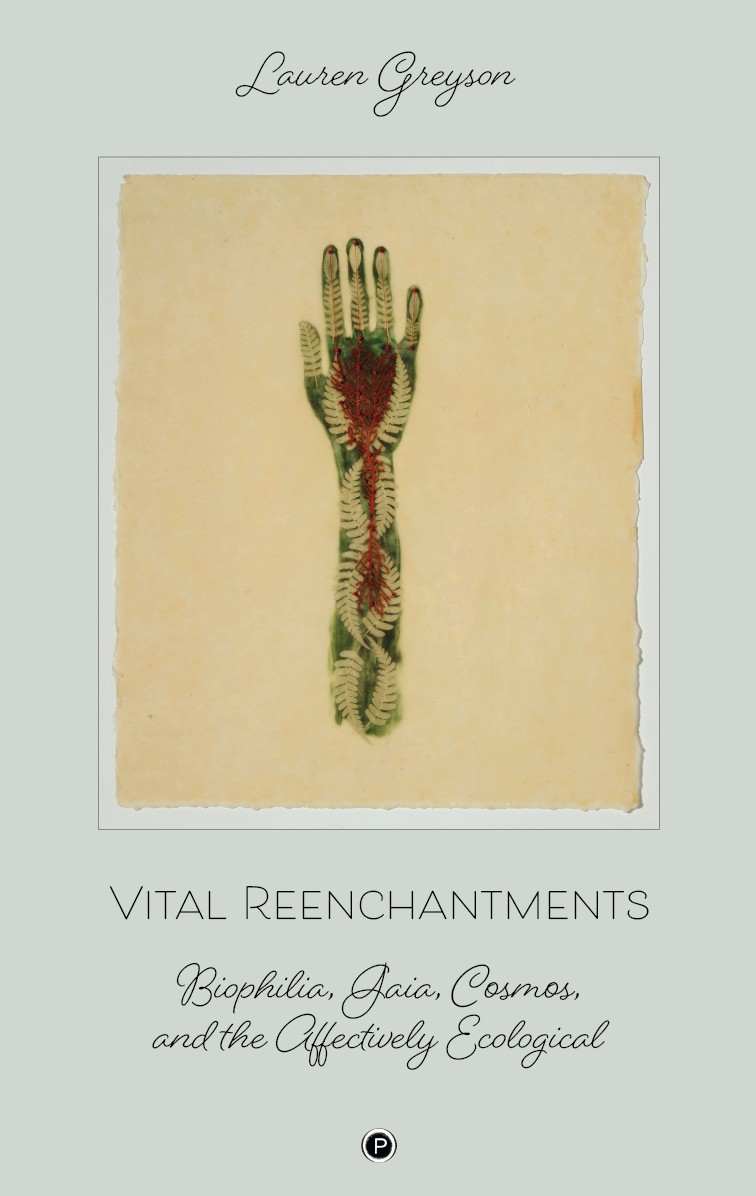
| Title | Vital Reenchantments |
|---|---|
| Subtitle | Biophilia, Gaia, Cosmos, and the Affectively Ecological |
| Contributor | Lauren Greyson (author) |
| DOI | https://doi.org/10.21983/P3.0240.1.00(opens in new tab) |
| Landing page | https://punctumbooks.com/titles/vital-reenchantments/(opens in new tab) |
| License | https://creativecommons.org/licenses/by-nc-sa/4.0/(opens in new tab) |
| Copyright | Greyson, Lauren |
| Publisher | punctum books |
| Publication place | Earth, Milky Way |
| Published on | 2019-01-16 |
| ISBN | 978-1-950192-07-6 (Paperback) |
| 978-1-950192-08-3 (PDF) | |
| Long abstract | Not all charms fly at the touch of cold philosophy. Vital Reenchantments examines so-called cold philosophy, or science, that does precisely the opposite — rather than mercilessly emptying out and unweaving, it operates as a philosophy that animates. More specifically, this book closely examines how a specific group of “poet-in-scientists” of the late 1970s and 1980s directed attention to the “wondrous” unfolding of life, at a time when the counter-culture had made the institution of science synonymous with technologies of alienation and destruction. Vital Reenchantments takes up E.O. Wilson’s Biophilia (1984), James Lovelock’s Gaia (1979), and Carl Sagan’s Cosmos (1980), in order to show how each work fleshes out scientific concepts with a unique attention to “affective wonder.” These works reenchanted the scientific world without pandering to what Richard Dawkins would later term “cosmic sentimentality.” Carl Sagan may have said “We are made of starstuff,” but he would never insist, as Joni Mitchell did in 1969, that “we’ve got to get ourselves back to the garden.” Instead, Wilson, Lovelock, and Sagan insisted on a third way that does not rely on the idea of an ecological Eden — a vigorously vital materialism in which the affective trumps the sentimental. Further, the historical emergence of these works, all published within 5 years of each other, was no accident: each book responded to an ever deepening sense of environmental crisis, as well as to the large-scale disenchantment brought on by modernity. Greyson argues that the persistence of these works and their affectively-charged scientific concepts in contemporary popular culture and ecological thought is no accident. As such, these works deserve recognition as far more than “popular science” and can be seen as essential contributions to more contemporary vital materialist thought and ecological theory. No doubt this talk of enchantment and wonder, so tied to immediate experience, can seem trivial in the face of any number of environmental crises (global warming first among these). The first task of this book is thus to pose the same question that Jane Bennett does at the end of her own work on enchantment: “How can someone write a book about enchantment in such a world?” Does this approach really provide, as Latour phrases it, “a way to bridge the distance between the scale of the phenomena we hear about and the tiny Umwelt inside which we witness, as if it were a fish inside its bowl, an ocean of catastrophes that are supposed to unfold”? Ultimately, Vital Reenchantments argues that affective ecologies, properly attended to, point toward an open present, one that broadens the horizons of the “fish bowl” and allows us to imagine engendering futures that are neither naively hopeful nor hopelessly apocalyptic. |
| Print length | 276 pages |
| Language | English (Original) |
| Dimensions | 127 x 203 mm | 5" x 8" (Paperback) |
| LCCN | 2018968577 |
| THEMA |
|
| BIC |
|
| BISAC |
|
| Keywords |
|
Contributors
Lauren Greyson
(author)Lauren Greyson works as an editor and translator in Cologne, Germany. She holds a PhD in Cultural Studies from the International Graduate Center for the Study of Culture, where she first began investigating the intersections between enchantment, affect, ecology, and popular science. When she is not wandering around Germany's more unusual nature preserves and cemeteries, she blogs about scientific illustration at haeckelian.tumblr.com(opens in new tab).
References
- (opens in new tab)
- (opens in new tab)
- (opens in new tab)
- (opens in new tab)
- (opens in new tab)
- (opens in new tab)
- (opens in new tab)
- (opens in new tab)
- (opens in new tab)
- (opens in new tab)
- (opens in new tab)
- (opens in new tab)
- (opens in new tab)
- (opens in new tab)
- (opens in new tab)
- (opens in new tab)
- (opens in new tab)
- (opens in new tab)
- (opens in new tab)
- (opens in new tab)
- (opens in new tab)
- (opens in new tab)
- (opens in new tab)
- (opens in new tab)
- (opens in new tab)