
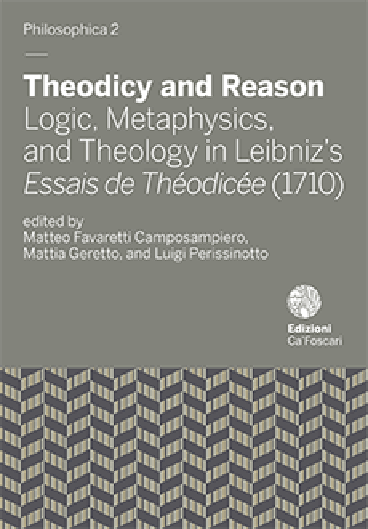
| Title | Theodicy and Reason |
|---|---|
| Subtitle | Logic, Metaphysics, and Theology in Leibniz’s Essais de Théodicée (1710) |
| Contributor | Matteo Favaretti Camposampiero(opens in new tab)(editor) |
| Mattia Geretto (editor) | |
| Luigi Perissinotto(opens in new tab)(editor) | |
| DOI | https://doi.org/10.14277/978-88-6969-083-9(opens in new tab) |
| Landing page | https://edizionicafoscari.it/en/edizioni4/libri/978-88-6969-084-6/(opens in new tab) |
| License | https://creativecommons.org/licenses/by/4.0/(opens in new tab) |
| Copyright | Matteo Favaretti Camposampiero, Mattia Geretto, Luigi Perissinotto |
| Publisher | Edizioni Ca’ Foscari – Venice University Press |
| Publication place | Venice, Italy |
| Published on | 2016-06-30 |
| Series |
|
| ISBN | 978-88-6969-083-9 (PDF) |
| Short abstract | Leibniz’s Theodicy is both a work of reason and a work on reason: reason as rational ground or justification, reason as universal order of the world, and reason as the human cognitive faculty, always in search of reasons. This book explores the depth of theodicean doctrines from the logical, metaphysical, and theological points of view. The first section is devoted to Leibniz’s argumentative style and rhetorical devices. The second section focuses on the metaphysical structures that underlie Leibniz’s vindication of God’s goodness. The third section offers new insights into Leibniz’s answer to one of the most difficult challenges faced by human reason: the existence of evil. |
| Long abstract | Leibniz’s Theodicy is both a work of reason and a work on reason: reason as rational ground or justification, reason as universal order of the world, and reason as the human cognitive faculty, always in search of reasons. This book explores the depth of theodicean doctrines from the logical, metaphysical, and theological points of view. The first section is devoted to Leibniz’s argumentative style and rhetorical devices. The second section focuses on the metaphysical structures that underlie Leibniz’s vindication of God’s goodness. The third section offers new insights into Leibniz’s answer to one of the most difficult challenges faced by human reason: the existence of evil. |
| Language | Italian (Original) |
| THEMA |
|
| BISAC |
|
| Keywords |
|