
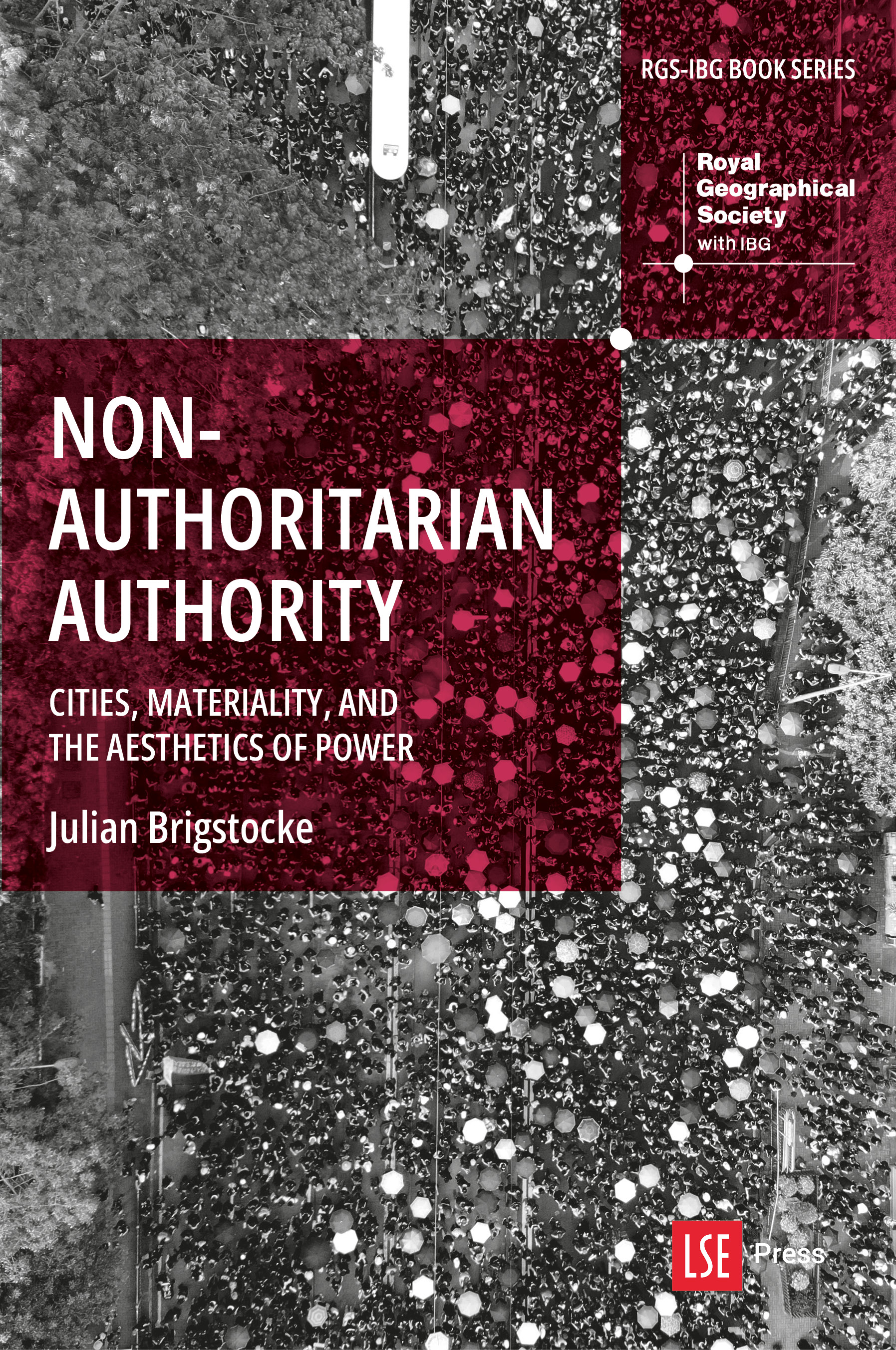
| Title | Nonauthoritarian Authority |
|---|---|
| Subtitle | Cities, Materiality, and the Aesthetics of Power |
| Contributor | Julian Brigstocke(opens in new tab)(author) |
| DOI | https://doi.org/10.31389/lsepress.noa(opens in new tab) |
| Landing page | https://press.lse.ac.uk/books/m/10.31389/lsepress.noa(opens in new tab) |
| License | https://creativecommons.org/licenses/by/4.0/(opens in new tab) |
| Copyright | Author |
| Publisher | LSE Press |
| Publication place | London |
| Published on | 2026-03-26 |
| Series |
|
| ISBN | 978-1-911712-55-8 (Paperback) |
| 978-1-911712-56-5 (PDF) | |
| 978-1-911712-57-2 (EPUB) | |
| 978-1-911712-58-9 (MOBI) | |
| Short abstract | In Nonauthoritarian Authority Julian Brigstocke argues that in these shattered times, anti-authoritarianism is not enough: a radical, speculative reinvention of authority is needed. He introduces the idea of non-authoritarian authority: a form of power that pluralises marginalised and hidden voices and recognises diverse agencies. Engaging with philosophical debates around materiality, experience, feeling, agency, and landscape, this book stages a series of experiments with thinking, reading, researching, and writing non-authoritarian authority. |
| Long abstract | Authority is not a word with many positive connotations. It suggests power-hungry dictators, trigger-happy police, stifling bureaucracies, and monumental urban landscapes. In Nonauthoritarian Authority Julian Brigstocke argues that in these shattered times, anti-authoritarianism is not enough: a radical, speculative reinvention of authority is needed. He introduces the idea of non-authoritarian authority: a form of power that pluralises marginalised and hidden voices, recognises diverse agencies, and amplifies heterogeneous demands. Engaging with key philosophical debates around materiality, experience, feeling, agency, and landscape, Nonauthoritarian Authority stages a series of experiments with thinking, reading, researching, and writing non-authoritarian authority. Dramatising a speculative search for barely sensed, dispersed authorities, Brigstocke’s experiments in thinking explore the intrinsically spatial nature of authority, through empirical studies of violent urban borders in Rio de Janeiro, colonial material infrastructures in Hong Kong, monumental architecture in Paris, and everyday spaces of encounter in the UK. Offering an intricate and playful reflection on the relationship between authority, urban forms, and writing, each exercise in thinking links form and genre to a distinctive way of imagining authority. Each chapter simultaneously critiques a form of authoritarian authority and searches for a new, nonauthoritarian authority within the rubble of the old. |
| Language | English (Original) |
| THEMA |
|
| BISAC |
|
| LCC |
|
| Keywords |
|
| Funding |
|
| |
|
Contents
Contributors
Julian Brigstocke
(author)Julian Brigstocke is a Reader in Human Geography at Cardiff University, UK. He is a social theorist with expertise in Geohumanities, cultural, social and historical geography, and philosophy of geography. His research focuses on both historical and contemporary studies of spaces and politics of aesthetics, authority, borders, and bodies in Bristol, Paris, Rio de Janeiro, and Hong Kong.