
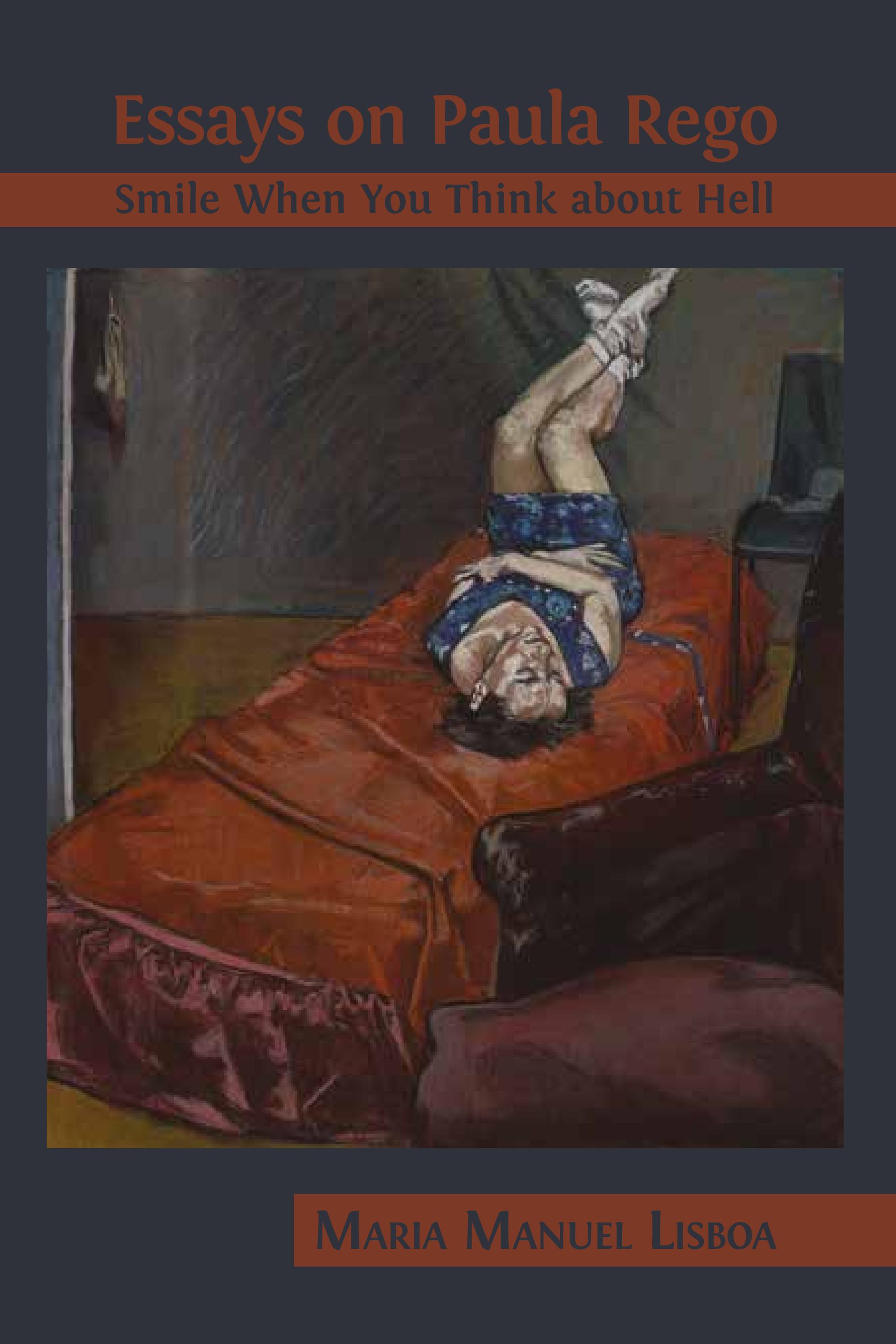
| Title | Essays on Paula Rego |
|---|---|
| Subtitle | Smile When You Think about Hell |
| Contributor | Maria Manuel Lisboa (author) |
| DOI | https://doi.org/10.11647/OBP.0178(opens in new tab) |
| Landing page | https://www.openbookpublishers.com/books/10.11647/obp.0178(opens in new tab) |
| License | http://creativecommons.org/licenses/by/4.0/(opens in new tab) |
| Copyright | Maria Manuel Lisboa |
| Publisher | Open Book Publishers |
| Publication place | Cambridge, UK |
| Published on | 2019-09-24 |
| ISBN | 978-1-78374-756-6 (Paperback) |
| 978-1-78374-757-3 (Hardback) | |
| 978-1-78374-758-0 (PDF) | |
| 978-1-80064-592-9 (HTML) | |
| 978-1-78374-761-0 (XML) | |
| 978-1-78374-759-7 (EPUB) | |
| 978-1-78374-760-3 (MOBI) | |
| Short abstract | In these powerful and stylishly written essays, Maria Manuel Lisboa dissects the work of Paula Rego, the Portuguese-born artist considered one of the greatest artists of modern times. Focusing primarily on Rego’s work since the 1980s, Lisboa explores the complex relationships between violence and nurturing, power and impotence, politics and the family that run through Rego’s art. |
| Long abstract | In these powerful and stylishly written essays, Maria Manuel Lisboa dissects the work of Paula Rego, the Portuguese-born artist considered one of the greatest artists of modern times. Focusing primarily on Rego’s work since the 1980s, Lisboa explores the complex relationships between violence and nurturing, power and impotence, politics and the family that run through Rego’s art. Taking a historicist approach to the evolution of the artist’s work, Lisboa embeds the works within Rego’s personal history as well as Portugal’s (and indeed other nations’) stories, and reveals the interrelationship between political significance and the raw emotion that lies at the heart of Rego’s uncompromising iconographic style. Fundamental to Lisboa’s analysis is an understanding that apparent opposites – male and female, sacred and profane, aggression and submissiveness – often co-exist in Rego’s work in a way that is both disturbing and destabilising. This collection of essays brings together both unpublished and previously published work to make a significant contribution to scholarship about Paula Rego. It will also be of interest to scholars and students of contemporary painting, Portuguese and British feminist art, and the political and ideological aspects of the visual arts. |
| Print length | 510 pages (xvi+494) |
| Language | English (Original) |
| Dimensions | 156 x 35 x 234 mm | 6.14" x 1.39" x 9.21" (Paperback) |
| 156 x 40 x 234 mm | 6.14" x 1.56" x 9.21" (Hardback) | |
| Weight | 2114g | 74.57oz (Paperback) |
| 2522g | 88.96oz (Hardback) | |
| Media | 181 illustrations |
| 1 table | |
| OCLC Number | 1193075914 |
| LCCN | 2019452856 |
| BIC |
|
| BISAC |
|
| LCC |
|
| Keywords |
|
Contents
- Past History and Deaths Foretold: A Map of Memory
- Maria Manuel Lisboa
- (He)Art History or a Death in the Family: The Late 80s
- Maria Manuel Lisboa
- The Sins of the Fathers: Mother and Land Revisited in the 1990s
- Maria Manuel Lisboa
- An Interesting Condition: The Abortion Pastels
- Maria Manuel Lisboa
- Brave New Worlds: The Birthing of Nations in The First Mass In Brazil
- Maria Manuel Lisboa
- I Am Coming to Your Kingdom, Prince Horrendous: Scary Stories for Baby, Perfect Stranger and Me
- Maria Manuel Lisboa
- Paula and the Madonna: Who's That Girl?
- Maria Manuel Lisboa
- Epilogue: Let Me Count the Ways I Love You
- Maria Manuel Lisboa
- Maria Manuel Lisboa
- Maria Manuel Lisboa
- Maria Manuel Lisboa