
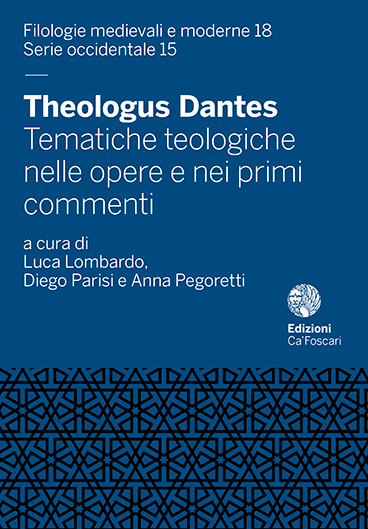
| Title | Theologus Dantes |
|---|---|
| Subtitle | Theological Themes in the Works and Early Commentaries |
| Contributor | Luca Lombardo (editor) |
| Diego Parisi (editor) | |
| Anna Pegoretti(opens in new tab)(editor) | |
| DOI | https://doi.org/10.30687/978-88-6969-298-7(opens in new tab) |
| Landing page | https://edizionicafoscari.it/en/edizioni4/libri/978-88-6969-298-7/(opens in new tab) |
| License | https://creativecommons.org/licenses/by/4.0/(opens in new tab) |
| Copyright | Diego Parisi, Luca Lombardo, Anna Pegoretti |
| Publisher | Edizioni Ca’ Foscari – Venice University Press |
| Publication place | Venice, Italy |
| Published on | 2018-12-17 |
| Series |
|
| ISBN | 978-88-6969-298-7 (Paperback) |
| 978-88-6969-298-7 (PDF) | |
| Short abstract | The contributions collected in these Acts offer a varied and articulate representation of the relations between Dante Alighieri’s work and late-medieval theological culture, observed in some of its fundamental aspects and with particular attention to the ancient exegesis of the Commedia. The topics covered cover a broad spectrum of issues: the presence of heresy in the poem; the presumed heterodoxy of Dante himself; the references to the Cross and the Passion, examined in the light of the theological doctrines and devotional practices of the time; the influence exerted by the so-called ‘affective mysticism’ on Dante's poetological reflection; the problem of the creation and resurrection of bodies; the connection between theology and the Empyrean sky proposed in the Convivio; the arduous theme of the prophetic vision, investigated starting from the Epistle to Cangrande. The last two contributions are dedicated to as yet little-known episodes in the reception of Dante’s poem: the Anonymous Theologian’s comments on Paradise and Dante’s presence in the 15th-century sermons of Gabriele Barletta and Paolo Attavanti. |
| Long abstract | The contributions collected in these Acts offer a varied and articulate representation of the relations between Dante Alighieri’s work and late-medieval theological culture, observed in some of its fundamental aspects and with particular attention to the ancient exegesis of the Commedia. The topics covered cover a broad spectrum of issues: the presence of heresy in the poem; the presumed heterodoxy of Dante himself; the references to the Cross and the Passion, examined in the light of the theological doctrines and devotional practices of the time; the influence exerted by the so-called ‘affective mysticism’ on Dante's poetological reflection; the problem of the creation and resurrection of bodies; the connection between theology and the Empyrean sky proposed in the Convivio; the arduous theme of the prophetic vision, investigated starting from the Epistle to Cangrande. The last two contributions are dedicated to as yet little-known episodes in the reception of Dante’s poem: the Anonymous Theologian’s comments on Paradise and Dante’s presence in the 15th-century sermons of Gabriele Barletta and Paolo Attavanti. |
| Print length | 262 pages |
| Language | Italian (Original) |
| THEMA |
|
| BISAC |
|
| Keywords |
|