
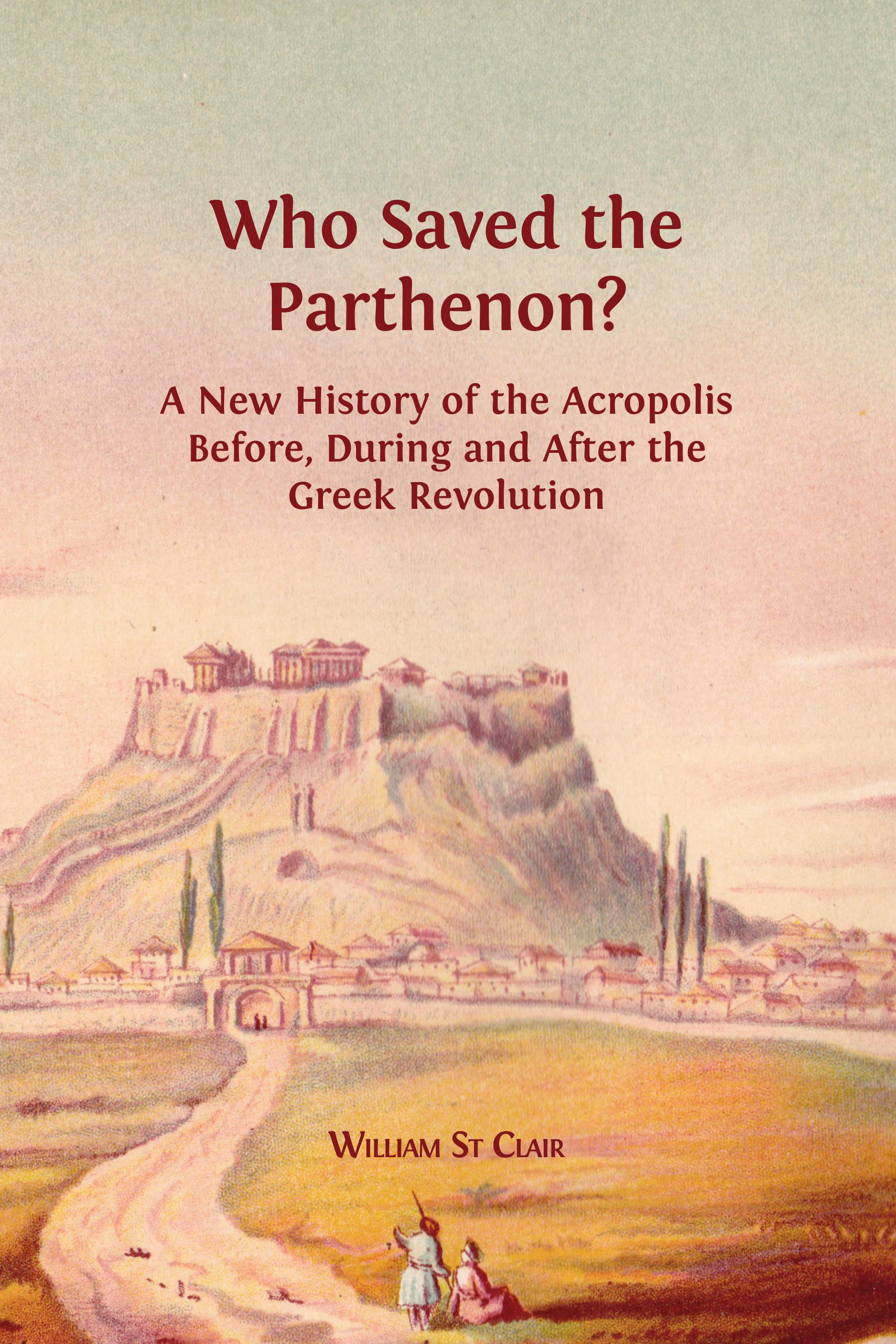
| Title | Who Saved the Parthenon? |
|---|---|
| Subtitle | A New History of the Acropolis Before, During and After the Greek Revolution |
| Contributor | William St Clair (author) |
| DOI | https://doi.org/10.11647/OBP.0136(opens in new tab) |
| Landing page | https://www.openbookpublishers.com/books/10.11647/obp.0136(opens in new tab) |
| License | https://creativecommons.org/licenses/by-nc-nd/4.0/(opens in new tab) |
| Copyright | William St Clair |
| Publisher | Open Book Publishers |
| Publication place | Cambridge, UK |
| Published on | 2022-05-26 |
| ISBN | 978-1-78374-461-9 (Paperback) |
| 978-1-78374-462-6 (Hardback) | |
| 978-1-78374-463-3 (PDF) | |
| 978-1-80064-555-4 (HTML) | |
| 978-1-80064-299-7 (XML) | |
| 978-1-78374-464-0 (EPUB) | |
| 978-1-78374-465-7 (AZW3) | |
| Short abstract | In this magisterial book, William St Clair unfolds the history of the Parthenon throughout the modern era to the present day, with special emphasis on the period before, during, and after the Greek War of Independence of 1821–32. |
| Long abstract | In this magisterial book, William St Clair unfolds the history of the Parthenon throughout the modern era to the present day, with special emphasis on the period before, during, and after the Greek War of Independence of 1821–32. Focusing particularly on the question of who saved the Parthenon from destruction during this conflict, with the help of documents that shed a new light on this enduring question, he explores the contributions made by the Philhellenes, Ancient Athenians, Ottomans and the Great Powers. Marshalling a vast amount of primary evidence, much of it previously unexamined and published here for the first time, St Clair rigorously explores the multiple ways in which the Parthenon has served both as a cultural icon onto which meanings are projected and as a symbol of particular national, religious and racial identities, as well as how it illuminates larger questions about the uses of built heritage. This book has a companion volume with the classical Parthenon as its main focus, which offers new ways of recovering the monument and its meanings in ancient times. St Clair builds on the success of his classic text, The Reading Nation in the Romantic Period, to present this rich and authoritative account of the Parthenon’s presentation and reception throughout history. With weighty implications for the present life of the Parthenon, it is itself a monumental contribution to accounts of the Greek Revolution, to classical studies, and to intellectual history. |
| Print length | 896 pages (xviii+878) |
| Language | English (Original) |
| Dimensions | 156 x 61 x 234 mm | 6.14" x 2.40" x 9.21" (Paperback) |
| 156 x 47 x 234 mm | 6.14" x 1.85" x 9.21" (Hardback) | |
| Weight | 1660g | 58.55oz (Paperback) |
| 1417g | 49.98oz (Hardback) | |
| Media | 191 illustrations |
| OCLC Number | 1099628716 |
| LCCN | 2021392553 |
| BIC |
|
| BISAC |
|
| LCC |
|
| Keywords |
|
Contents
- William St Clair
- Why Another Book?
- William St Clair
- The Place
- William St Clair
- The People
- William St Clair
- The Encounter
- William St Clair
- Communities, Real and Imagined
- William St Clair
- The Evidence
- William St Clair
- The New Science and its Enemies
- William St Clair
- Towards a Practical Theory of History
- William St Clair
- Romanticism and its Rhetorics
- William St Clair
- The Choices
- William St Clair
- The Siege of 1826 and 1827
- William St Clair
- The Surrender
- William St Clair
- The Last Days of Ottoman Athens
- William St Clair
- The Living
- William St Clair
- The Dead
- William St Clair
- ‘The World had need of them’
- William St Clair
- The Secret
- William St Clair
- The Bargain
- William St Clair
- The Silence
- William St Clair
- The Stories
- William St Clair
- Which Pasts, which Futures?
- William St Clair
- Still a Dark Heritage
- William St Clair
- Whose Parthenon?
- William St Clair
- The Parthenon in our Time
- William St Clair
- Heritage
- William St Clair
- William St Clair
- William St Clair
- William St Clair
- William St Clair
- William St Clair
- William St Clair
Contributors
William St Clair
(author)(7 December 1937 – 30 June 2021) was a British historian, senior research fellow at the Institute of English Studies, School of Advanced Study, University of London.