
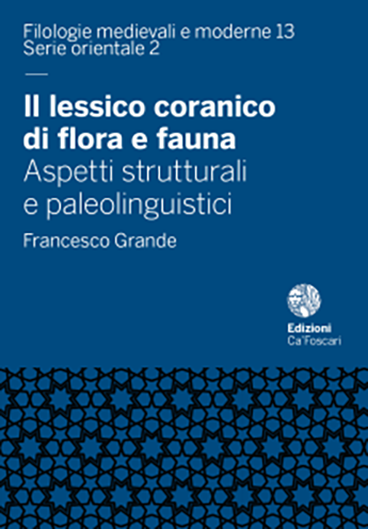
| Title | The Koranic Lexicon of Flora and Fauna |
|---|---|
| Subtitle | Structural and Palaeolinguistic Aspects |
| Contributor | Francesco Grande(opens in new tab)(author) |
| DOI | https://doi.org/10.14277/978-88-6969-105-8(opens in new tab) |
| Landing page | https://edizionicafoscari.it/en/edizioni4/libri/978-88-6969-104-1/(opens in new tab) |
| License | https://creativecommons.org/licenses/by/4.0/(opens in new tab) |
| Copyright | Francesco Grande |
| Publisher | Edizioni Ca’ Foscari – Venice University Press |
| Publication place | Venice, Italy |
| Published on | 2016-12-18 |
| Series |
|
| ISBN | 978-88-6969-105-8 (PDF) |
| Short abstract | In this study, three linguistic methods are synergistically applied to the lexicon of the Koran in order to reconstruct the material context of early Islam. Due to their material relevance, the focus is placed on the zoonyms and phytonyms of this lexicon. The comparative method selects among them thirty nouns which are frequent in terms of genetic relationship: zoonyms and phytonyms with cognates in North-West and South Semitic and with no Semitic cognates. The structural method highlights the semantic connections among these nouns, and the philological method better defines them by investigating Arabic lexicography. These thirty zoonyms and phytonyms reveal in a coherent and detailed manner a non-desert material context. |
| Long abstract | In this study, three linguistic methods are synergistically applied to the lexicon of the Koran in order to reconstruct the material context of early Islam. Due to their material relevance, the focus is placed on the zoonyms and phytonyms of this lexicon. The comparative method selects among them thirty nouns which are frequent in terms of genetic relationship: zoonyms and phytonyms with cognates in North-West and South Semitic and with no Semitic cognates. The structural method highlights the semantic connections among these nouns, and the philological method better defines them by investigating Arabic lexicography. These thirty zoonyms and phytonyms reveal in a coherent and detailed manner a non-desert material context. |
| Language | Italian (Original) |
| THEMA |
|
| BISAC |
|
| Keywords |
|