
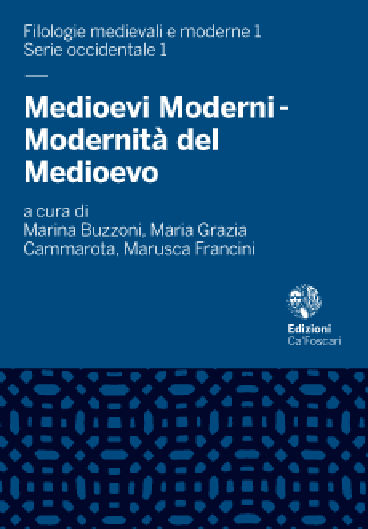
| Title | Modernity of the Middle Ages |
|---|---|
| Contributor | Marina Buzzoni(opens in new tab)(editor) |
| Maria Grazia Cammarota(opens in new tab)(editor) | |
| Marusca Francini (editor) | |
| DOI | https://doi.org/10.14277/978-88-97735-31-1(opens in new tab) |
| Landing page | https://edizionicafoscari.it/en/edizioni4/libri/978-88-97735-30-4/(opens in new tab) |
| License | https://creativecommons.org/licenses/by/4.0/(opens in new tab) |
| Copyright | Marusca Francini, Marina Buzzoni, Maria Grazia Cammarota |
| Publisher | Edizioni Ca’ Foscari – Venice University Press |
| Publication place | Venice, Italy |
| Published on | 2013-05-01 |
| Series |
|
| ISBN | 978-88-97735-31-1 (PDF) |
| Short abstract | The approach to the Middle Ages, more than a millennium long and far from unified and coherent, continues to oscillate between the two opposing images that the Enlightenment and Romanticism have given us. On the one hand, the Middle Ages of religious fanaticism, of superstitions, of the clash between church and state; a dark, barbaric, oppressive Middle Ages. On the other, the Middle Ages of sincere religious devotion, of great artistic expressions, of the affirmation of the freedom of peoples against the tyranny of the Roman Empire; a bright, refined, imaginative Middle Ages. In order to encounter the Middle Ages in a less stereotypical way, we must open ourselves up to the languages of the past, which on close examination reveal unexpected dimensions. If we try to listen to the voices coming to us from that distant time, we can perhaps also better understand the meaning of what the current operations of reusing the Middle Ages – of the various Middle Ages – are trying to tell us, not only about that historical period itself, but also about ourselves, today. |
| Long abstract | The approach to the Middle Ages, more than a millennium long and far from unified and coherent, continues to oscillate between the two opposing images that the Enlightenment and Romanticism have given us. On the one hand, the Middle Ages of religious fanaticism, of superstitions, of the clash between church and state; a dark, barbaric, oppressive Middle Ages. On the other, the Middle Ages of sincere religious devotion, of great artistic expressions, of the affirmation of the freedom of peoples against the tyranny of the Roman Empire; a bright, refined, imaginative Middle Ages. In order to encounter the Middle Ages in a less stereotypical way, we must open ourselves up to the languages of the past, which on close examination reveal unexpected dimensions. If we try to listen to the voices coming to us from that distant time, we can perhaps also better understand the meaning of what the current operations of reusing the Middle Ages – of the various Middle Ages – are trying to tell us, not only about that historical period itself, but also about ourselves, today. |
| Language | Italian (Original) |
| THEMA |
|
| BISAC |
|
| Keywords |
|