
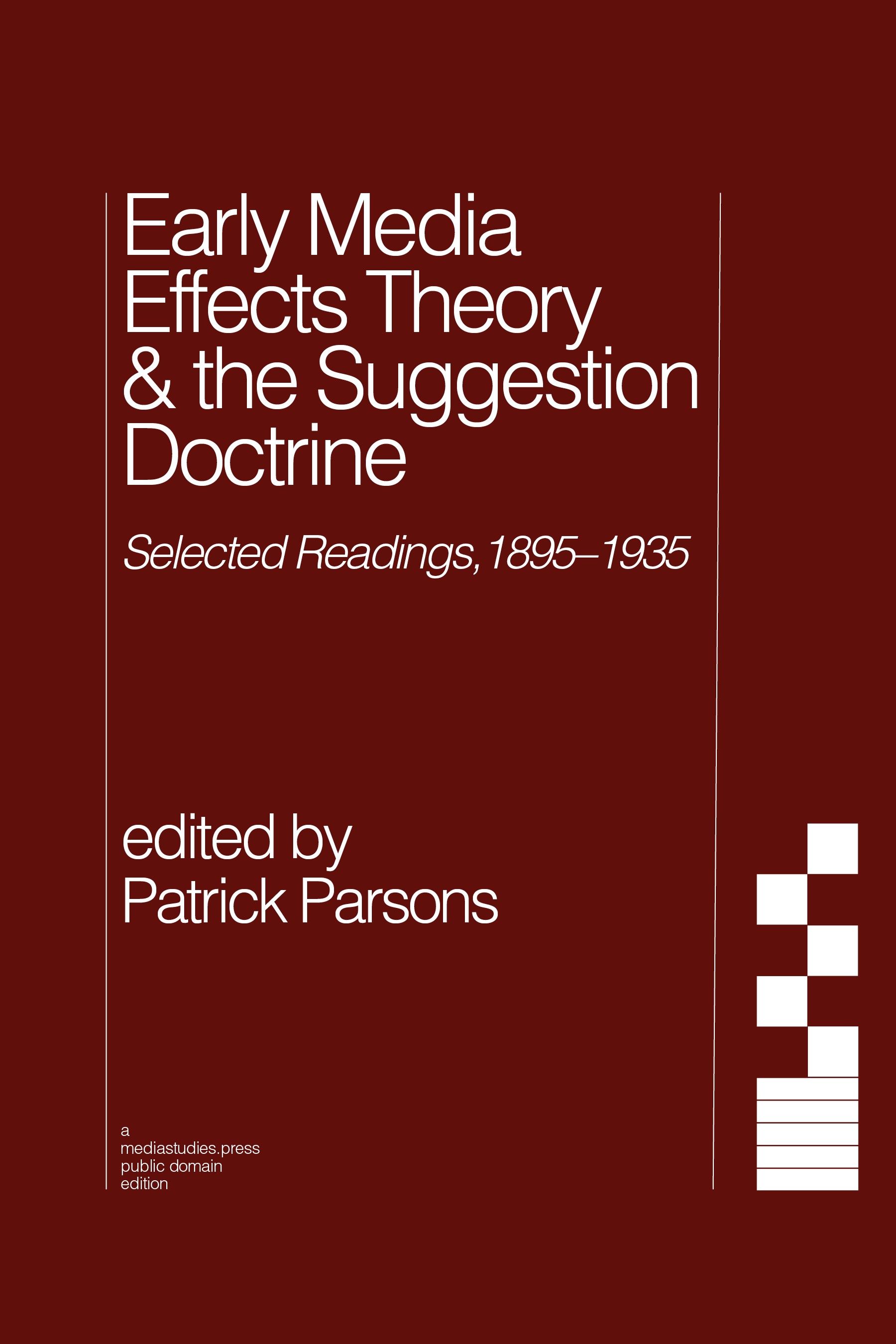
Early Media Effects Theory & the Suggestion Doctrine: Selected Readings, 1895–1935

  • Patrick Parsons (editor)
mediastudies.press
2024-12-28
All rights reserved
Early Media Effects Theory & the Suggestion Doctrine: Selected Readings, 1895–1935
Export Metadata
Metadata
TitleEarly Media Effects Theory & the Suggestion Doctrine
SubtitleSelected Readings, 1895–1935
ContributorPatrick Parsons (editor)
DOIhttps://doi.org/10.32376/3f8575cb.f1e0489e(opens in new tab)
Landing pagehttps://www.mediastudies.press/early-media-effects-theory-the-suggestion-doctrine(opens in new tab)
CopyrightParsons, Patrick (introduction, chapter introductions)
Publishermediastudies.press
Publication placeBethlehem, PA
Published on2024-12-28
Series
  • Public Domain Series vol. 6
  • ISSN Print: 2770-2472
  • ISSN Digital: 2770-2480
ISBN978-1-951399-28-3 (Paperback)
978-1-951399-26-9 (PDF)
978-1-951399-27-6 (HTML)
978-1-951399-29-0 (EPUB)
Short abstract

Early Media Effects Theory & the Suggestion Doctrine: Selected Readings, 1895–1935 consists of over 30 public domain works originally publishing from the late 19th century to the mid-1930s on the concept of “suggestion”

Long abstract

While much has been written on the history of media effects research in the United States, a casual review of the literature could reasonably lead one to believe that little if any such work was conducted until the 1940s. Early Media Effects Theory & the Suggestion Doctrine: Selected Readings, 1895–1935, consisting of over 30 public domain works originally publishing from the late 19th century to the mid-1930s, demonstrates the rich and varied study of media effects before mid-century—much of it centered on the concept of “suggestion.” What media scholars know today as “persuasion,” social psychologists of the early 1900s would have understood as the process of suggestion. The works collected in Early Media Effects Theory & the Suggestion Doctrine include the original statements on the subject from many of the leading social theorists of the age, among them figures such as Gabriel Tarde and Gustave Le Bon in France and James Baldwin, Edward Ross, and Floyd Allport in the United States.

Print length330 pages (i-xii,1-318)
LanguageEnglish (Original)
Dimensions152 x 229 mm | 6" x 9" (Paperback)
Media1 illustration
LCCN2024931261
THEMA
  • JMH
  • JMT
  • JBCT
BISAC
  • SOC052000
  • PSY031000
  • POL049000

Contents

Introduction: An Overview of the Origins and Evolution of Suggestion Theory(pp. 1–9)
  • Patrick Parsons
The Crowd: A Study of the Popular Mind (1896)(pp. 13–22)
  • Gustav Le Bon
The Laws of Imitation (1903)(pp. 23–30)
  • Gabriel Tarde
The Imitative Functions and Their Place in Human Nature (1894)(pp. 31–42)
  • Josiah Royce
Mental Development of the Child and the Race (1911)(pp. 43–53)
  • James Mark Baldwin
The Psychology of Suggestion (1898)(pp. 54–63)
  • Boris Sidis
Social Psychology: An Outline and Sourcebook (1908)(pp. 64–74)
  • Edward Alsworth Ross
A Sociological Definition of Suggestion (1921), Definition of Imitation (1921), & Attention, Interest, and Imitation (1921)(pp. 75–89)
  • W. V. Bechterew
  • Charles Judd
  • George Stout
The Need for Social Psychology (1917)(pp. 90–96)
  • John Dewey
An Introduction to Social Psychology (1913)(pp. 101–1111)
  • William McDougall
Instincts of the Herd in War and Peace (1917)(pp. 112–121)
  • Wilfred Trotter
The Original Nature of Man (1913)(pp. 122–127)
  • Edward Lee Thorndike
Social Psychology (1924)(pp. 128–138)
  • Floyd Henry Allport
Suggestion and Suggestibility (1919)(pp. 139–146)
  • Robert H. Gault
Suggestion and Suggestibility (1920)(pp. 147–158)
  • Edmund Prideaux
The Comparative Influence of Majority and Expert Opinion (1921)(pp. 159–164)
  • Henry T. Moore
The Psychology of Belief: A Study of Its Emotional, and Volitional Determinants (1925)(pp. 165–172)
  • Frederick Lund
Social Psychology (1925) & The Concept of Imitation (1926)(pp. 173–184)
  • Knight Dunlap
  • Ellsworth Faris
An Introduction to Social Psychology (1922)(pp. 185–197)
  • Charles A. Ellwood
An Introduction to Social Psychology (1926)(pp. 198–212)
  • Luther Lee Bernard
Principles of Sociology (1928)(pp. 213–222)
  • Frederick Elmore Lumley
Social Psychology (1931)(pp. 223–233)
  • Ernest Théodore Krueger
  • Walter C. Reckless
The Influence of Newspaper Presentations Upon the Growth of Crime and Other Anti-Social Activity (1910 & 1911)(pp. 234–250)
  • Frances Fenton
The Psychology of Persuasion (1920)(pp. 255–267)
  • William Macpherson
The Control of the Social Mind (1923)(pp. 268–276)
  • Arland Deyett Weeks
Control of Propaganda as a Psychological Problem (1922)(pp. 277–287)
  • Edward Kellog Strong, Jr.
The Theory of Political Propaganda (1927)(pp. 288–294)
  • Harold D. Lasswell
The Psychology of Advertising (1913)(pp. 295–300)
  • Walter Dill Scott
The Conditions of the Belief in Advertising (1923)(pp. 301–307)
  • Albert T. Poffenberger
The Psychology of the Audience (1935)(pp. 308–317)
  • Harry L. Hollingworth
Locations
PaperbackLanding page(opens in new tab)Full text URL(opens in new tab)
PDFLanding page(opens in new tab)Full text URL(opens in new tab)THOTH
Landing page(opens in new tab)Full text URL(opens in new tab)PROJECT MUSE
Landing page(opens in new tab)Full text URL(opens in new tab)OAPEN
Landing page(opens in new tab)Full text URL(opens in new tab)DOAB
Landing page(opens in new tab)Full text URL(opens in new tab)
Landing page(opens in new tab)Full text URL(opens in new tab)GOOGLE BOOKS
Landing page(opens in new tab)Full text URL(opens in new tab)INTERNET ARCHIVE
Landing page(opens in new tab)Full text URL(opens in new tab)Publisher Website
HTMLLanding page(opens in new tab)Full text URL(opens in new tab)Publisher Website
EPUBLanding page(opens in new tab)Full text URL(opens in new tab)THOTH
Landing page(opens in new tab)Full text URL(opens in new tab)
Landing page(opens in new tab)
Landing page(opens in new tab)Full text URL(opens in new tab)Publisher Website

Contributors

Patrick Parsons

(editor)

Patrick Parsons is professor emeritus at the Donald P. Bellisario College of Communications at Penn State.