
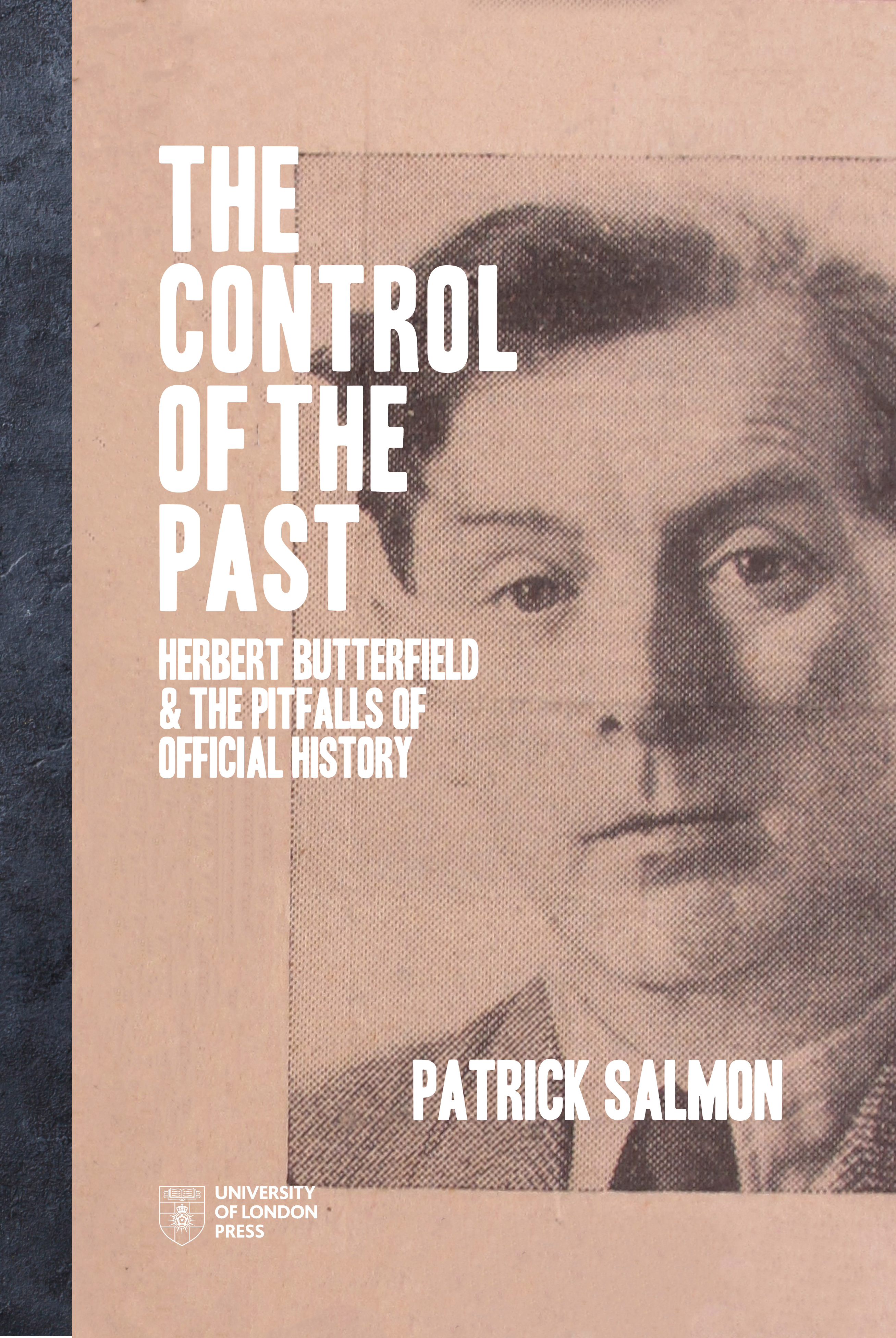
| Title | The Control of the Past |
|---|---|
| Subtitle | Herbert Butterfield and the Pitfalls of Official History |
| Contributor | Patrick Salmon (author) |
| DOI | https://doi.org/10.14296/202112.9781914477218(opens in new tab) |
| Landing page | https://uolpress.co.uk/book/the-control-of-the-past/(opens in new tab) |
| License | https://creativecommons.org/licenses/by-nc-nd/4.0/(opens in new tab) |
| Publisher | University of London Press |
| Publication place | London, GB |
| Published on | 2021-12-06 |
| ISBN | 978-1-914477-19-5 (Paperback) |
| 978-1-914477-21-8 (PDF) | |
| 978-1-913002-11-4 (HTML) | |
| 978-1-914477-22-5 (EPUB) | |
| Short abstract | Written by one of the few historians employed by the British government, this important book details how successive governments have applied a selective approach to the past in order to tell or re-tell Britain’s national history, with implications for the future. Providing a unique overview of the main trends of official history in Britain since the Second World War, the book details how Herbert Butterfield (1900–1979) became one of the earliest and strongest critics of what he saw as the British government’s attempts to control the past through the writing of so-called, ‘official histories’. |
| Long abstract | Herbert Butterfield (1900–1979) was one of the earliest and strongest critics of what he saw as the British government’s attempts to control the past through the writing of so-called, ‘official histories’. His famous diatribe against the 'pitfalls' of government-mandated history first appeared in 1949, at a time when the British government was engaged in publishing official histories and diplomatic documents on an unprecedented scale following the Second World War. But why was Butterfield so hostile to official history, and why do his views still matter today? Written by one of the few historians employed by the British government, this important book details how successive governments have applied a selective approach to the past in order to tell or re-tell Britain’s national history, with implications for the future. Providing a unique overview of the main trends of official history in Britain since the Second World War, the book details how Butterfield came to suspect that the British government was trying to suppress vital documents revealing the Duke of Windsor’s dealings with Nazi Germany. This seemed to confirm his long-held belief that all governments would seek to manipulate history if they could, and conceal the truth if they could not. At the beginning of the 21st century, official history is still being written and the book concludes with an insider’s perspective on the many issues it faces today– on freedom of information, social media and reengaging with our nation’s colonial legacy. Governments have recently been given many reminders that history matters, and it is Herbert Butterfield above all who reminds us that we must remain vigilant in monitoring how they respond to the challenge. |
| Print length | 118 pages |
| Language | English (Original) |
| Dimensions | 234 x 156 mm | 9.19" x 6.13" (Paperback) |
| THEMA |
|
| BIC |
|
| BISAC |
|
| Keywords |
|
Contributors
Patrick Salmon
(author)Patrick Salmon is Chief Historian at the Foreign, Commonwealth and Development Office. He was formerly Professor of International History at the University of Newcastle upon Tyne. He is a Fellow of the Royal Historical Society and a Foreign Member of the Norwegian Academy of Science and Letters. His publications include Scandinavia and the Great Powers 1890-1940 (1997), Deadlock and Diversion: Scandinavia in British Strategy during the Twilight War 1939-1940 (2012) and several volumes in the series Documents on British Policy Overseas (DBPO), including German Unification, 1989-1990 (2009), The Challenge of Apartheid: UK-South African Relations, 1985-1986 (2017) and The Unwinding of Apartheid: UK-South African Relations, 1986-1990 (2019).