
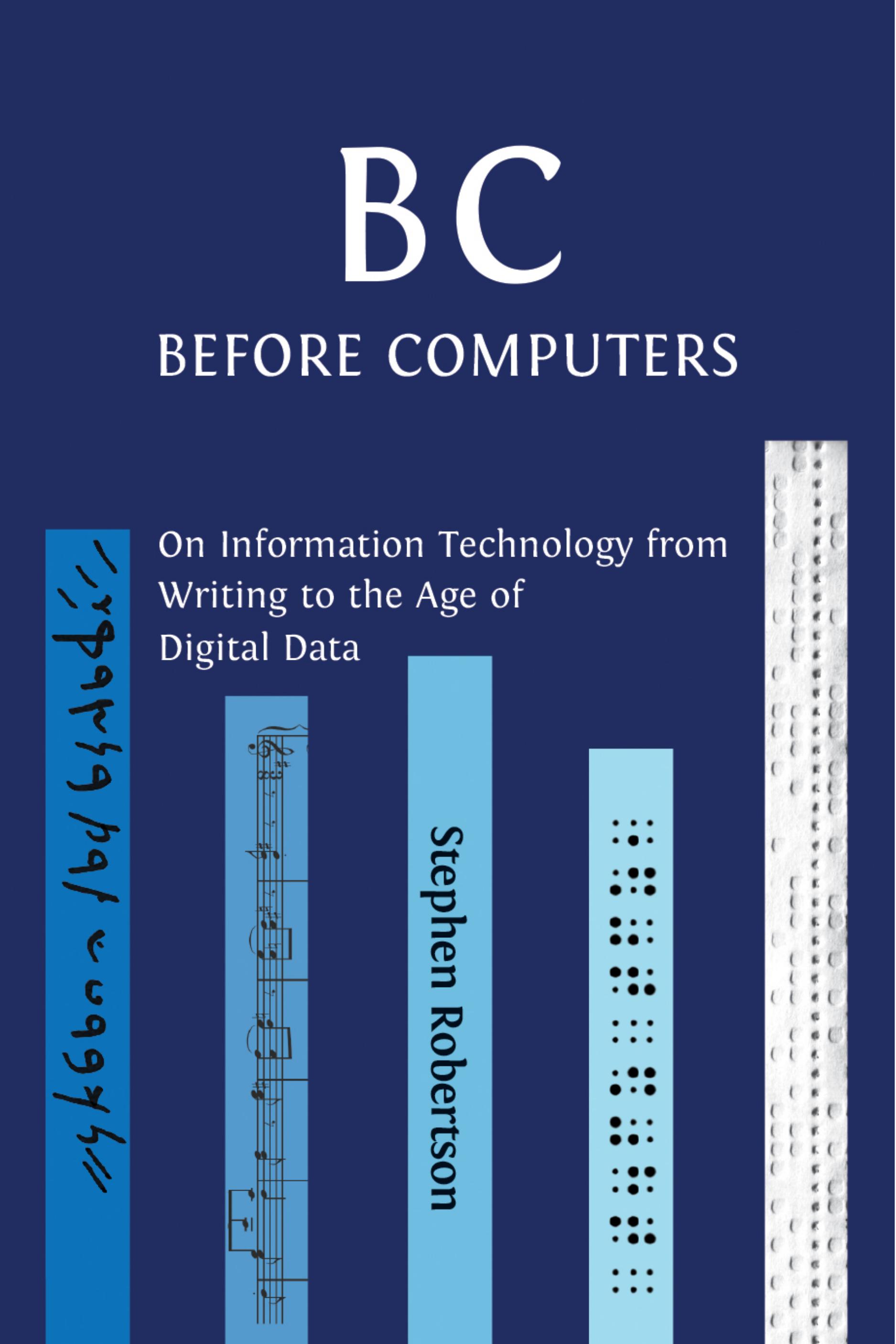
| Title | B C, Before Computers |
|---|---|
| Subtitle | On Information Technology from Writing to the Age of Digital Data |
| Contributor | Stephen Robertson (author) |
| DOI | https://doi.org/10.11647/OBP.0225(opens in new tab) |
| Landing page | https://www.openbookpublishers.com/books/10.11647/obp.0225(opens in new tab) |
| License | http://creativecommons.org/licenses/by/4.0/(opens in new tab) |
| Copyright | Stephen Robertson |
| Publisher | Open Book Publishers |
| Publication place | Cambridge, UK |
| Published on | 2020-10-22 |
| ISBN | 978-1-80064-029-0 (Paperback) |
| 978-1-80064-030-6 (Hardback) | |
| 978-1-80064-031-3 (PDF) | |
| 978-1-80064-630-8 (HTML) | |
| 978-1-80064-106-8 (XML) | |
| 978-1-80064-104-4 (EPUB) | |
| 978-1-80064-105-1 (MOBI) | |
| Short abstract | Treading the line between philosophy and technical history, Robertson draws on his extensive technical knowledge to produce a text which is both thought-provoking and accessible to a wide range of readers. |
| Long abstract | The idea that the digital age has revolutionized our day-to-day experience of the world is nothing new, and has been amply recognized by cultural historians. In contrast, Stephen Robertson’s 'BC: Before Computers' is a work which questions the idea that the mid-twentieth century saw a single moment of rupture. It is about all the things that we had to learn, invent, and understand – all the ways we had to evolve our thinking – before we could enter the information technology revolution of the second half of the twentieth century. Its focus ranges from the beginnings of data processing, right back to such originary forms of human technology as the development of writing systems, gathering a whole history of revolutionary moments in the development of information technologies into a single, although not linear narrative. Treading the line between philosophy and technical history, Robertson draws on his extensive technical knowledge to produce a text which is both thought-provoking and accessible to a wide range of readers. The book is wide in scope, exploring the development of technologies in such diverse areas as cryptography, visual art and music, and the postal system. Through all this, it does not simply aim to tell the story of computer developments but to show that those developments rely on a long history of humans creating technologies for increasingly sophisticated methods of manipulating information. Through a clear structure and engaging style, it brings together a wealth of informative and conceptual explorations into the history of human technologies, and avoids assumptions about any prior knowledge on the part of the reader. As such, it has the potential to be of interest to the expert and the general reader alike. |
| Print length | 171 pages (x+161) |
| Language | English (Original) |
| Dimensions | 156 x 12 x 234 mm | 6.14" x 0.47" x 9.21" (Paperback) |
| 156 x 16 x 234 mm | 6.14" x 0.63" x 9.21" (Hardback) | |
| Weight | 737g | 26.00oz (Paperback) |
| 1118g | 39.44oz (Hardback) | |
| Media | 19 illustrations |
| OCLC Number | 1202297871 |
| LCCN | 2020445105 |
| BIC |
|
| BISAC |
|
| LCC |
|
| Keywords |
|
Contents
- In the beginning...
- Stephen Robertson
- Stephen Robertson
- Stephen Robertson
- Stephen Robertson
- Stephen Robertson
- Stephen Robertson
- Stephen Robertson
- Stephen Robertson
- Stephen Robertson
- Stephen Robertson
- Stephen Robertson
- Stephen Robertson
- Stephen Robertson
- Stephen Robertson