
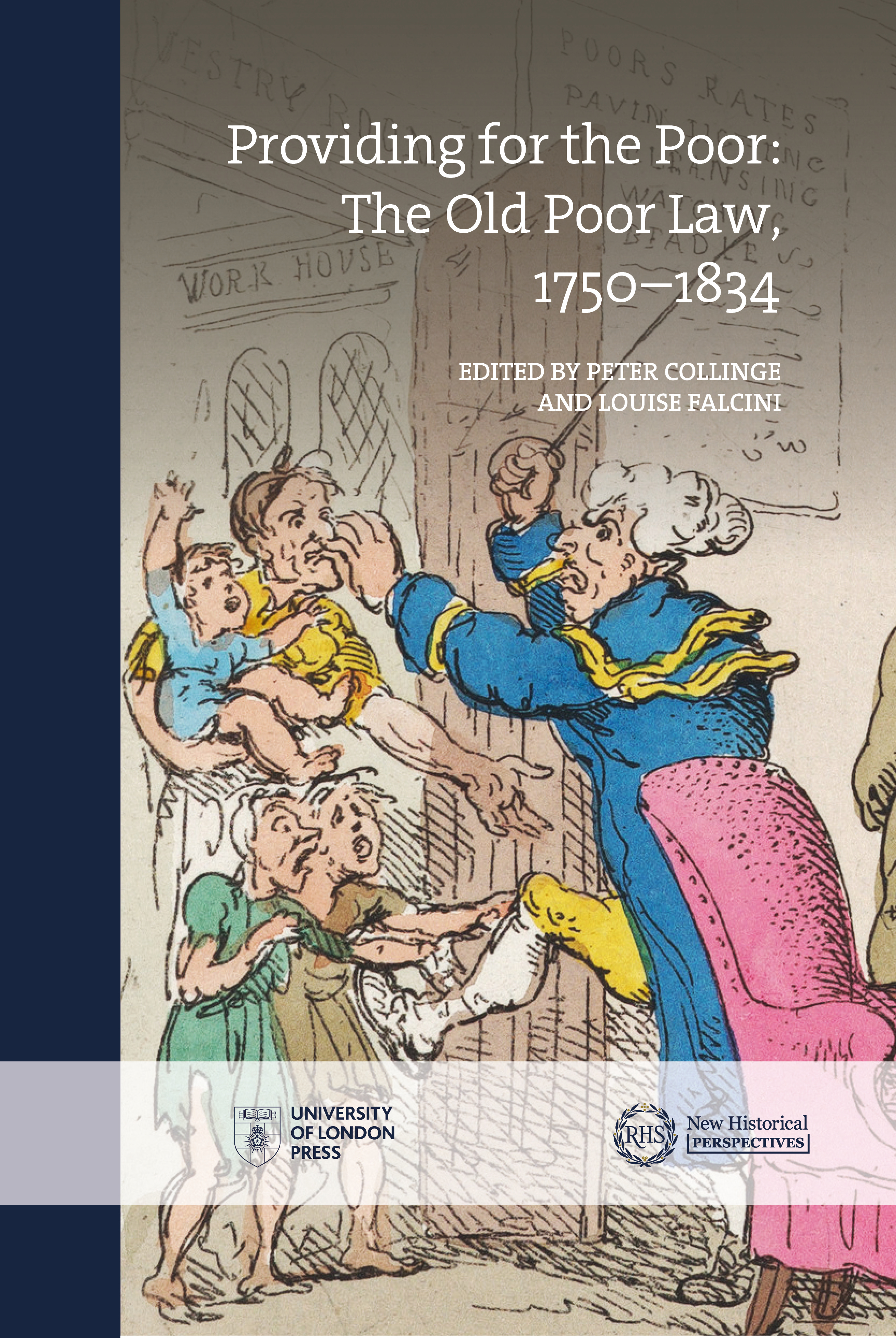
| Title | Providing for the Poor |
|---|---|
| Subtitle | The Old Poor Law, 1750–1834 |
| Contributor | Peter Collinge (editor) |
| Louise Falcini (editor) | |
| DOI | https://doi.org/10.14296/npin8958(opens in new tab) |
| Landing page | https://uolpress.co.uk/book/providing-for-the-poor/(opens in new tab) |
| License | https://creativecommons.org/licenses/by-nc-nd/4.0/(opens in new tab) |
| Copyright | Authors |
| Publisher | University of London Press |
| Publication place | London, GB |
| Published on | 2022-08-29 |
| ISBN | 978-1-914477-11-9 (Paperback) |
| 978-1-914477-10-2 (Hardback) | |
| 978-1-914477-14-0 (PDF) | |
| 978-1-913002-20-6 (HTML) | |
| 978-1-914477-12-6 (EPUB) | |
| Short abstract | The Old Poor Law dispensed benefits to paupers in a uniquely comprehensive, pre-modern system of relief. Providing for the Poor re-examines the micro-politics of poverty in the long eighteenth century. It bridges the gaps in our understanding of the experiences of people across the social spectrum whose lives were touched by the law and explores some of the wider arguments concerning the nature of welfare during economically testing times to produce a radical new history of the Old Poor Law in astonishing detail. |
| Long abstract | The Old Poor Law in England and Wales, administered by the local parish, dispensed benefits to paupers providing a uniquely comprehensive, pre-modern system of relief. Remaining in force until 1834, the law provided goods and services to keep the poor alive. Combining short- and long-form articles and essays, Providing for the Poor brings together academics and practitioners from across disciplines to re-examine the micro-politics of poverty in the long eighteenth century through the eyes of the poor, their providers and enablers. From the providence of the parochial sixpence given in order to move a beggar on, to coercive marriages, plebeian clothing and the much broader implications of vagrancy towards the end of the long eighteenth century, this volume aims to bridge the gaps in our understanding of the experiences of people across the social spectrum whose lives were touched by the Old Poor Law. It brings together some of the wider arguments concerning the nature of welfare during economically testing times, and navigates the rising bureaucracy inherent in the system, to produce a radical new history of the Old Poor Law in astonishing detail. |
| Print length | 224 pages |
| Language | English (Original) |
| Dimensions | 234 x 156 mm | 9.19" x 6.13" (Paperback) |
| 163 x 245 mm | 6.44" x 9.63" (Hardback) | |
| Media | 25 illustrations |
| THEMA |
|
| BIC |
|
| BISAC |
|
| Keywords |
|