
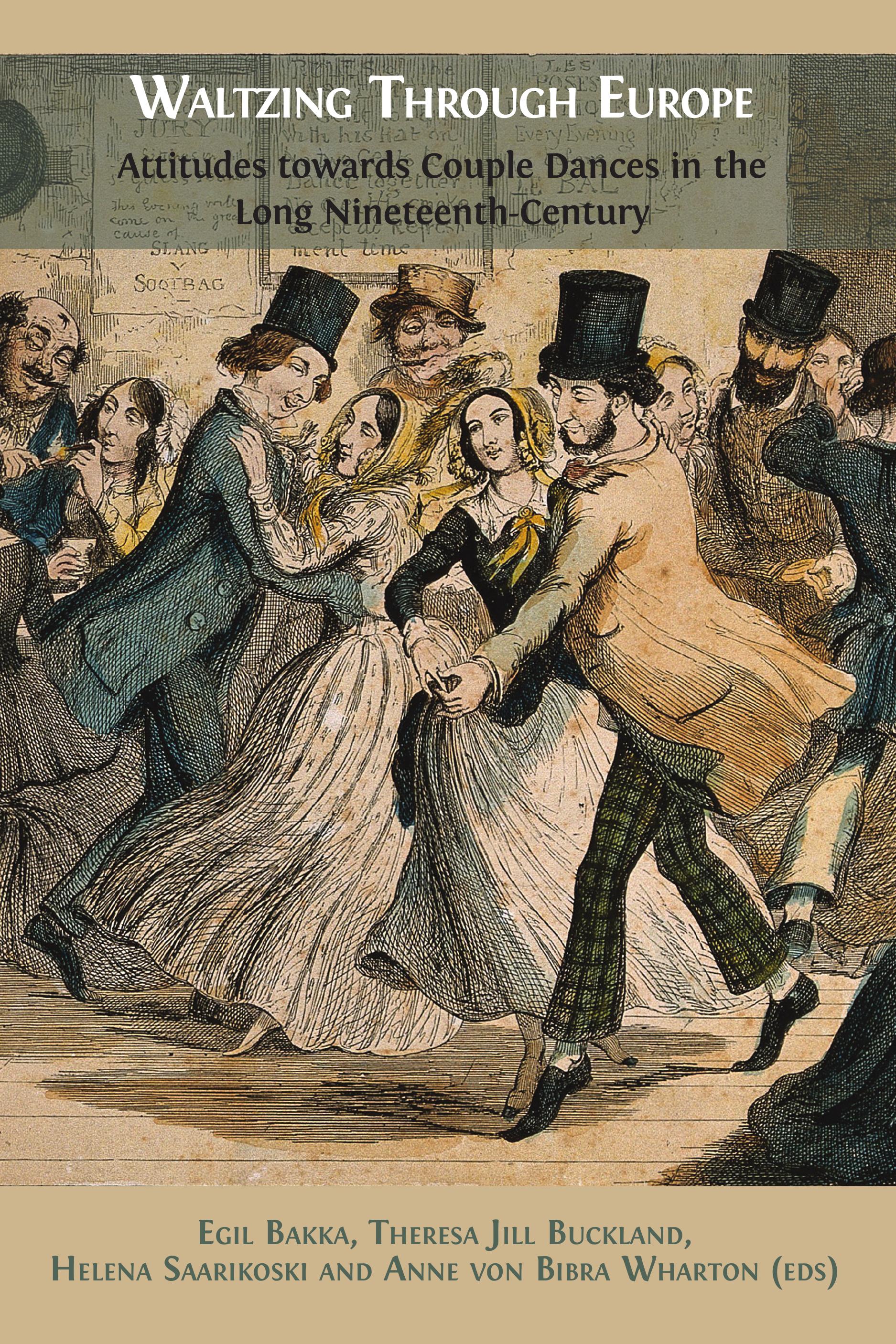
| Title | Waltzing Through Europe |
|---|---|
| Subtitle | Attitudes towards Couple Dances in the Long Nineteenth Century |
| Contributor | Egil Bakka(opens in new tab)(editor) |
| Theresa Jill Buckland(opens in new tab)(editor) | |
| Helena Saarikoski (editor) | |
| Anne von Bibra Wharton (editor) | |
| DOI | https://doi.org/10.11647/OBP.0174(opens in new tab) |
| Landing page | https://www.openbookpublishers.com/books/10.11647/obp.0174(opens in new tab) |
| License | http://creativecommons.org/licenses/by/4.0/(opens in new tab) |
| Copyright | Egil Bakka; Theresa Jill Buckland; Helena Saarikoski; Anne von Bibra Wharton |
| Publisher | Open Book Publishers |
| Publication place | Cambridge, UK |
| Published on | 2020-09-10 |
| ISBN | 978-1-78374-732-0 (Paperback) |
| 978-1-78374-733-7 (Hardback) | |
| 978-1-78374-734-4 (PDF) | |
| 978-1-80064-588-2 (HTML) | |
| 978-1-78374-737-5 (XML) | |
| 978-1-78374-735-1 (EPUB) | |
| 978-1-78374-736-8 (MOBI) | |
| Short abstract | From ‘folk devils’ to ballroom dancers, Waltzing Through Europe explores the changing reception of fashionable couple dances in Europe from the eighteenth century onwards. It is essential reading for researchers of dance in central and northern Europe, while also appealing to the general reader who wants to learn more about the vibrant histories of these familiar dance forms. |
| Long abstract | From ‘folk devils’ to ballroom dancers, Waltzing Through Europe explores the changing reception of fashionable couple dances in Europe from the eighteenth century onwards. A refreshing intervention in dance studies, this book brings together elements of historiography, cultural memory, folklore, and dance across comparatively narrow but markedly heterogeneous localities. Rooted in investigations of often newly discovered primary sources, the essays afford many opportunities to compare sociocultural and political reactions to the arrival and practice of popular rotating couple dances, such as the Waltz and the Polka. Leading contributors provide a transnational and affective lens onto strikingly diverse topics, ranging from the evolution of romantic couple dances in Croatia, and Strauss’s visits to Hamburg and Altona in the 1830s, to dance as a tool of cultural preservation and expression in twentieth-century Finland. Waltzing Through Europe creates openings for fresh collaborations in dance historiography and cultural history across fields and genres. It is essential reading for researchers of dance in central and northern Europe, while also appealing to the general reader who wants to learn more about the vibrant histories of these familiar dance forms. |
| Print length | 494 pages (x+484) |
| Language | English (Original) |
| Dimensions | 156 x 34 x 234 mm | 6.14" x 1.35" x 9.21" (Paperback) |
| 156 x 38 x 234 mm | 6.14" x 1.50" x 9.21" (Hardback) | |
| Weight | 2049g | 72.28oz (Paperback) |
| 2456g | 86.63oz (Hardback) | |
| Media | 144 illustrations |
| OCLC Number | 1197556636 |
| LCCN | 2019394530 |
| BIC |
|
| BISAC |
|
| LCC |
|
| Keywords |
|
Contents
- The Round Dance Paradigm
- Egil Bakka
- The State of Research
- Egil Bakka
- A Survey of the Chapters in the Book
- Egil Bakka
- The Waltz at Some Central European Courts
- Egil Bakka
- The Polka as a Czech National Symbol
- Daniela Stavělová
- Decency, Health, and Grace Endangered by Quick Dancing? The New Dance Style in Bohemia in 1830
- Dorota Gremlicová
- Reception of Nineteenth-Century Couple Dances in Hungary
- László Felföldi
- The Waltz among Slovenians
- Rebeka Kunej
- Dancing and Politics in Croatia: The Salonsko Kolo as a Patriotic Response to the Waltz
- Ivana Katarinčić
- Iva Niemčić
- Waltzing Through Europe: Johann Strauss (the Elder) in Hamburg and Altona in 1836
- Jörgen Torp
- Continuity and Reinvention: Past Round Dances in Present Estonia
- Sille Kapper
- The Ban on Round Dances 1917–1957: Regulating Social Dancing in Norwegian Community Houses
- Egil Bakka
- Dance and ‘Folk Devils’
- Mats Nilsson
- Nostalgia as a Perspective on Past Dance Culture in Finland
- Helena Saarikoski
- A Twenty-First Century Resurrection: The Potresujka, the Croatian Polka Tremblante
- Tvrtko Zebec
Contributors
Egil Bakka
(editor)Egil Bakka is Professor Emeritus of Dance Studies at the Norwegian University of Science and Technology, and former Director of the Norwegian Centre for Traditional Music and Dance. He built a full teaching program in Ethnochoreology at NTNU, and, in collaboration with six other universities, he developed two international Masters programs — NoMAds (Nordic Master in Dance Studies) and Choreomundus (International Master in Dance Knowledge, Practice, and Heritage) – which he coordinated. His latest publications include 'Theorizing and De-Theorizing Dance' (2018) and 'Museums, Dance, and the Safeguarding of Intangible Cultural Heritage: "Events of Practice" – A New Strategy for Museums?' (with Tone Erlien, 2017).
Theresa Jill Buckland
(editor)Theresa Jill Buckland is Professor of Dance History and Ethnography, Department of Dance, University of Roehampton, London. Her edited books include Dancing from Past to Present (2006) and Folklore Revival Movements in Europe post 1950 (with Daniela Stavělová, 2018). She is also the author of Society Dancing: Fashionable Bodies in England 1870–1920 (2011).
Helena Saarikoski
(editor)Helena Saarikoski is Adjunct Professor of Folklore and Women's Studies, University of Helsinki. She is a Helsinki-based folklorist, specialising in youth and women studies and ethnographic studies of popular culture.
Anne von Bibra Wharton
(editor)Anne von Bibra Wharton teaches ballroom and world dance traditions in the Dance Department at St. Olaf College in Minnesota. She has served as Secretary of the ICTM Study Group on Ethnochoreolgy and as an editor for multiple study group proceedings. Among her research interests are continuity and change in social dance forms in the Franconian region of Germany, which include many round dances.