
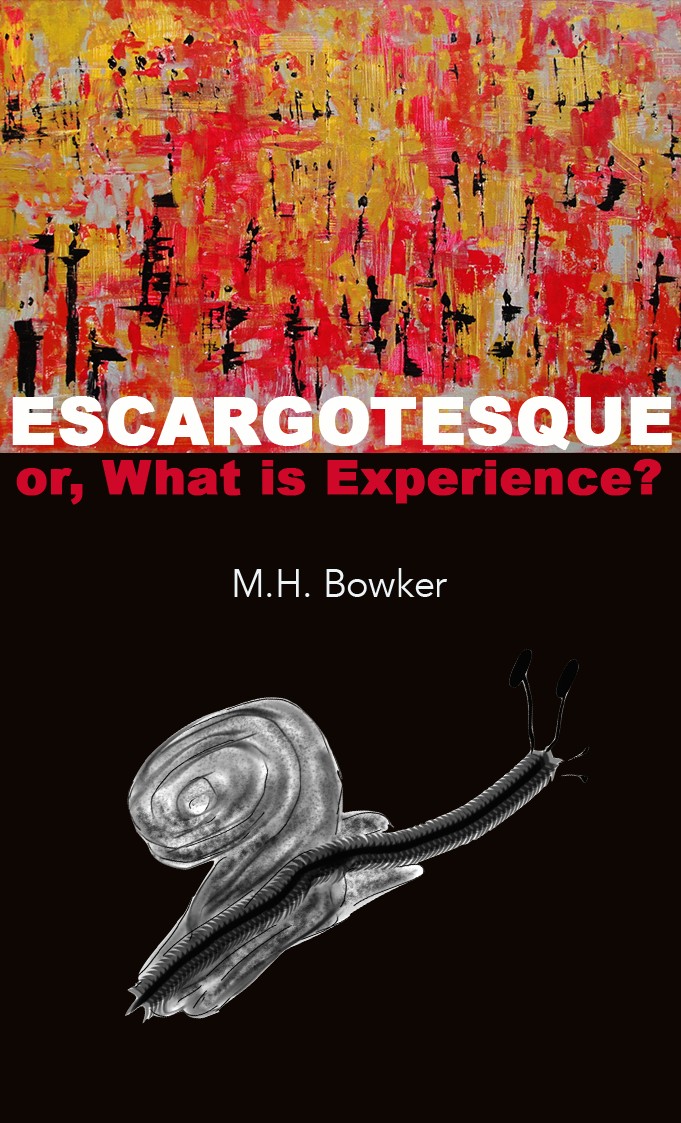
| Title | Escargotesque, or, What Is Experience |
|---|---|
| Contributor | M.H. Bowker(opens in new tab)(author) |
| DOI | https://doi.org/10.21983/P3.0089.1.00(opens in new tab) |
| Landing page | https://punctumbooks.com/titles/escargotesque/(opens in new tab) |
| License | https://creativecommons.org/licenses/by-nc-sa/3.0/(opens in new tab) |
| Copyright | Bowker, M.H. (0000-0001-5539-5589) |
| Publisher | punctum books |
| Publication place | Brooklyn, NY |
| Published on | 2015-01-26 |
| ISBN | 978-0-692-37388-0 (Paperback) |
| Long abstract | “Experience” is a concept paradoxically deployed to accentuate the aconceptual. Although thinking, knowing, reflecting, and analyzing are kinds of experiences, invocations of “experience” typically direct our attention to what is immediate, embodied, unrepresented, unthought, even unthinkable. And yet, whether by learning experience, traumatic experience, life experience, mystical experience, or all of these, we hope most fervently that our experience will teach us, transform us, become part of us. Why do we strive to find, profit from, and possess experience while insisting upon experience’s intellectual elusiveness? What do we intend when we petition (and re-petition) experience for truth, for growth, for strength? To whom or to what do we sing when we sing experience’s song? Escargotesque, or, What is Experience? asks why both our lived experiences and our mythologies of experience so often fold inward, repeat, return. Departing from his unusual experience of working as a garbage-collector in the West African country of Benin, M.H. Bowker converses with several champions of experience (from Michel de Montaigne to John Dewey, from Søren Kierkegaard to Ralph Waldo Emerson, from Simone Weil to R.D. Laing) to pose radical questions about the intentions and dynamics that guide our quest for experience, intentions and dynamics that are more destructive and more melancholy than celebrants of experience would care to admit. Across Escargotesque’s six loosely linear parts, fragments of prose memoir intersect with poetry, sketch art, philosophical reflection, cultural criticism, and psychological examination in ways that both evoke and unsettle the thinking person’s experience. Escargotesque both testifies to an experience and reveals surprising fantasies driving the modern and postmodern turn to experience as a source of truth and hope. Such fantasies include the sacredness of even the most violent ‘pure experience,’ the necessity of supplicating experience’s objects, and the ultimate demise of the one who experiences. |
| Print length | 116 pages |
| Language | English (Original) |
| Dimensions | 114 x 184 mm | 4.50" x 7.25" (Paperback) |
| THEMA |
|
| BIC |
|
| BISAC |
|
| Keywords |
|
Contributors
M.H. Bowker
(author)M.H. Bowker is the author of ten books — including Ostranenie: On Shame and Knowing(opens in new tab) and Misinterest: Essays, Pensées, and Dreams(opens in new tab) (both published with punctum) — and numerous papers in the areas of psychoanalytic theory, social and political philosophy, literary criticism, and critical pedagogy. He is a professor at a small college in upstate New York. Educated at Columbia University and the University of Maryland, College Park, he edits the Psychoanalytic Political Theory book series at Routledge and is the (North American) Editor of the Journal of Psycho-Social Studies. He is a recent Fulbright grant recipient and has taught approximately one hundred courses in a wide array of disciplines, including Political Science, Philosophy, Psychology, English, and more.