
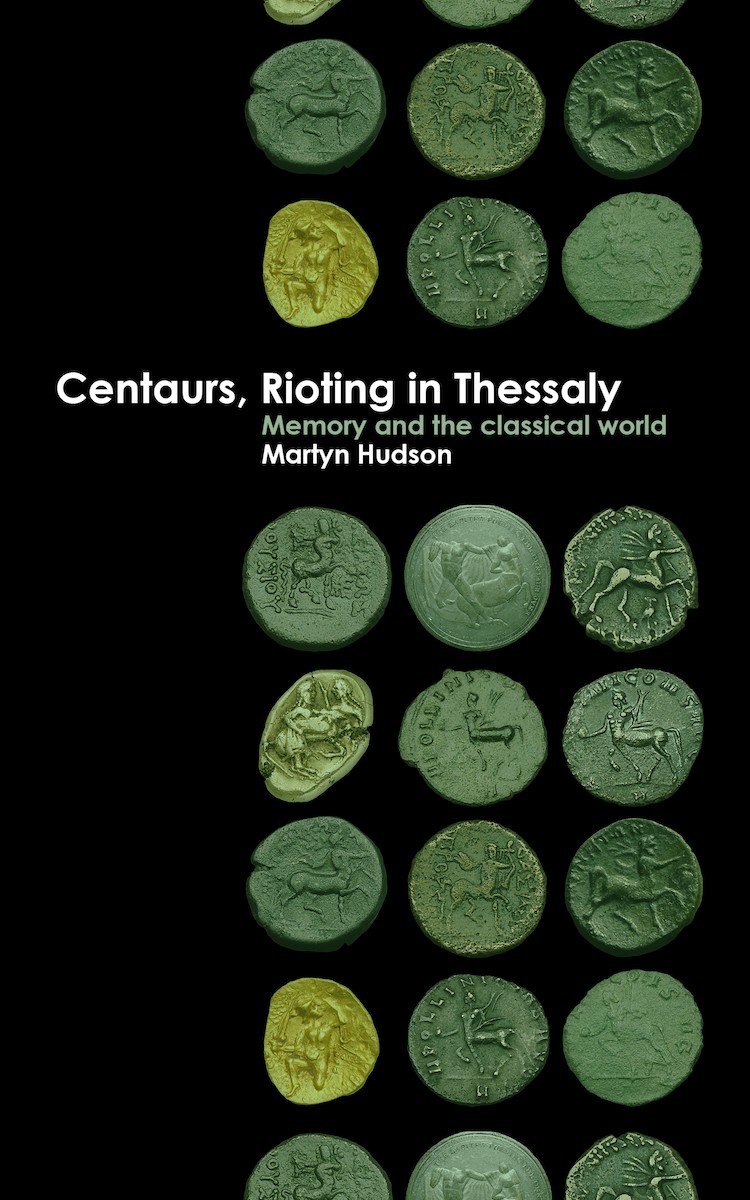
| Title | Centaurs, Rioting in Thessaly |
|---|---|
| Subtitle | Memory and the Classical World |
| Contributor | Martyn Hudson(opens in new tab)(author) |
| DOI | https://doi.org/10.21983/P3.0192.1.00(opens in new tab) |
| Landing page | https://punctumbooks.com/titles/centaurs-rioting-in-thessaly/(opens in new tab) |
| License | https://creativecommons.org/licenses/by-nc-sa/4.0/(opens in new tab) |
| Copyright | Hudson, Martyn |
| Publisher | punctum books |
| Publication place | Earth, Milky Way |
| Published on | 2018-01-09 |
| ISBN | 978-1-947447-40-0 (Paperback) |
| 978-1-947447-41-7 (PDF) | |
| Long abstract | This book treads new paths through the labyrinths of our human thought. It meanders through the darkness to encounter the monsters at the heart of the maze: Minotaurs, Centaurs, Automata, Makers, Humans. One part of our human thought emerges from classical Ionia and Greek civilisation more generally. We obsessively return to that thought, tread again its pathways, re-enact its stories, repeat its motifs and gestures. We return time and time again to construct and re-construct the beings which were part of its cosmology and mythology – stories enacted from a classical world which is itself at once imaginary and material. The “Never Never Lands” of the ancient world contain fabulous beasts and humans and landscapes of desire and violence. We encounter the rioting Centaurs there and never again cease to conjure them up time and time again through our history. The Centaur mythologies display a fascination with animals and what binds and divides human beings from them. The Centaur hints ultimately at the idea of the genesis of civilisation itself. The Labyrinth, constructed by Daedalus, is itself a prison and a way of thinking about making, designing, and human aspiration. Designed by humans it offers mysteries that would be repeated time and time again – a motif which is replicated through human history. Daedalus himself is an archetype for creation and mastery, the designer of artefacts and machines which would be the beginning of forays into the total domination of nature. Centaurs, Labyrinths, Automata offer clues to the origins and ultimately the futures of humanity and what might come after it. |
| Print length | 116 pages |
| Language | English (Original) |
| Dimensions | 140 x 216 mm | 5.50" x 8.50" (Paperback) |
| LCCN | 2017962641 |
| THEMA |
|
| BIC |
|
| BISAC |
|
| Keywords |
|
Contributors
Martyn Hudson
(author)Martyn Hudson is the coordinator of the Co-Curate North East digital archives and machines project at Newcastle University in the School of Arts and Cultures, as well as a Lecturer in Art and Design History. He has published widely in landscape, history, music, and archives. His book The Slave Ship, Memory and the Origin of Modernity was published by Routledge in 2016, and he has two other books forthcoming from Routledge: Ghosts, Landscapes and Social Memory and Species and Machines: The Human Subjugation of Nature.