
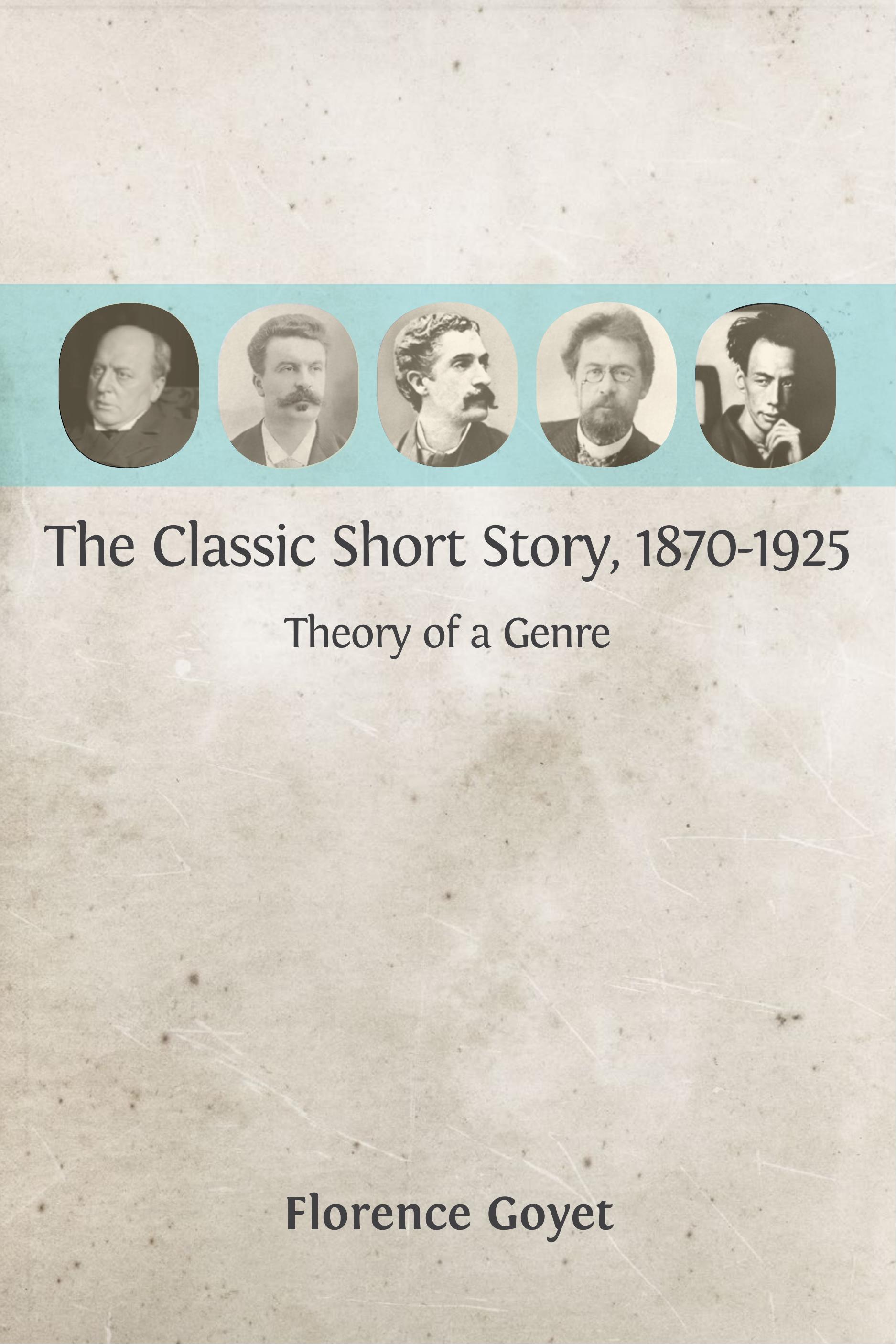
| Title | The Classic Short Story, 1870-1925 |
|---|---|
| Subtitle | Theory of a Genre |
| Contributor | Florence Goyet (author) |
| Yvonne Freccero (translator) | |
| DOI | https://doi.org/10.11647/OBP.0039(opens in new tab) |
| Landing page | https://www.openbookpublishers.com/books/10.11647/obp.0039(opens in new tab) |
| License | http://creativecommons.org/licenses/by/4.0/(opens in new tab) |
| Copyright | Florence Goyet |
| Publisher | Open Book Publishers |
| Publication place | Cambridge, UK |
| Published on | 2014-01-13 |
| ISBN | 978-1-909254-75-6 (Paperback) |
| 978-1-909254-76-3 (Hardback) | |
| 978-1-909254-77-0 (PDF) | |
| 978-1-80064-466-3 (HTML) | |
| 978-1-78374-420-6 (XML) | |
| 978-1-909254-78-7 (EPUB) | |
| 978-1-909254-79-4 (MOBI) | |
| Short abstract | In the late nineteenth and early twentieth centuries the short story – sometimes seen as the ultimate test of an author’s creativity – was at its most popular. This book is the only study to focus exclusively on this classic period across French, English, Italian, Russian and Japanese writing. Goyet shows that authors managed to create brilliant short stories using the very simple ‘tools of brevity’ of that period. Demonstrating that, despite the apparent intention of these stories to question bourgeois ideals, they mostly affirmed the prejudices of the readers, this book forces us to rethink our preconceptions about this ‘forgotten’ genre. |
| Long abstract | The ability to construct a nuanced narrative or complex character in the constrained form of the short story has sometimes been seen as the ultimate test of an author's creativity. Yet during the time when the short story was at its most popular - the late nineteenth and early twentieth centuries - even the greatest writers followed strict generic conventions that were far from subtle. This expanded and updated translation of Florence Goyet's influential La Nouvelle, 1870-1925: Description d'un genre à son apogée (Paris, 1993) is the only study to focus exclusively on this classic period across different continents. Ranging through French, English, Italian, Russian and Japanese writing - particularly the stories of Guy de Maupassant, Henry James, Giovanni Verga, Anton Chekhov and Akutagawa Ryūnosuke - Goyet shows that these authors were able to create brilliant and successful short stories using the very simple 'tools of brevity' of that period. In this challenging and far-reaching study, Goyet looks at classic short stories in the context in which they were read at the time: cheap newspapers and higher-end periodicals. She demonstrates that, despite the apparent intention of these stories to question bourgeois ideals, they mostly affirmed the prejudices of their readers. In doing so, her book forces us to re-think our preconceptions about this 'forgotten' genre. |
| Print length | 220 pages (viii + 212) |
| Language | English (Translated into) |
| French (Original) | |
| Dimensions | 156 x 12 x 234 mm | 6.14" x 0.46" x 9.21" (Paperback) |
| 156 x 14 x 234 mm | 6.14" x 0.56" x 9.21" (Hardback) | |
| Weight | 697g | 24.59oz (Paperback) |
| 1076g | 37.95oz (Hardback) | |
| Media | 1 illustration |
| OCLC Number | 878145065 |
| LCCN | 2019467794 |
| BIC |
|
| BISAC |
|
| LCC |
|
| Keywords |
|
Contents
- Paroxystic Characterisation
- Florence Goyet
- Antithetic Structure
- Florence Goyet
- Ending with a Twist
- Florence Goyet
- The Tools of Brevity
- Florence Goyet
- Conclusion to Part I
- Florence Goyet
- Exoticism in the Classic Short Story
- Florence Goyet
- Short Stories and the Travelogue
- Florence Goyet
- Foreign World
- Florence Goyet
- Dialogue and Character Discreditation
- Florence Goyet
- The Narrator, the Reflector and the Reader
- Florence Goyet
- Distance and Emotion
- Florence Goyet
- Conclusion to Part III: Are Dostoevsky’s Short Stories Polyphonic?
- Florence Goyet
- Florence Goyet
- Florence Goyet