
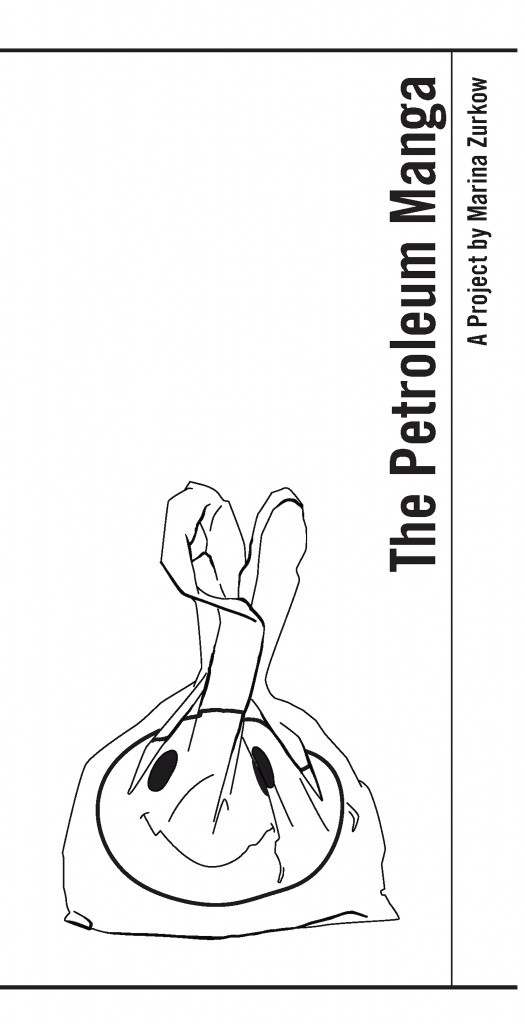
| Title | The Petroleum Manga |
|---|---|
| Subtitle | A Project by Marina Zurkow |
| Contributor | Valerie Vogrin (editor) |
| Marina Zurkow (editor) | |
| Marina Zurkow (illustrator) | |
| DOI | https://doi.org/10.21983/P3.0062.1.00(opens in new tab) |
| Landing page | https://punctumbooks.com/titles/petroleum-manga/(opens in new tab) |
| License | https://creativecommons.org/licenses/by-nc-sa/3.0/(opens in new tab) |
| Copyright | Zurkow, Marina |
| Publisher | punctum books |
| Publication place | Brooklyn, NY |
| Published on | 2014-02-25 |
| ISBN | 978-0-615-96596-3 (Paperback) |
| Long abstract | The Petroleum Manga, first conceived of and rendered as 10-foot banners printed on Tyvek for gallery installation(opens in new tab) is now reproduced in book form. Originally, manga was used in Japanese to refer to whimsical drawings or picture books. Long before manga was a multi-billion-dollar-a-year comic book industry, there was Hokusai’s thirteen-volume manga, depicting everything from trees to demons, from squirrels to shingles. This was the work that inspired the form for Marina Zurkow’s own crazy amalgam depicting a taxonomy of products derived from petroleum. Remaining true to this inspiration, this book compiles a curious array of imaginative-philosophical texts by a variety of poets, fiction writers, and theorists illuminating, illustrating, fabulating, and riffing upon a wide range of petrochemical-based objects and ideas. This “collection” maps new webs of relations between us and these seemingly ubiquitous yet often unremarked objects, along the lines of a fanciful petro-poetics. Fanciful, yet dead serious. As Duncan Murrell writes, “our plastics will live forever, no longer able to decompose, while we become molecules again. When we are long gone, there will still be plastic clown masks circling in the Pacific Ocean. This, and not our great works of art and literature, will be the persistent legacy of life on earth, these objects crafted out of life’s own ancient flesh.” |
| Print length | 172 pages |
| Language | English (Original) |
| Dimensions | 152 x 297 mm | 5.98" x 11.69" (Paperback) |
| THEMA |
|
| BIC |
|
| BISAC |
|
| Keywords |
|
Contents
- Duncan Murrell
- Melissa Kwansy
- Hali Felt
- Lucy Corin
- Maureen N. McLane
- Matt Dube
- Lucy Corin
- Max Liboirin
- Derek Woods
- Susan Squier
- Elizabeth Crane
- Lucy Corin
- Lydia Millet
- Rachel Cantor
- Lucy Corin
- Una Chaudhuri
- K.A. Hays
- Melissa Kwansy
- Elena Glasberg
- James Grinwis
- Joseph Campana
- Nancy Hechinger
- Christine Hume
- Cecily Parks
- Kellie Wells
- Lucy Corin
- Lucy Corin
- Timothy Morton
- Michael Mejia
- Doug Watson
- Gabriel Fried
- Ruth Ozeki
- Nicole Walker
- Abigail Simon
- Oliver Kelhammer
- Seth Horowitz
- Oliver Kelhammer
- David M. Johns
- Valerie Vogrin
- James Grinwis
- Melissa Kwansy
- Jamie "Skye" Bianco
- Marina Zurkow
Contributors
Valerie Vogrin
(editor)Valerie Vogrin is the author of the novel Shebang (University Press of Mississippi, 2004). Her short stories have appeared in Ploughshares, AGNI, The Florida Review, Natural Bridge, Black Warrior Review, and Esquire, among other publications, and she is also the winner of a 2011 Pushcart Prize. She is currently an associate professor of English at Southern Illinois University Edwardsville, where she also serves as prose editor of Sou’wester and Director of Peanut Books.
Marina Zurkow
(editor)Crossing multiple disciplines with her practice, Marina Zurkow(opens in new tab) builds animations and participatory environments that are centered on humans and their relationship to animals, plants and the weather. Engaging audiences using film and video, sculpture, print graphics and public interventions, Zurkow’s work is by turns humorous and contemplative. Through the experience of her projects it is clear that nature has long been a stage upon which we project ourselves, making ourselves other. Marina Zurkow is the recipient of a 2011 John Simon Guggenheim Memorial Fellowship. She has also been granted awards from the New York Foundation for the Arts, New York State Council for the Arts, the Rockefeller Foundation, and Creative Capital. She is on faculty at NYU’s Interactive Technology Program (ITP), and lives in Brooklyn, New York.
Marina Zurkow
(illustrator)Crossing multiple disciplines with her practice, Marina Zurkow(opens in new tab) builds animations and participatory environments that are centered on humans and their relationship to animals, plants and the weather. Engaging audiences using film and video, sculpture, print graphics and public interventions, Zurkow’s work is by turns humorous and contemplative. Through the experience of her projects it is clear that nature has long been a stage upon which we project ourselves, making ourselves other. Marina Zurkow is the recipient of a 2011 John Simon Guggenheim Memorial Fellowship. She has also been granted awards from the New York Foundation for the Arts, New York State Council for the Arts, the Rockefeller Foundation, and Creative Capital. She is on faculty at NYU’s Interactive Technology Program (ITP), and lives in Brooklyn, New York.