
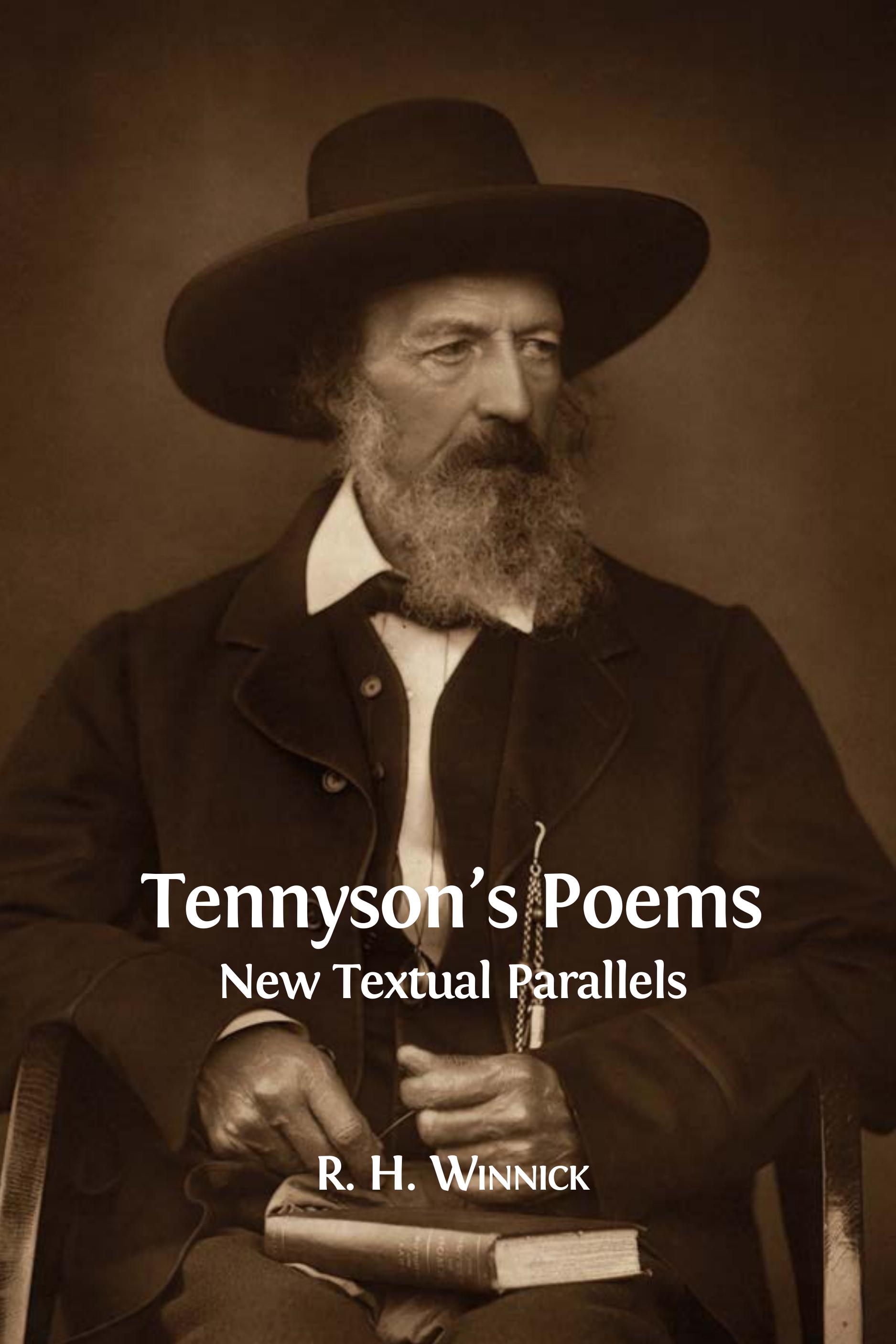
| Title | Tennyson’s Poems |
|---|---|
| Subtitle | New Textual Parallels |
| Contributor | R. H. Winnick(opens in new tab)(author) |
| DOI | https://doi.org/10.11647/OBP.0161(opens in new tab) |
| Landing page | https://www.openbookpublishers.com/books/10.11647/obp.0161(opens in new tab) |
| License | http://creativecommons.org/licenses/by/4.0/(opens in new tab) |
| Copyright | R. H. Winnick |
| Publisher | Open Book Publishers |
| Publication place | Cambridge, UK |
| Published on | 2019-04-18 |
| ISBN | 978-1-78374-661-3 (Paperback) |
| 978-1-78374-662-0 (Hardback) | |
| 978-1-78374-663-7 (PDF) | |
| 978-1-80064-579-0 (HTML) | |
| 978-1-78374-666-8 (XML) | |
| 978-1-78374-664-4 (EPUB) | |
| 978-1-78374-665-1 (MOBI) | |
| Short abstract | In Tennyson’s Poems: New Textual Parallels, R. H. Winnick identifies more than a thousand previously unknown instances in which Tennyson phrases of two or three to as many as several words are similar or identical to those occurring in prior works by other hands—discoveries aided by the proliferation of digitized texts and the related development of powerful search tools over the three decades since the most recent major edition of Tennyson’s poems was published. |
| Long abstract | In Tennyson’s Poems: New Textual Parallels, R. H. Winnick identifies more than a thousand previously unknown instances in which Tennyson phrases of two or three to as many as several words are similar or identical to those occurring in prior works by other hands—discoveries aided by the proliferation of digitized texts and the related development of powerful search tools over the three decades since the most recent major edition of Tennyson’s poems was published. Each of these instances may be deemed an allusion (meant to be recognized as such and pointing, for definable purposes, to a particular antecedent text), an echo (conscious or not, deliberate or not, meant to be noticed or not, meaningful or not), or merely accidental. Unless accidental, Winnick writes, these new textual parallels significantly expand our knowledge both of Tennyson’s reading and of his thematic intentions and artistic technique. Coupled with the thousand-plus textual parallels previously reported by Christopher Ricks and other scholars, he says, they suggest that a fundamental and lifelong aspect of Tennyson’s art was his habit of echoing any work, ancient or modern, which had the potential to enhance the resonance or deepen the meaning of his poems. The new textual parallels Winnick has identified point most often to the King James Bible and to such canonical authors as Shakespeare, Milton, Dryden, Pope, Thomson, Cowper, Shelley, Byron, and Wordsworth. But they also point to many authors rarely if ever previously cited in Tennyson editions and studies, including Michael Drayton, Richard Blackmore, Isaac Watts, Erasmus Darwin, John Ogilvie, Anna Lætitia Barbauld, Letitia Elizabeth Landon, John Wilson, and—with surprising frequency—Felicia Hemans. Tennyson’s Poems: New Textual Parallels is thus a major new resource for Tennyson scholars and students, an indispensable adjunct to the 1987 edition of Tennyson’s complete poems edited by Christopher Ricks. |
| Print length | 308 pages (xii + 296) |
| Language | English (Original) |
| Dimensions | 156 x 16 x 234 mm | 6.14" x 0.65" x 9.21" (Paperback) |
| 156 x 19 x 234 mm | 6.14" x 0.75" x 9.21" (Hardback) | |
| Weight | 966g | 34.07oz (Paperback) |
| 1350g | 47.62oz (Hardback) | |
| OCLC Number | 1101155078 |
| LCCN | 2019452969 |
| BIC |
|
| BISAC |
|
| LCC |
|
| Keywords |
|
Contents
- R. H. Winnick
- R. H. Winnick
Contributors
R. H. Winnick
(author)R. H. Winnick earned his Ph.D. in English and American Literature from Princeton University in 1976, receiving dissertation credit for his co-authorship, as a graduate student, of Robert Frost: The Later Years, 1938–1963 (Holt, Rinehart and Winston, 1977), vol. 3 of the late Lawrance Thompson’s Pulitzer Prize-winning (for vol. 2) ‘official’ Frost biography. He next researched an authorized biography of the American poet, playwright, educator, journalist, and statesman Archibald MacLeish, and edited Letters of Archibald MacLeish, 1907 to 1982 (Houghton Mifflin, 1983). Winnick’s next book, Tennyson’s Poems: New Textual Parallels, published in 2019 by Open Book Publishers, documented more than a thousand previously unrecognized, unidentified, or misidentified textual parallels in the work of that poet, and has since been accessed online or downloaded more than thirty thousand times. He has also published sixteen article-length studies on Chaucer, Sidney, Shakespeare, Melville, Clough, Hardy, and Larkin, appearing in, among other journals, The Chaucer Review, Nineteenth-Century Literature, Literary Imagination, The Hardy Review, and About Larkin.