
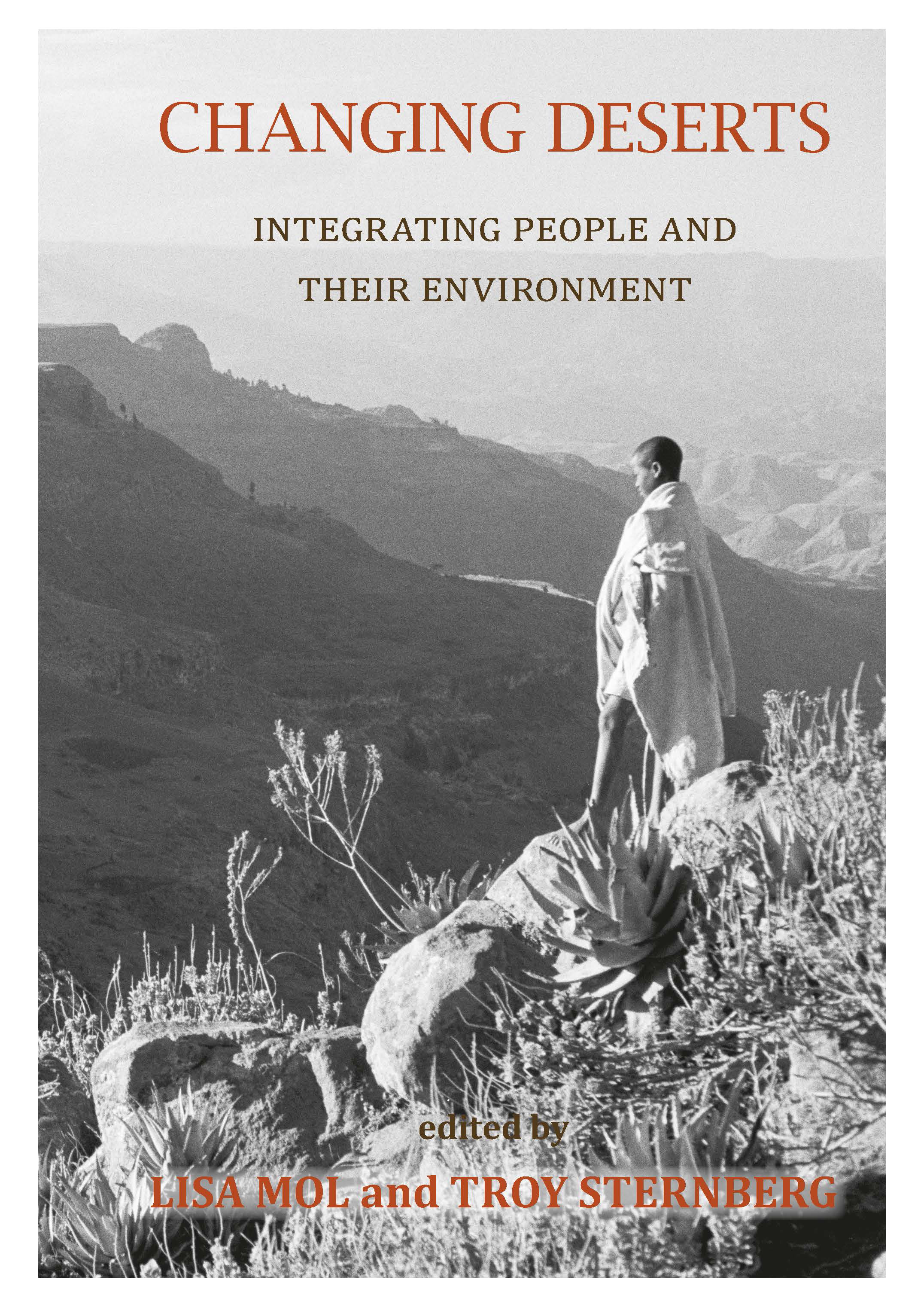
| Title | Changing Deserts |
|---|---|
| Subtitle | Integrating People and their Environment |
| Contributor | Lisa Mol(opens in new tab)(editor) |
| Troy Sternberg (editor) | |
| DOI | https://doi.org/10.3197/9781912186310.book(opens in new tab) |
| Landing page | https://www.whpress.co.uk/publications/2012/03/30/changing-deserts/(opens in new tab) |
| License | https://creativecommons.org/licenses/by-nc-nd/4.0/(opens in new tab) |
| Copyright | The White Horse Press |
| Publisher | The White Horse Press |
| Publication place | Winwick, UK |
| Published on | 2012-03-30 |
| ISBN | 978-1-874267-69-0 (Hardback) |
| 978-1-912186-31-0 (PDF) | |
| Short abstract | This volume draws on the diversity of papers presented to give an overview of current research in deserts and drylands. Readers are invited to explore the wide range of desert environments and peoples and the ever-evolving challenges they face. |
| Long abstract | Deserts – vast, empty places where time appears to stand still. The very word conjures images of endless seas of sand, blistering heat and a virtual absence of life. However, deserts encompass a large variety of landscapes and life beyond our stereotypes. As well as magnificent Saharan dunes under blazing sun, the desert concept encompasses the intensely cold winters of the Gobi, the snow-covered expanse of Antarctica and the rock-strewn drylands of Pakistan. Deserts are environments in perpetual flux and home to peoples as diverse as their surroundings, peoples who grapple with a broad spectrum of cultural, political and environmental issues as they wrest livelihoods from marginal lands. The cultures, environments and histories of deserts, while fundamentally entangled, are rarely studied as part of a network. To bring different disciplines together, the 1st Oxford Interdisciplinary Deserts Conference in March 2010 brought together a wide range of researchers from backgrounds as varied as physics, history, archaeology anthropology, geology and geography. This volume draws on the diversity of papers presented to give an overview of current research in deserts and drylands. Readers are invited to explore the wide range of desert environments and peoples and the ever-evolving challenges they face. |
| Print length | 346 pages |
| Language | English (Original) |
| Dimensions | 152 x 229 mm | 5.98" x 9.02" (Hardback) |
| Weight | 678g | 23.92oz (Hardback) |
| Media | 70 illustrations |
| 13 tables | |
| BIC |
|
| BISAC |
|
| Keywords |
|
| Funding |
Contents
- James Blinkhorn
Contributors
Lisa Mol
(editor)Lisa Mol is a Research Associate at the School of Geography and the Environment, Oxford University. She is a stone weathering geomorphologist and has conducted research on the weathering of Rock Art in South Africa. She currently researches the effect of armed warfare on fragile immovable heritage in Eastern Europe and the Middle East.
Troy Sternberg
(editor)Troy Sternberg is a researcher at the School of Geography, Oxford University. His research focus is on natural hazards, environmental processes, the effectiveness of traditional nomadic strategies and the comparative ecological impact of livelihoods across the Asian steppe. In Mongolia his interest is in developing rural water access, quantifying drought and degradation and placing Mongolian pastoralism and the Gobi environment in a broader global context.