
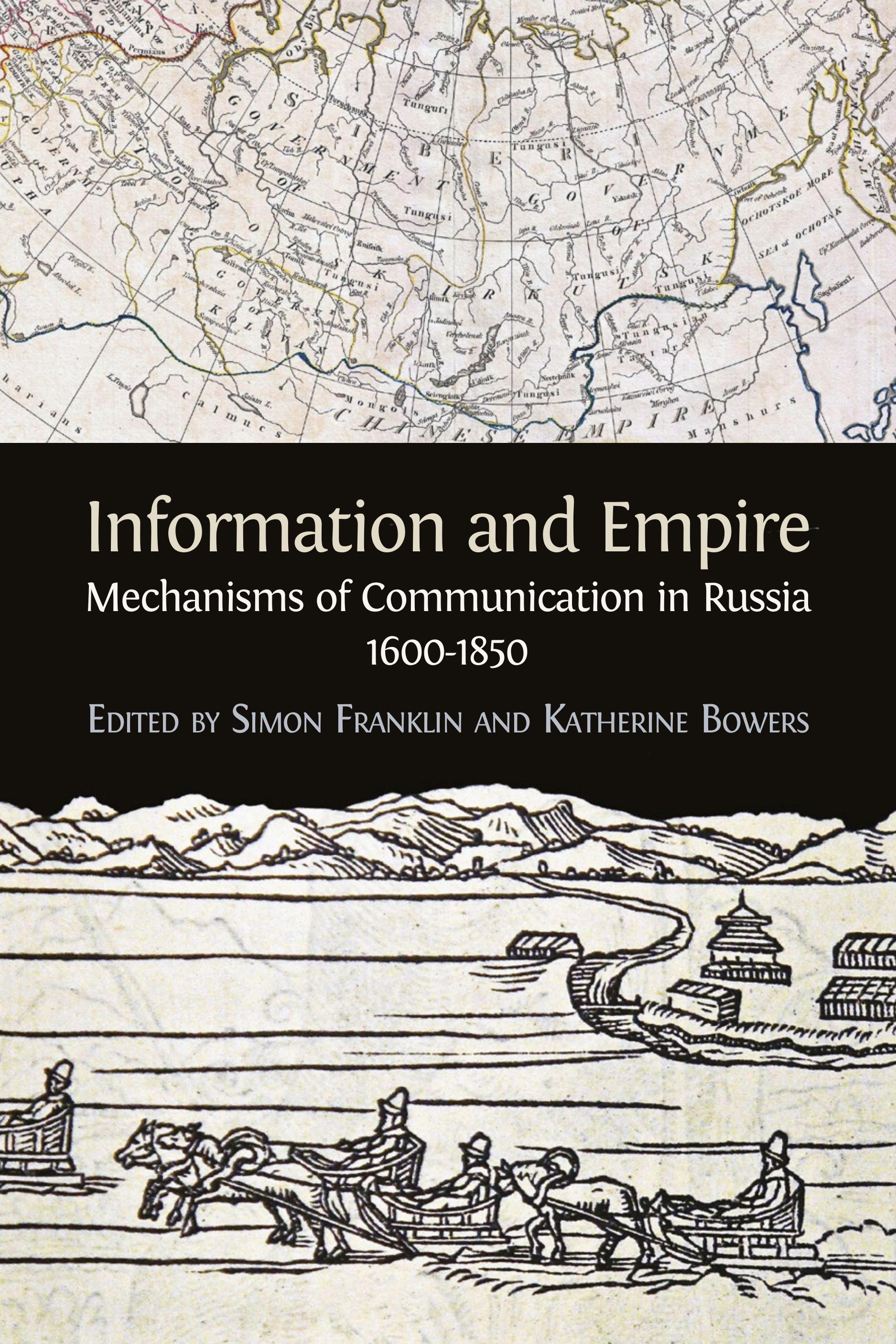
| Title | Information and Empire |
|---|---|
| Subtitle | Mechanisms of Communication in Russia, 1600-1854 |
| Contributor | Simon Franklin(opens in new tab)(editor) |
| Katherine Bowers(opens in new tab)(editor) | |
| DOI | https://doi.org/10.11647/OBP.0122(opens in new tab) |
| Landing page | https://www.openbookpublishers.com/books/10.11647/obp.0122(opens in new tab) |
| License | http://creativecommons.org/licenses/by/4.0/(opens in new tab) |
| Copyright | Simon Franklin; Katherine Bowers; Copyright of each chapter is maintained by the author. |
| Publisher | Open Book Publishers |
| Publication place | Cambridge, UK |
| Published on | 2017-11-27 |
| ISBN | 978-1-78374-373-5 (Paperback) |
| 978-1-78374-374-2 (Hardback) | |
| 978-1-78374-375-9 (PDF) | |
| 978-1-80064-541-7 (HTML) | |
| 978-1-78374-452-7 (XML) | |
| 978-1-78374-376-6 (EPUB) | |
| 978-1-78374-377-3 (MOBI) | |
| Short abstract | From the mid-sixteenth to the mid-nineteenth century Russia was transformed from a moderate-sized, land-locked principality into the largest empire on earth. How did systems of information and communication shape and reflect this extraordinary change? Information and Mechanisms of Communication in Russia, 1600-1850 brings together a range of contributions to shed some light on this complex question. More than a series of institutional histories, this book is concerned with the way Russia discovered itself, envisioned itself and represented itself to its people. |
| Long abstract | From the mid-sixteenth to the mid-nineteenth century Russia was transformed from a moderate-sized, land-locked principality into the largest empire on earth. How did systems of information and communication shape and reflect this extraordinary change? Information and Mechanisms of Communication in Russia, 1600-1850 brings together a range of contributions to shed some light on this complex question. Communication networks such as the postal service and the gathering and circulation of news are examined alongside the growth of a bureaucratic apparatus that informed the government about its country and its people. The inscription of space is considered from the point of view of mapping and the changing public ‘graphosphere’ of signs and monuments. More than a series of institutional histories, this book is concerned with the way Russia discovered itself, envisioned itself and represented itself to its people. Innovative and scholarly, this collection breaks new ground in its approach to communication and information as a field of study in Russia. More broadly, it is an accessible contribution to pre-modern information studies, taking as its basis a country whose history often serves to challenge habitual Western models of development. It is important reading not only for specialists in Russian Studies, but also for students and non-Russianists who are interested in the history of information and communications. |
| Print length | 440 pages (vi + 436) |
| Language | English (Original) |
| Dimensions | 156 x 23 x 234 mm | 6.14" x 0.90" x 9.21" (Paperback) |
| 156 x 25 x 234 mm | 6.14" x 1" x 9.21" (Hardback) | |
| Weight | 1365g | 48.15oz (Paperback) |
| 1757g | 61.98oz (Hardback) | |
| Media | 48 illustrations |
| 2 tables | |
| OCLC Number | 1167489297 |
| LCCN | 2017433308 |
| BIC |
|
| BISAC |
|
| LCC |
|
| Keywords |
|
Contents
- Simon Franklin
- Early Mapping: The Tsardom in Manuscript
- Valerie Kivelson
- New Technology and the Mapping of Empire: The Adoption of the Astrolabe
- Aleksei Golubinskii
- Muscovy and the European Information Revolution: Creating the Mechanisms for Obtaining Foreign News
- Daniel C. Waugh
- Ingrid Maier
- How Was Western Europe Informed about Muscovy? The Razin Rebellion in Focus
- Ingrid Maier
- Communication and Obligation: The Postal System of the Russian Empire, 1700–1850
- John Randolph
- Information and Efficiency: Russian Newspapers, ca.1700–1850
- Alison K. Smith
- What Was News and How Was It Communicated in Pre-Modern Russia?
- Daniel C. Waugh
- Bureaucracy and Knowledge Creation: The Apothecary Chancery
- Clare Griffin
- What Could the Empress Know About Her Money? Russian Poll Tax Revenues in the Eighteenth Century
- Elena Korchmina
- Communication and Official Enlightenment: The Journal of the Ministry of Public Education, 1834–1855
- Ekaterina Basargina
- Information in Plain Sight: The Formation of the Public Graphosphere
- Simon Franklin
- Experiencing Information: An Early Nineteenth-Century Stroll Along Nevskii Prospekt
- Katherine Bowers
Contributors
Simon Franklin
(editor)Simon Franklin is Professor of Slavonic Studies at the University of Cambridge and a Fellow of Clare College, Cambridge. He has written widely on the history and culture of early Rus, Muscovy and Russia. Books include The Emergence of Rus 700–1200 (1996, with Jonathan Shepard), Writing, Society and Culture in Early Rus, c. 950–1300 (2002), and National Identity in Russian Culture: an Introduction (2004, ed., with Emma Widdis). His recent research has focussed on the social and cultural history of technologies of the word in Russia in the late medieval and early modern periods (ca.1450–1850).
Katherine Bowers
(editor)Katherine Bowers is an Assistant Professor of Slavic Studies at the University of British Columbia. Her research interest is nineteenth-century Russian literature and cultural history, and she is currently working on a book about the influence of gothic fiction on Russian realism. Other publications include Russian Writers at the Fin de Siècle: The Twilight of Realism (2015, ed., with A. Kokobobo) and A Dostoevskii Companion: Texts and Contexts (forthcoming 2018, eds., with C. Doak and K. Holland). From 2012–14 she was Research Associate on the project, "Information Technologies in Russia, 1450–1850", led by Simon Franklin, and a Research Fellow of Darwin College, Cambridge.