
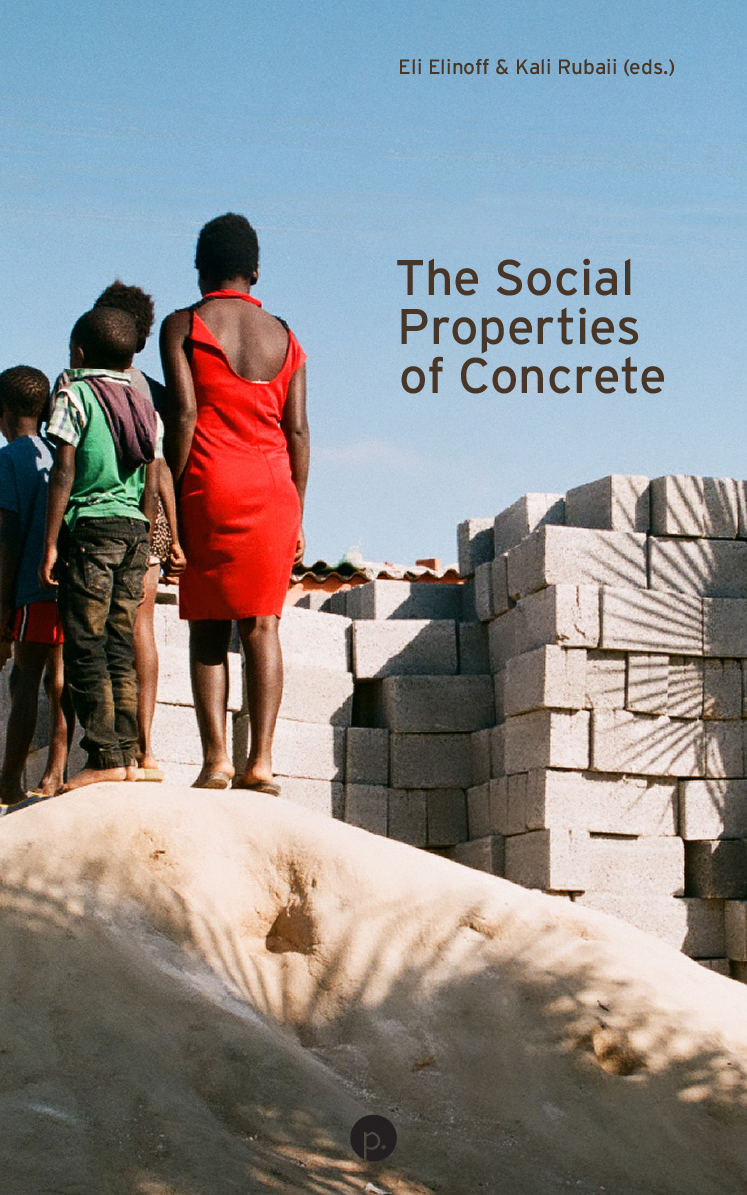
| Title | The Social Properties of Concrete |
|---|---|
| Contributor | Eli Elinoff(opens in new tab)(editor) |
| Kali Rubaii(opens in new tab)(editor) | |
| DOI | https://doi.org/10.53288/0405.1.00(opens in new tab) |
| Landing page | https://punctumbooks.com/titles/the-social-properties-of-concrete/(opens in new tab) |
| License | https://creativecommons.org/licenses/by-nc-sa/4.0/(opens in new tab) |
| Copyright | Eli Elinoff and Kali Rubaii |
| Publisher | punctum books |
| Publication place | Earth, Milky Way |
| Published on | 2025-05-09 |
| ISBN | 978-1-68571-248-8 (Paperback) |
| 978-1-68571-249-5 (PDF) | |
| Long abstract | Concrete is a ubiquitous part of our world. It composes our dwellings and shapes our infrastructures. It unites and divides urban space and is used to wage both war and peace. Concrete is simultaneously an indicator of freedom and development and is an essential part of the carceral apparatus. The Social Properties of Concrete begins from the premise that concrete is as richly social as it is densely material. Just as concrete’s materiality permeates our everyday life, our political projects, social practices, religious concepts, environmental transformations, and ethical questions suffuse concrete structures. Like concrete itself,* The Social Properties of Concrete* is an aggregate: it draws together essays by social scientists, historians, architects, artists, and urban planners who each blend social theory, material science, and empirical analysis to explore the ways in which social life is embedded within concrete and to inquire about how concrete shapes social life. Across forty globally situated chapters, these essays open new conversations around our relationships with anthropogenic stone and serve as a teachable introduction to the social and political lives of materials. By taking this approach, this volume develops a conceptual language and methodological approach that should inform new understandings of material politics and our built environment. The social properties of concrete are neither metaphors nor are they simple reflections of the social. Instead, they are modes of materially enacting social, economic, and political life itself. |
| Print length | 478 pages |
| Language | English (Original) |
| Dimensions | 127 x 27 x 203 mm | 5" x 1.08" x 8" (Paperback) |
| Weight | 603g | 21.28oz (Paperback) |
| LCCN | 2025931525 |
| THEMA |
|
| BISAC |
|
| Keywords |
|
| Funding |
|
Contents
- Eli Elinoff
- Kali Rubaii
- Eli Elinoff
- Penny Harvey
- Constance Smith
- Claudia Gastrow
- Malini Sur
- Austin Zeiderman
- Pinai Sirikiatikul
- Cassandra Hartblay
- Rachel Cypher
- Tim Oakes
- Matt Edgeworth
- Lukas Ley
- Greg Dvorak
- Nasser Abourahme
- Denis Byrne
- Vanessa Lamb
- Mona Chettri
- Rebecca Bowers
- Erik Harms
- Rosalie Stolz
- Rowan McCormick
- Siddharth Menon
- Heid Jerstad
- Naomi Haynes
- Matthew Gandy
- Elihu Rubin
- Julie Soleil Archambault
- Gabriel Lee
- Marina Peterson
- Tyson Vaughan
- Tong Lam
- Emily Brownell
- Lila Sharif
- Duncan McDuie-Ra
- Diana Martinez
- Christina Schwenkel
- Cristián Simonetti
- Jerome Whitington
- Mo H. Zareei
- Kali Rubaii
Contributors
Eli Elinoff
(editor)Eli Elinoff is a Senior Lecturer of Cultural Anthropology at Victoria University of Wellington. His research explores the intersection between politics, urbanization, and environmental transformation in Southeast Asia. He is the author of Citizen Designs: City-Making and Democracy in Northeastern Thailand (Hawai‘i, 2021).
Kali Rubaii
(editor)Kali Rubaii is Assistant Professor of Anthropology at Purdue University. Her research explores the environmental impacts of warfare in Iraq. Taking toxicity as an analytic for material politics, her current book project examines how farmers in Anbar, Iraq struggle to survive and recover from transnational counterinsurgency projects. Her next project explores how the concrete industry in post-invasion Iraq enforces global regimes of race, class, and environmental degradation.
References
- (opens in new tab)
- (opens in new tab)
- (opens in new tab)
- (opens in new tab)
- (opens in new tab)
- (opens in new tab)
- (opens in new tab)
- (opens in new tab)
- (opens in new tab)
- (opens in new tab)
- (opens in new tab)
- (opens in new tab)
- (opens in new tab)
- (opens in new tab)
- (opens in new tab)
- (opens in new tab)
- (opens in new tab)
- (opens in new tab)
- (opens in new tab)
- (opens in new tab)
- (opens in new tab)
- (opens in new tab)
- (opens in new tab)
- (opens in new tab)
- (opens in new tab)
- (opens in new tab)
- (opens in new tab)
- (opens in new tab)
- (opens in new tab)
- (opens in new tab)
- (opens in new tab)
- (opens in new tab)
- (opens in new tab)
- (opens in new tab)
- (opens in new tab)
- (opens in new tab)
- (opens in new tab)
- (opens in new tab)
- (opens in new tab)
- (opens in new tab)
- (opens in new tab)
- (opens in new tab)
- (opens in new tab)
- (opens in new tab)
- (opens in new tab)
- (opens in new tab)
- (opens in new tab)
- (opens in new tab)
- (opens in new tab)
- (opens in new tab)
- (opens in new tab)
- (opens in new tab)
- (opens in new tab)
- (opens in new tab)
- (opens in new tab)
- (opens in new tab)
- (opens in new tab)
- (opens in new tab)
- (opens in new tab)
- (opens in new tab)
- (opens in new tab)
- (opens in new tab)
- (opens in new tab)
- (opens in new tab)
- (opens in new tab)
- (opens in new tab)
- (opens in new tab)
- (opens in new tab)
- (opens in new tab)
- (opens in new tab)
- (opens in new tab)
- (opens in new tab)
- (opens in new tab)
- (opens in new tab)
- (opens in new tab)
- (opens in new tab)
- (opens in new tab)
- (opens in new tab)
- (opens in new tab)
- (opens in new tab)
- (opens in new tab)
- (opens in new tab)
- (opens in new tab)
- (opens in new tab)
- (opens in new tab)
- (opens in new tab)
- (opens in new tab)
- (opens in new tab)
- (opens in new tab)
- (opens in new tab)
- (opens in new tab)
- (opens in new tab)
- (opens in new tab)
- (opens in new tab)
- (opens in new tab)
- (opens in new tab)
- (opens in new tab)
- (opens in new tab)
- (opens in new tab)
- (opens in new tab)
- (opens in new tab)
- (opens in new tab)
- (opens in new tab)
- (opens in new tab)
- (opens in new tab)
- (opens in new tab)
- (opens in new tab)
- (opens in new tab)
- (opens in new tab)
- (opens in new tab)
- (opens in new tab)
- (opens in new tab)
- (opens in new tab)
- (opens in new tab)
- (opens in new tab)
- (opens in new tab)
- (opens in new tab)
- (opens in new tab)
- (opens in new tab)
- (opens in new tab)
- (opens in new tab)
- (opens in new tab)
- (opens in new tab)
- (opens in new tab)
- (opens in new tab)
- (opens in new tab)
- (opens in new tab)
- (opens in new tab)
- (opens in new tab)
- (opens in new tab)
- (opens in new tab)
- (opens in new tab)
- (opens in new tab)
- (opens in new tab)
- (opens in new tab)
- (opens in new tab)
- (opens in new tab)
- (opens in new tab)
- (opens in new tab)
- (opens in new tab)
- (opens in new tab)
- (opens in new tab)
- (opens in new tab)
- (opens in new tab)
- (opens in new tab)
- (opens in new tab)
- (opens in new tab)
- (opens in new tab)
- (opens in new tab)
- (opens in new tab)
- (opens in new tab)
- (opens in new tab)
- (opens in new tab)
- (opens in new tab)
- (opens in new tab)
- (opens in new tab)
- (opens in new tab)
- (opens in new tab)
- (opens in new tab)
- (opens in new tab)
- (opens in new tab)