
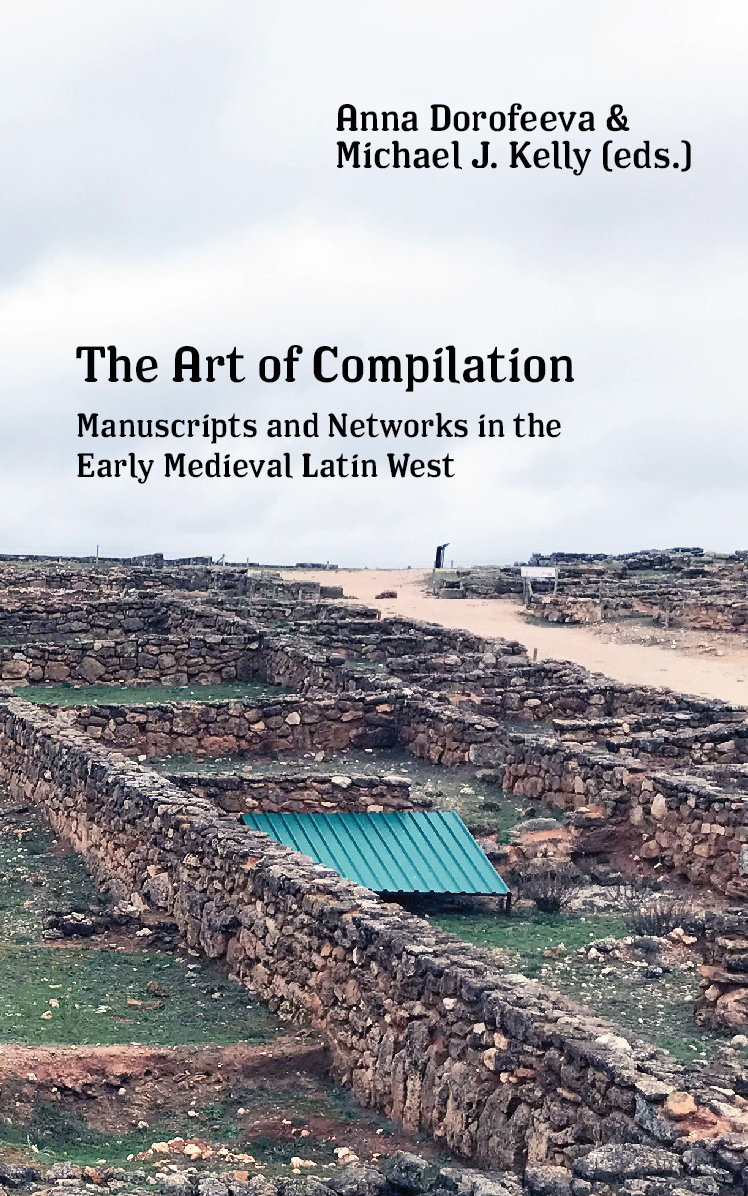
| Title | The Art of Compilation |
|---|---|
| Subtitle | Manuscripts and Networks in the Early Medieval Latin West |
| Contributor | Anna Dorofeeva(opens in new tab)(editor) |
| Michael J. Kelly (editor) | |
| DOI | https://doi.org/10.53288/0494.1.00(opens in new tab) |
| Landing page | https://punctumbooks.com/titles/the-art-of-compilation-manuscripts-and-networks-in-the-early-medieval-latin-west/(opens in new tab) |
| License | https://creativecommons.org/licenses/by-nc-sa/4.0/(opens in new tab) |
| Copyright | Anna Dorofeeva & Michael J. Kelly |
| Publisher | punctum books |
| Publication place | Earth, Milky Way |
| Published on | 2025-03-04 |
| ISBN | 978-1-68571-158-0 (Paperback) |
| 978-1-68571-159-7 (PDF) | |
| Long abstract | The Art of Compilation: Manuscripts and Networks in the Early Medieval Latin West interrogates the medieval manuscript book as a dynamic, constantly changing object entangled in intellectual and cultural networks, constructed and deconstructed by different people, and transmuting in form and meaning over time. Medieval manuscripts are not static, permanently bound, and delimited, but rather serve as evidence for the layered relationships between texts and their material supports, and when we realize that, we gain a clearer view of medieval manuscript culture as driven by the agency and intellectual exchange of the people behind it. This volume of essays investigates early medieval Western European manuscript culture as a field of entangled objects, focusing on the connections between knowledge selection, material representation, and scribal agency. The complex road of compiling selected texts into manuscripts (compilatio) in the early Middle Ages is still not well understood, yet it is the key to the historical context surrounding medieval manuscript culture. The practice of knowledge selection consisted of three key stages: the intellectual selection of the textual content of manuscript collections; the pragmatic action of arranging the textual content in a draft form by authors or editors; and the material representation and aesthetic exposition of texts in manuscripts. These stages were part of a linear development, but also exercised reciprocal influence upon one another. By tracing this process in surviving manuscript collections, we can better understand in what practical ways knowledge was encoded and how these often innovative and experimental practices contributed to the emergence and consolidation of intellectual and scribal traditions. This has important implications for how we understand education, reform, and the exercise of power in the early Middle Ages. |
| Print length | 454 pages |
| Language | English (Original) |
| Dimensions | 127 x 26 x 203 mm | 5" x 1.03" x 8" (Paperback) |
| Weight | 576g | 20.32oz (Paperback) |
| LCCN | 2024945178 |
| THEMA |
|
| BIC |
|
| BISAC |
|
| Keywords |
|
Contents
- Michael J. Kelly
- Anna Dorofeeva
- Michael Eber
- Lucia Castaldi
- Laura Pani
- Sinéad O’Sullivan
- Evina Stein
- Cinzia Grifoni
- Thom Gobbitt
- Mark Stansbury
- Elizabeth P. Archibald
- Anna Dorofeeva
- Mariken Teeuwen
Contributors
Anna Dorofeeva
(editor)Anna Dorofeeva is a Lecturer in Digital Paleography at the Institute for Digital Humanities, University of Göttingen. She has held research fellowships at the University of Frankfurt, University College Dublin, the University of Durham, and the Free University of Berlin. Her research interests center on early medieval book history, especially digital paleography and codicology.
Michael J. Kelly
(editor)Michael J. Kelly lectures in history, critical theory, and the philosophy of history at Binghamton University (SUNY) and is Director of Networks and Neighbours(opens in new tab) and Co-Director of Gracchi Books(opens in new tab). His publications include Isidore of Seville and the “Liber Iudiciorum”: The Struggle for the Past in the Visigothic Kingdom (Brill, 2021) and Theories of History: History Read Across the Humanities (Bloomsbury, 2018). He is currently preparing a monograph on the concept of “human nature” in Visigothic ontotheology.
References
- (opens in new tab)
- (opens in new tab)
- (opens in new tab)
- (opens in new tab)
- (opens in new tab)
- (opens in new tab)
- (opens in new tab)
- (opens in new tab)
- (opens in new tab)
- (opens in new tab)
- (opens in new tab)
- (opens in new tab)
- (opens in new tab)
- (opens in new tab)
- (opens in new tab)
- (opens in new tab)
- (opens in new tab)
- (opens in new tab)
- (opens in new tab)
- (opens in new tab)
- (opens in new tab)
- (opens in new tab)
- (opens in new tab)
- (opens in new tab)
- (opens in new tab)
- (opens in new tab)
- (opens in new tab)
- (opens in new tab)
- (opens in new tab)
- (opens in new tab)
- (opens in new tab)
- (opens in new tab)
- (opens in new tab)
- (opens in new tab)
- (opens in new tab)
- (opens in new tab)
- (opens in new tab)
- (opens in new tab)
- (opens in new tab)
- (opens in new tab)
- (opens in new tab)
- (opens in new tab)
- (opens in new tab)
- (opens in new tab)
- (opens in new tab)
- (opens in new tab)
- (opens in new tab)
- (opens in new tab)
- (opens in new tab)
- (opens in new tab)
- (opens in new tab)
- (opens in new tab)
- (opens in new tab)
- (opens in new tab)
- (opens in new tab)
- (opens in new tab)
- (opens in new tab)
- (opens in new tab)
- (opens in new tab)
- (opens in new tab)
- (opens in new tab)
- (opens in new tab)
- (opens in new tab)
- (opens in new tab)
- (opens in new tab)
- (opens in new tab)
- (opens in new tab)
- (opens in new tab)
- (opens in new tab)
- (opens in new tab)
- (opens in new tab)
- (opens in new tab)
- (opens in new tab)
- (opens in new tab)
- (opens in new tab)
- (opens in new tab)
- (opens in new tab)
- (opens in new tab)
- (opens in new tab)
- (opens in new tab)
- (opens in new tab)
- (opens in new tab)
- (opens in new tab)
- (opens in new tab)
- (opens in new tab)
- (opens in new tab)
- (opens in new tab)
- (opens in new tab)
- (opens in new tab)
- (opens in new tab)
- (opens in new tab)
- (opens in new tab)
- (opens in new tab)
- (opens in new tab)
- (opens in new tab)
- (opens in new tab)
- (opens in new tab)
- (opens in new tab)
- (opens in new tab)
- (opens in new tab)
- (opens in new tab)
- (opens in new tab)
- (opens in new tab)
- (opens in new tab)
- (opens in new tab)
- (opens in new tab)
- (opens in new tab)
- (opens in new tab)
- (opens in new tab)
- (opens in new tab)
- (opens in new tab)
- (opens in new tab)
- (opens in new tab)
- (opens in new tab)
- (opens in new tab)
- (opens in new tab)
- (opens in new tab)
- (opens in new tab)
- (opens in new tab)
- (opens in new tab)
- (opens in new tab)
- (opens in new tab)
- (opens in new tab)
- (opens in new tab)
- (opens in new tab)
- (opens in new tab)
- (opens in new tab)
- (opens in new tab)
- (opens in new tab)
- (opens in new tab)
- (opens in new tab)
- (opens in new tab)
- (opens in new tab)
- (opens in new tab)
- (opens in new tab)
- (opens in new tab)
- (opens in new tab)
- (opens in new tab)
- (opens in new tab)
- (opens in new tab)
- (opens in new tab)
- (opens in new tab)
- (opens in new tab)
- (opens in new tab)
- (opens in new tab)
- (opens in new tab)