
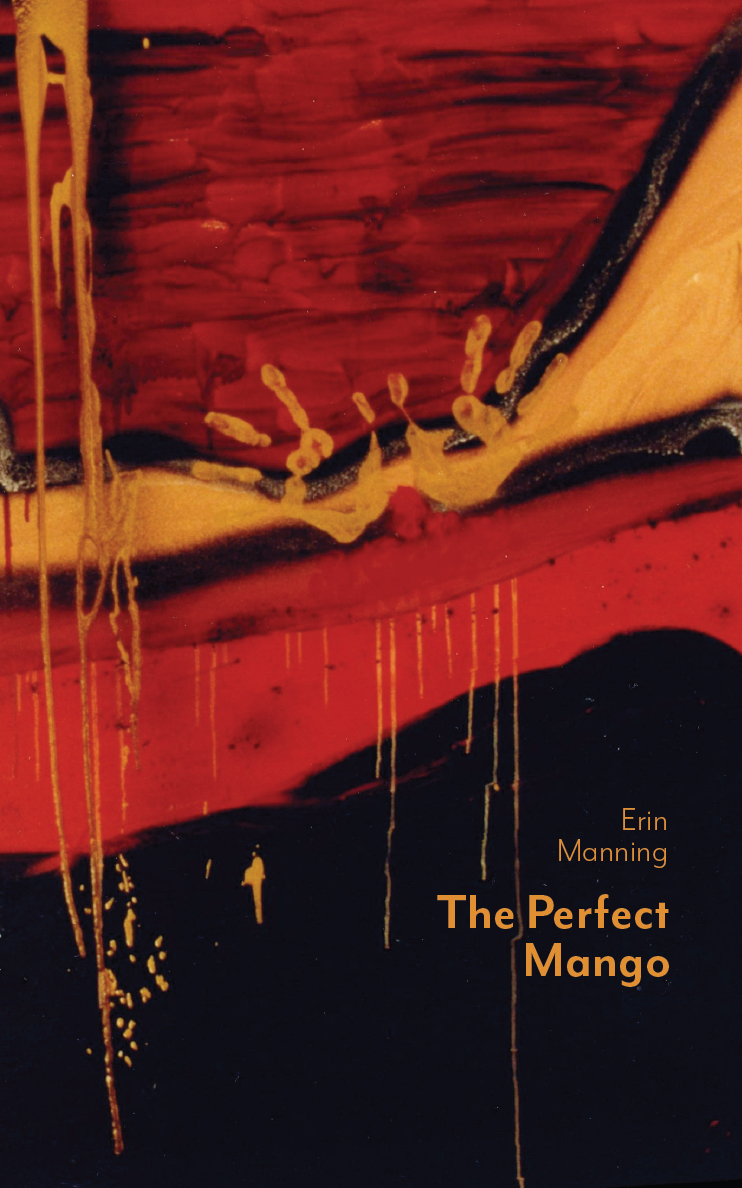
| Title | The Perfect Mango |
|---|---|
| Contributor | Erin Manning (author) |
| DOI | https://doi.org/10.21983/P3.0245.1.00(opens in new tab) |
| Landing page | https://punctumbooks.com/titles/the-perfect-mango/(opens in new tab) |
| License | https://creativecommons.org/licenses/by-nc-sa/4.0/(opens in new tab) |
| Copyright | Manning, Erin |
| Publisher | punctum books |
| Publication place | Earth, Milky Way |
| Published on | 2019-02-20 |
| ISBN | 978-1-950192-13-7 (Paperback) |
| 978-1-950192-14-4 (PDF) | |
| Long abstract | In 1994, at the age of twenty-five, when the “terrible brokenness that comes with sexual assault” was folded deep within her body and thoughts of suicide were always close by, Erin Manning wrote The Perfect Mango at an almost feverish pitch: nineteen chapters in nineteen days, a sort of self-rescue operation, where writing became a form of making (and feeling) life otherwise. Throughout those nineteen days, and although not able to fully articulate it to herself at the time, Manning wrote her way into a “composition that asks how else life might be lived.” And in the rhythms of that composition, which was also a living, Manning was, and is, able to refuse the category and norm and stillness of “victim” (while still understanding the inheritances of violence) in order to follow instead the more-than-I as well as the joy of the “more-than of experience in the making.” Twenty-five years later, Manning allows these earlier writings to find their way back into the world, which is also a way of giving “voice to those moments of messy survival” while also asking us, who share in (and help to bear) those moments as readers, to consider “other ways of listening to the urgency that is living.” To (re)publish the book now is to give it a place in the world in a way that honors its force as something that is always beyond anyone’s claim to it, even Manning’s. In this sense, The Perfect Mango invites us, with Manning, to be in excess of ourselves, and also to consider, in Manning’s words, “how to create conditions for living beyond humanism’s fierce belief that we, the privileged, the neurotypicals, the as-yet-unscathed, the able-bodied, hold the key to all perspectives in the theatre of living.” Ultimately, The Perfect Mango and Manning’s reflections on its composition ask us to consider living “in the fierce celebration of a world invented by those modes of life which tear at the colonial, white, neurotypical fabric of life as we know it.” |
| Print length | 156 pages |
| Language | English (Original) |
| Dimensions | 127 x 203 mm | 5" x 8" (Paperback) |
| LCCN | 2019932679 |
| THEMA |
|
| BIC |
|
| BISAC |
|
| Keywords |
|
Contributors
Erin Manning
(author)Erin Manning is a professor in the Faculty of Fine Arts at Concordia University (Montreal, Canada). She is also the founder of SenseLab(opens in new tab), a laboratory that explores the intersections between art practice and philosophy through the matrix of the sensing body in movement. Current art projects are focused around the concept of minor gestures in relation to colour and movement. Art exhibitions include the Sydney and Moscow Biennales, Glasshouse (New York), Vancouver Art Museum, McCord Museum (Montreal) and House of World Cultures (Berlin) and Galateca Gallery (Bucarest). Publications include For a Pragmatics of the Useless (Duke, forthcoming), The Minor Gesture (Duke, 2016), Always More Than One: Individuation’s Dance (Duke, 2013), Relationscapes: Movement, Art, Philosophy (MIT, 2009) and, with Brian Massumi, Thought in the Act: Passages in the Ecology of Experience (Minnesota, 2014).