
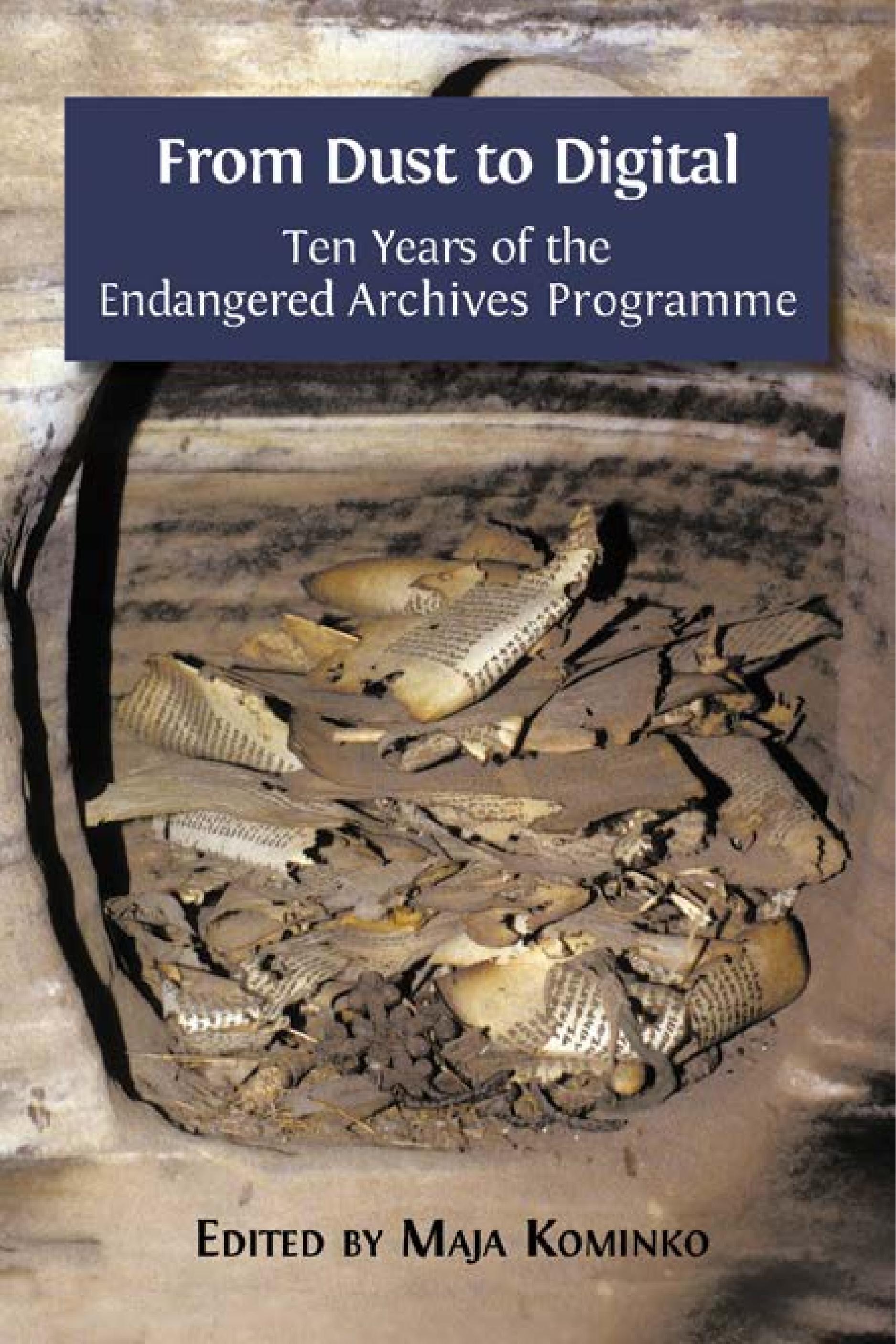
| Title | From Dust to Digital |
|---|---|
| Subtitle | Ten Years of the Endangered Archives Programme |
| Contributor | Maja Kominko (editor) |
| DOI | https://doi.org/10.11647/OBP.0052(opens in new tab) |
| Landing page | https://www.openbookpublishers.com/books/10.11647/obp.0052(opens in new tab) |
| License | http://creativecommons.org/licenses/by-nc-nd/4.0/(opens in new tab) |
| Copyright | Maja Kominko. Copyright of individual chapters is maintained by the chapters’ authors. |
| Publisher | Open Book Publishers |
| Publication place | Cambridge, UK |
| Published on | 2015-02-16 |
| ISBN | 978-1-78374-062-8 (Paperback) |
| 978-1-78374-063-5 (Hardback) | |
| 978-1-78374-064-2 (PDF) | |
| 978-1-80064-479-3 (HTML) | |
| 978-1-78374-065-9 (EPUB) | |
| 978-1-78374-066-6 (MOBI) | |
| Short abstract | Much of world’s documentary heritage rests in vulnerable, little-known and often inaccessible archives. Many of these archives preserve information that may cast new light on historical phenomena and lead to their reinterpretation. But such rich collections are often at risk of being lost before the history they capture is recorded. This volume celebrates the tenth anniversary of the Endangered Archives Programme at the British Library, established to document and publish online formerly inaccessible and neglected archives from across the globe. |
| Long abstract | Much of world’s documentary heritage rests in vulnerable, little-known and often inaccessible archives. Many of these archives preserve information that may cast new light on historical phenomena and lead to their reinterpretation. But such rich collections are often at risk of being lost before the history they capture is recorded. This volume celebrates the tenth anniversary of the Endangered Archives Programme at the British Library, established to document and publish online formerly inaccessible and neglected archives from across the globe. From Dust to Digital showcases the historical significance of the collections identified, catalogued and digitised through the Programme, bringing together articles on 19 of the 244 projects supported since its inception. These contributions demonstrate the range of materials documented — including rock inscriptions, manuscripts, archival records, newspapers, photographs and sound archives — and the wide geographical scope of the Programme. Many of the documents are published here for the first time, illustrating the potential these collections have to further our understanding of history. |
| Print length | 722 pages (lxviii + 654) |
| Language | English (Original) |
| Dimensions | 156 x 37 x 234 mm | 6.14" x 1.44" x 9.21" (Paperback) |
| 156 x 38 x 234 mm | 6.14" x 1.50" x 9.21" (Hardback) | |
| Weight | 2195g | 77.43oz (Paperback) |
| 2601g | 91.75oz (Hardback) | |
| Media | 230 illustrations |
| 18 tables | |
| 28 audio | |
| OCLC Number | 904562444 |
| BIC |
|
| BISAC |
|
| LCC |
|
| Keywords |
|
| Funding |
Contents
- The “written landscape” of the central Sahara: recording and digitising the Tifinagh inscriptions in the Tadrart Acacus Mountains
- Stefano Biagetti
- Ali Ait Kaci
- Savino di Lernia
- Metadata and endangered archives: lessons from the Ahom Manuscripts Project
- Stephen Morey
- Unravelling Lepcha manuscripts
- Heleen Plaisier
- Technological aspects of the monastic manuscript collection at May Wäyni, Ethiopia
- Jacek Tomaszewski
- Michael Gervers
- Localising Islamic knowledge: acquisition and copying of the Riyadha Mosque manuscript collection in Lamu, Kenya
- Anne K. Bang
- In the shadow of Timbuktu: the manuscripts of Djenné
- Sophie Sarin
- The first Gypsy/Roma organisations, churches and newspapers
- Elena Marushiakova
- Vesselin Popov
- Sacred boundaries: parishes and the making of space in the colonial Andes
- Gabriela Ramos
- Researching the history of slavery in Colombia and Brazil through ecclesiastical and notarial archives
- Jane Landers
- Pablo Gómez
- José Polo Acuña
- Courtney J. Campbell
- Convict labour in early colonial Northern Nigeria: a preliminary study
- Mohammed Bashir Salau
- Murid Ajami sources of knowledge: the myth and the reality
- Fallou Ngom
- Digitisation of Islamic manuscripts and periodicals in Jerusalem and Acre
- Qasem Abu Harb
- A charlatan’s album: cartes-devisite from Bolivia, Argentina and Paraguay (1860-1880)
- Irina Podgorny
- Hearing images, tasting pictures: making sense of Christian mission photography in the Lushai Hills district, Northeast India (1870-1920)
- Kyle Jackson
- The photographs of Baluev: capturing the “socialist transformation” of the Krasnoyarsk northern frontier, 1938-1939
- David G. Anderson
- Mikhail S. Batashev
- Craig Campbell
- Archiving a Cameroonian photographic studio
- David Zeitlyn
- Music for a revolution: the sound archives of Radio Télévision Guinée
- Graeme Counsel
- Conservation of the Iranian Golha radio programmes and the heritage of Persian classical poetry and music
- Jane Lewisohn
- The use of sound archives for the investigation, teaching and safeguarding of endangered languages in Russia
- Tjeerd de Graaf
- Victor Denisov
- Lisbet Rausing
- Peter Baldwin
- Barry Supple
- Anthea Case
- Maja Kominko
Contributors
Maja Kominko
(editor)Maja Kominko is a historian of late antiquity and Byzantium. Her research focuses on intellectual history. She held postdoctoral and academic positions at the University of York, Princeton University and the University of Oxford. She currently manages the cultural grants portfolio at the Arcadia Fund.