
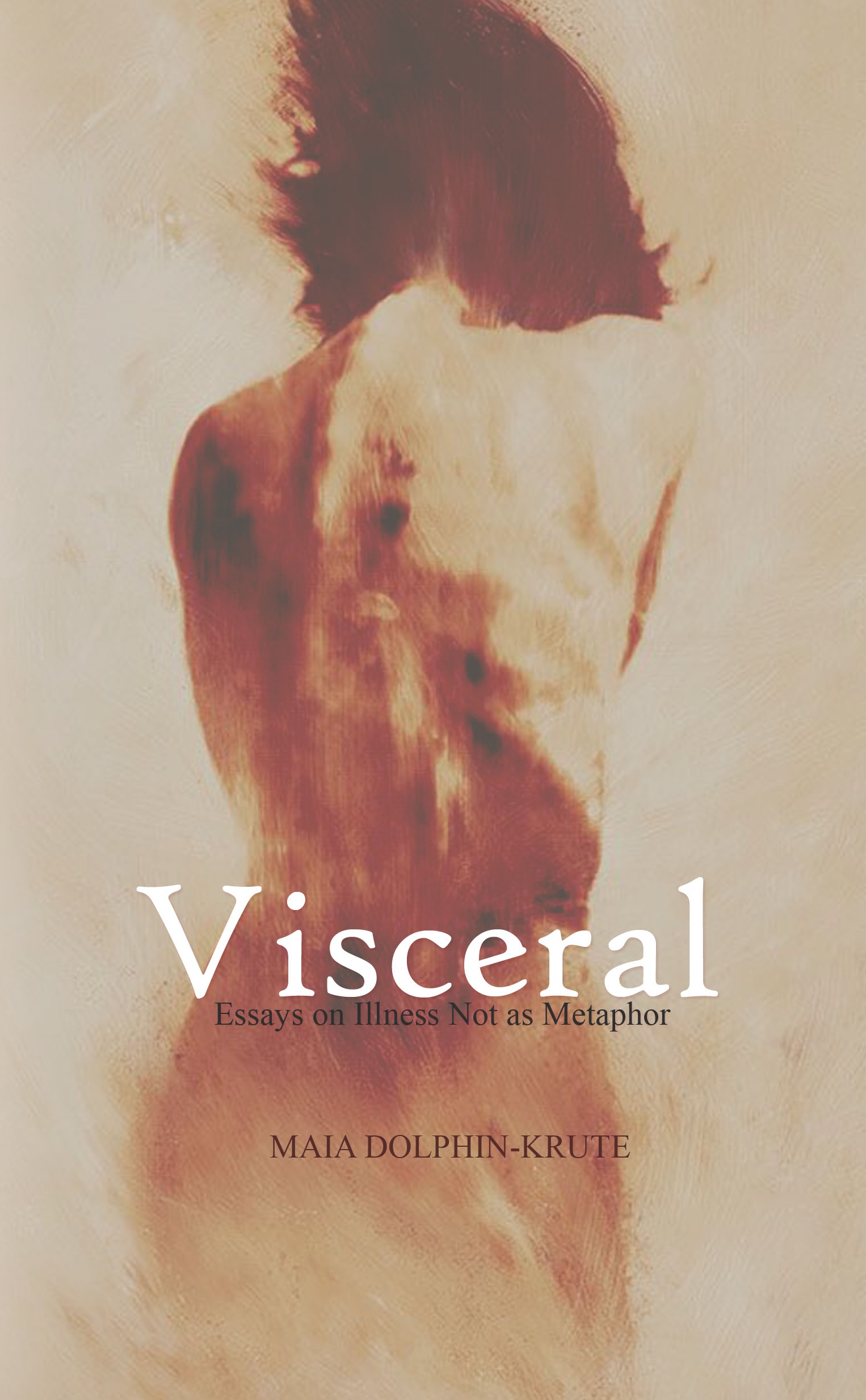
| Title | Visceral |
|---|---|
| Subtitle | Essays on Illness Not as Metaphor |
| Contributor | Maia Dolphin-Krute (author) |
| DOI | https://doi.org/10.21983/P3.0185.1.00(opens in new tab) |
| Landing page | https://punctumbooks.com/titles/visceral-essays-on-illness-not-as-metaphor/(opens in new tab) |
| License | https://creativecommons.org/licenses/by-nc-sa/4.0/(opens in new tab) |
| Copyright | Dolphin-Krute, Maia |
| Publisher | punctum books |
| Publication place | Earth, Milky Way |
| Published on | 2017-10-16 |
| ISBN | 978-1-947447-26-4 (Paperback) |
| 978-1-947447-27-1 (PDF) | |
| Long abstract | Memoirs about being sick are popular and everywhere and only ever contribute to pop narratives of illness as a single event or heroic struggle or journey. Visceral: Essays on Illness as Metaphor is not that. Visceral, to the extent that it is a memoir, is a record not of illness but of the research project being sick became. While rooted firmly in critical disability and queer practices, the use of personal narratives opens these approaches up to new ways of writing the body—ultimately a body that is at once theoretical and unavoidably physical. A body where everything is visceral, so theory must be too. From the gothic networks of healthcare bureaucracy and hospital philanthropy to the proliferation of wellness media, off-label usage of drugs, and running off to live a life with, these essays move fluidly through theoretical and physical anger, curiosity and surprise. Arguing for disability rights that attend to the theoretical as much as the physical, this is Illness Not As Metaphor, Being Sick and Time, and The Body in Actual Pain as one. A sick body of text that is—and is not—in direct correspondence to an actual sick body, Visceral is an unrelenting examination of chronic illness that turns towards the theoretical only to find itself in the realms of the biological and autobiographical: because how much theory can a body take? |
| Print length | 148 pages |
| Language | English (Original) |
| Dimensions | 127 x 203 mm | 5" x 8" (Paperback) |
| LCCN | 2017956831 |
| THEMA |
|
| BIC |
|
| BISAC |
|
| Keywords |
|
Contributors
Maia Dolphin-Krute
(author)Maia Dolphin-Krute is a writer and artist based in Boston, having graduated from the School of the Museum of Fine Arts and Tufts University in 2014. She is the author of Ghostbodies: Towards a New Theory of Invalidism (Intellect/Chicago, 2017) and the chapbook Aron Ralston: States of Injury (glo worm press, 2016). Her essays and poetry have appeared or are forthcoming in American Chordata, Full-Stop, Gigantic Sequins and elsewhere, and her performances have been shown at venues including the Museum of Fine Arts, Boston, and Brigham and Women’s Hospital. She is also an Ideas Editor for The Deaf Poets Society(opens in new tab), an online journal of deaf and disabled literature & art. Currently, Dolphin-Krute is engaged in a long-term project about the forms of freedom that become possible when continually modulated by physical experiences and material proximities; about how do you “live with.” More information about this and other projects can be found at Ghostbodies(opens in new tab).