
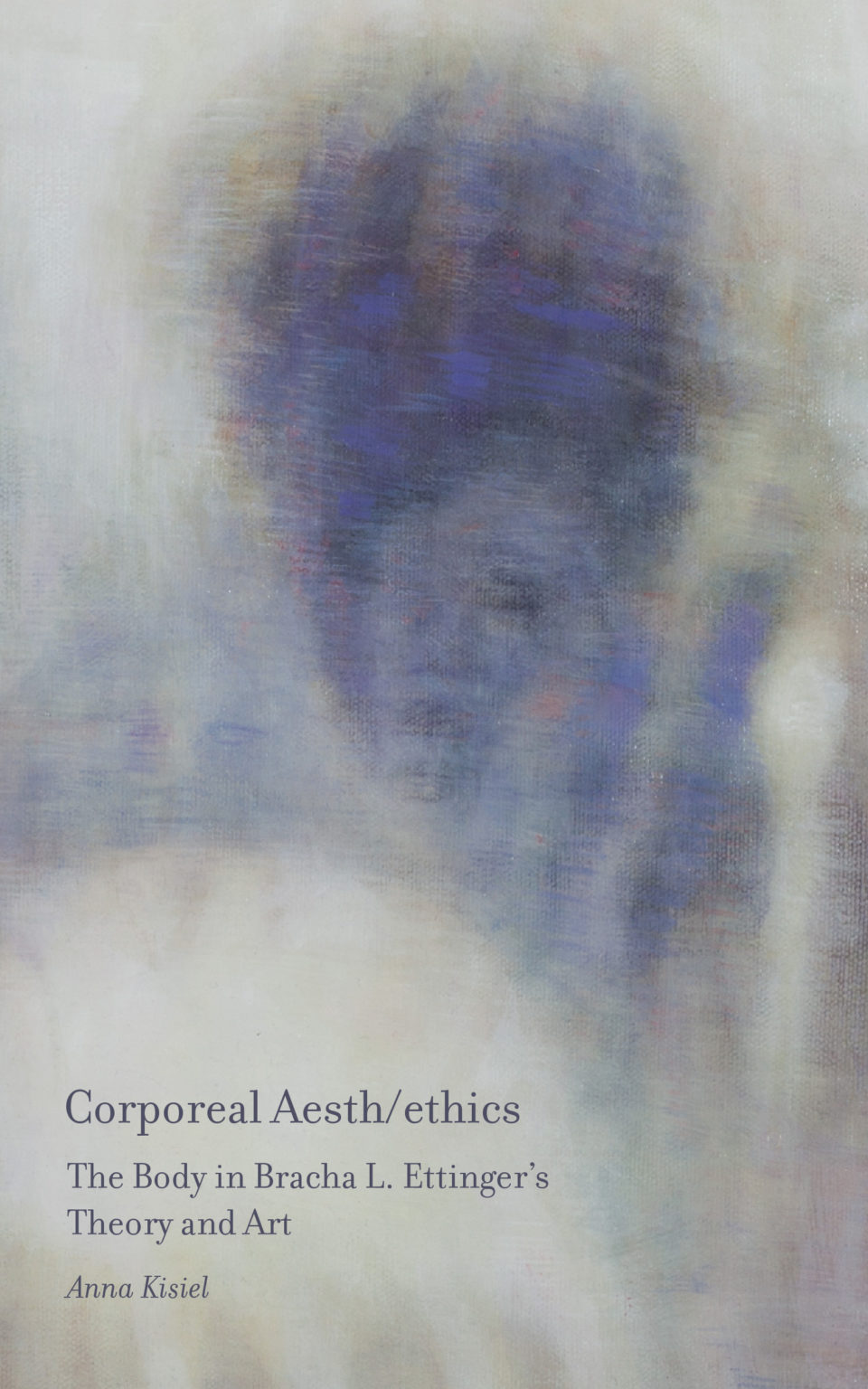
| Title | Corporeal Aesth/ethics |
|---|---|
| Subtitle | The Body in Bracha L. Ettinger's Theory and Art |
| Contributor | Anna Kisiel(opens in new tab)(author) |
| DOI | https://doi.org/10.53288/0499.1.00(opens in new tab) |
| Landing page | https://punctumbooks.com/titles/corporeal-aesth-ethics-the-body-in-bracha-l-ettingers-theory-and-art/(opens in new tab) |
| License | https://creativecommons.org/licenses/by-nc-sa/4.0/(opens in new tab) |
| Copyright | Anna Kisiel |
| Publisher | punctum books |
| Publication place | Earth, Milky Way |
| Published on | 2026-02-03 |
| ISBN | 978-1-68571-214-3 (Paperback) |
| 978-1-68571-215-0 (PDF) | |
| 978-1-68571-299-0 (EPUB) | |
| Long abstract | Can we think of an ethics that originates in corporeality, and not in codified or symbolic systems? In* Corporeal Aesth/ethics,* the body resurfaces as a central category of Bracha L. Ettinger’s theory and art, as well as an interpretive key that allows us to assume ethical responsibility for an Other who is not abstract, or distant, or total. Ettinger’s matrixial theory, a deeply feminist psycho-analytical system, ventures beyond the models of subjectivity based on separation and lack, and thus it helps us rethink togetherness and our own humanity. Corporeal Aesth/ethics explores how we become subjects not through a series of cuts, but through an encounter with radical openness, modeled upon the intrauterine/pregnancy period. Even though the theorized encounter relies on caring, carrying, and sharing, it is far from pleasant and safe, as we might assume. Indeed, some of the knowledge communicated in this phase of subjectivity-becoming may turn out to be painful, even traumatic. It is this profoundly corporeal encounter, Kisiel contends, that makes it possible to conceive of the body as a site and source of ethics. Envisioned through the lens of the matrixial, a subject (never alone, always in severality) reaches new modes of intimacy and hospitality, occasioned by our universally shared, originary experience of becoming with-in the maternal body. A psychoanalyst, theoretician, and feminist, Ettinger is also an artist. Sharing Ettinger’s conviction that “painting and theory are not different aspects that attest to the same thing, but are rather differentiated levels of working-through,” Kisiel maps the entanglements of the (feminine/motherly) body in both dimensions of Ettinger’s work. In five chapters, this book delineates the project of Ettinger’s corporeal aesth/ethics. It contextualizes the matrixial body, analyzes its humanizing potential, and proposes dialogues of Ettinger’s work with feminism, theology, and Holocaust studies. |
| Print length | 220 pages |
| Language | English (Original) |
| Dimensions | 127 x 13 x 203 mm | 5" x 0.50" x 8" (Paperback) |
| Weight | 224g | 7.90oz (Paperback) |
| LCCN | 2026932367 |
| THEMA |
|
| BISAC |
|
| Keywords |
|
Contributors
Anna Kisiel
(author)Anna Kisiel is a literary scholar, English philologist, and assistant professor at the University of Silesia in Katowice, Poland. In 2019, she received her PhD in literary studies. She has published extensively on Bracha L. Ettinger’s matrixial theory both in English and in Polish. She is an editorial team member of several academic journals, including ER(R)GO: Theory – Literature – Culture and MAI: Feminism & Visual Culture, and she is a member of the Polish Academy of Sciences Commission on Literary History (Katowice Branch). Her academic research revolves around – but is not limited to – matrixial psychoanalysis, trauma studies, photography theory, and body and femininity in the visual arts and literature.