
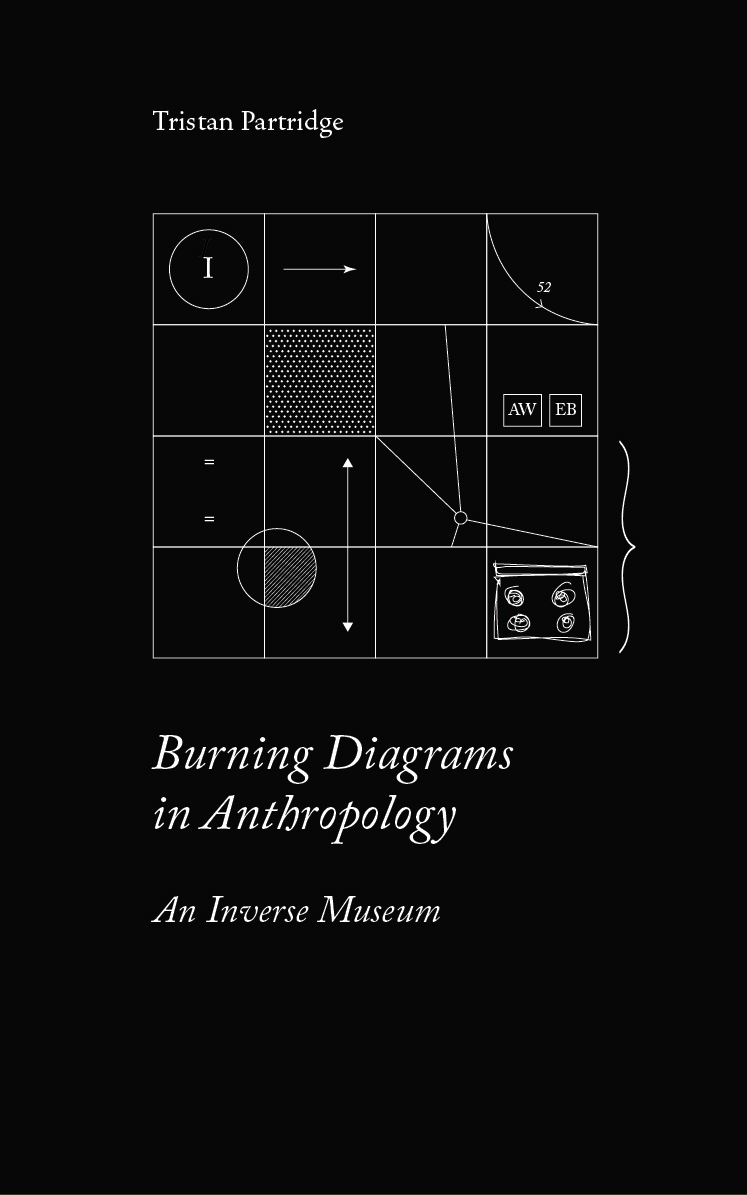
| Title | Burning Diagrams in Anthropology |
|---|---|
| Subtitle | An Inverse Museum |
| Contributor | Tristan Partridge(opens in new tab)(author) |
| DOI | https://doi.org/10.53288/0468.1.00(opens in new tab) |
| Landing page | https://punctumbooks.com/titles/burning-diagrams-in-anthropology-an-inverse-museum/(opens in new tab) |
| License | https://creativecommons.org/licenses/by-nc-sa/4.0/(opens in new tab) |
| Copyright | Tristan Partridge |
| Publisher | punctum books |
| Publication place | Earth, Milky Way |
| Published on | 2024-11-21 |
| ISBN | 978-1-68571-174-0 (Paperback) |
| 978-1-68571-175-7 (PDF) | |
| Long abstract | Burning Diagrams in Anthropology examines the use of diagrams in anthropology to reimagine how we think about, and challenge, intellectual histories. Highlighting the impossibility of escaping what different disciplines and institutions deem to be “past,” the author combines critical analysis of selected diagrams with an expansive, exploratory reimmersion in their aesthetic, ethical, and political potential. Diagrams persist. Yet while other visual components of scholarly work—especially photography, cartography, and film—have been subject to significant critical scrutiny, diagrams have received far less reflexive attention. Reversing this trend, Partridge presents a collection of 52 diagrams, covering a period of 150 years, to create an “inverse museum”—a space where the collection matters less than reactions to it. While the images are drawn from sociocultural anthropology, they are discussed in dialogue with approaches from philosophy, postcolonial studies, architecture, aesthetics, posthumanism, and critical art theory. Dissecting the notion of The Canon in order to confront academic complicity in hierarchical and racialized relations of inequality, the figurative burning of the title refers to how we might prepare the ground for scholarly work that meets the immediate, collective needs of an Earth in crisis—not least, by refusing adherence to disciplinary normalcy. By refusing this adherence, Partridge reaffirms knowledge creation in general, and anthropology in particular, as deeply ethical, creative, and relational processes. |
| Print length | 214 pages |
| Language | English (Original) |
| Dimensions | 127 x 12 x 203 mm | 5" x 0.49" x 8" (Paperback) |
| Weight | 295g | 10.40oz (Paperback) |
| LCCN | 2024945546 |
| THEMA |
|
| BISAC |
|
| Keywords |
|
Contributors
Tristan Partridge
(author)Tristan Partridge is a Lecturer in Global Studies at the University of California, Santa Barbara and co-founder of the CREW Center for Restorative Environmental Work. He received his PhD in Social Anthropology from the University of Edinburgh and has since been a Research Fellow at universities in Spain, the UK, and the US, also teaching courses on ethnographic methods, political ecology, visual anthropology, and anthropological theory. His research addresses global struggles for environmental justice through collaborative projects with Indigenous communities defending land and water rights in Ecuador, with farmers’ movements for non-toxic agriculture in northern India, and with groups resisting new oil extraction in California. His work is published across academic journals and media platforms and in his book, Energy and Environmental Justice: Movements, Solidarities, and Critical Connections (Palgrave, 2022). Tristan’s ethnographic work also draws on aural anthropology and visual methods: he has written text scores for The Center For Deep Listening and his fieldwork photography has been exhibited internationally. His collaborative documentary work continues through an ongoing photographic project with colleagues in Ecuador, Mingas : Solidarity.
References
- (opens in new tab)
- (opens in new tab)
- (opens in new tab)
- (opens in new tab)
- (opens in new tab)
- (opens in new tab)
- (opens in new tab)
- (opens in new tab)
- (opens in new tab)
- (opens in new tab)
- (opens in new tab)
- (opens in new tab)
- (opens in new tab)
- (opens in new tab)
- (opens in new tab)
- (opens in new tab)
- (opens in new tab)
- (opens in new tab)
- (opens in new tab)
- (opens in new tab)
- (opens in new tab)
- (opens in new tab)
- (opens in new tab)
- (opens in new tab)
- (opens in new tab)
- (opens in new tab)
- (opens in new tab)
- (opens in new tab)
- (opens in new tab)
- (opens in new tab)
- (opens in new tab)
- (opens in new tab)
- (opens in new tab)
- (opens in new tab)
- (opens in new tab)
- (opens in new tab)
- (opens in new tab)
- (opens in new tab)
- (opens in new tab)
- (opens in new tab)
- (opens in new tab)
- (opens in new tab)
- (opens in new tab)
- (opens in new tab)
- (opens in new tab)
- (opens in new tab)
- (opens in new tab)
- (opens in new tab)
- (opens in new tab)
- (opens in new tab)
- (opens in new tab)
- (opens in new tab)