
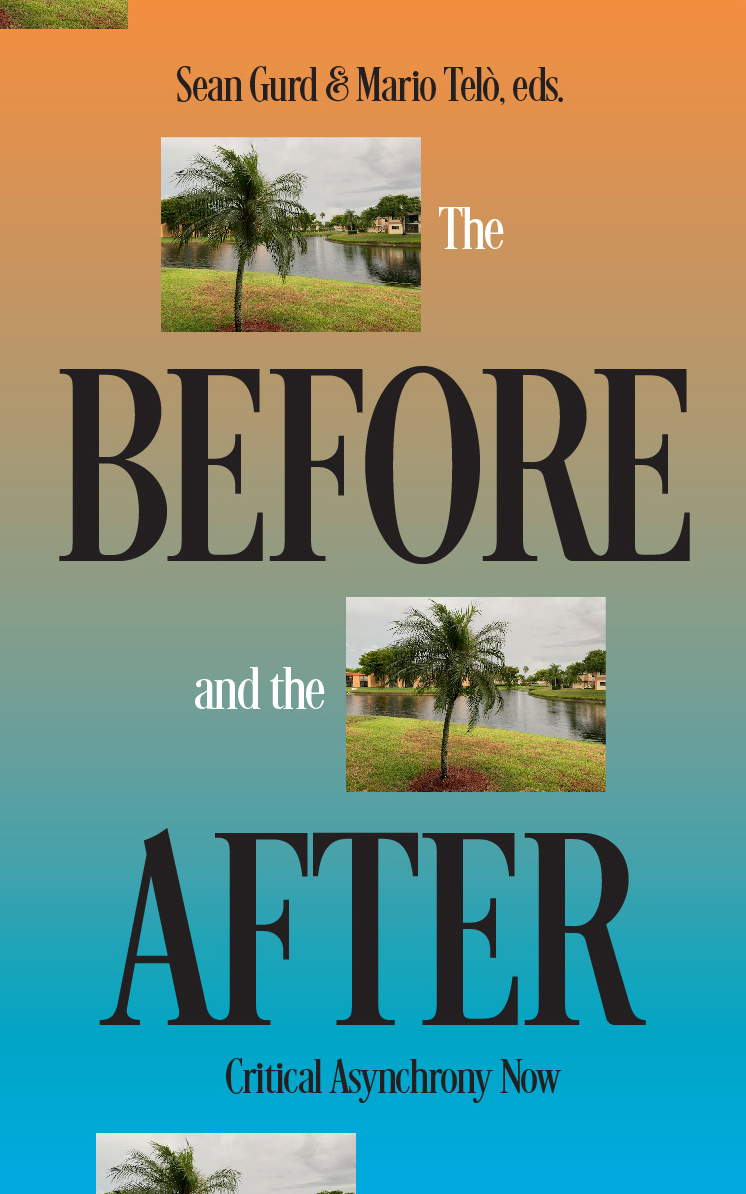
| Title | The Before and the After |
|---|---|
| Subtitle | Critical Asynchrony Now |
| Contributor | Sean Gurd (editor) |
| Mario Telò(opens in new tab)(editor) | |
| DOI | https://doi.org/10.53288/0446.1.00(opens in new tab) |
| Landing page | https://punctumbooks.com/titles/the-before-and-the-after-critical-asynchrony-now/(opens in new tab) |
| License | https://creativecommons.org/licenses/by-nc-sa/4.0/(opens in new tab) |
| Copyright | Mario Telò and Sean Gurd |
| Publisher | punctum books |
| Publication place | Earth, Milky Way |
| Published on | 2025-01-29 |
| ISBN | 978-1-68571-198-6 (Paperback) |
| 978-1-68571-199-3 (PDF) | |
| Long abstract | Between 2020 and 2021, in the depths of the Covid-19 pandemic, the thirteen authors included in The Before and the After: Critical Asynchrony Now turned to reflections on the late work of Jacques Derrida in an attempt to think through the temporal disjunctions imposed by the global emergency. They found themselves thinking through ideas and philosophical tropes that had been in vogue more than twenty years earlier—as though a deep theoretical nostalgia could somehow rescue them from the moment that beset them. As a belated turn to Derrida’s late work, The Before and the After provides a series of visions of what we might become, in our engagements with the past—both the contemporary and ancient past—in our occupation of every fractured “now.” This book is a document of a moment now largely (hopefully) behind us and an attempt to imagine what remains to come. |
| Print length | 380 pages |
| Language | English (Original) |
| Dimensions | 127 x 22 x 203 mm | 5" x 0.86" x 8" (Paperback) |
| Weight | 490g | 17.28oz (Paperback) |
| LCCN | 2024945618 |
| THEMA |
|
| BISAC |
|
| Keywords |
|
Contents
- Mario Telò
- Paul Allen Miller
- Ben Radcliffe
- Francesca Martelli
- David Youd
- Karen Bassi
- Andres Matlock
- Bruce Rosenstock
- Sarah Nooter
- Carol Dougherty
- Mario Telò
- Ahuvia Kahane
- Daniel Orrells
- Sean Gurd
Contributors
Sean Gurd
(editor)Sean Gurd is a professor in the Department of Classics at the University of Texas at Austin. He has written four monographs: Iphigenias at Aulis: Textual Multiplicity, Radical Philology (Cornell, 2006), Work in Progress: Literary Revision as Social Performance in Ancient Rome (Oxford, 2012), Dissonance: Auditory Aesthetics in Ancient Greece (Fordham, 2016), and The Origins of Music Theory in the Age of Plato (Bloomsbury, 2019). He also edited Philology and Its Histories (Ohio State, 2010) and co-edited ‘Pataphilology: An Irreader (punctum, 2018) with Vincent W.J. van Gerven Oei. With Pauline LeVen, he co-edited the Cultural History of Western Music in Antiquity (Bloomsbury, 2023). He is an editor of Tangent, an imprint of punctum books dedicated to publishing innovative books and projects that touch on classical antiquity, and director of the Ancient Music and Performance Lab at the University of Texas at Austin.
Mario Telò
(editor)Mario Telò is Professor of Rhetoric, Comparative Literature, and Ancient Greek and Roman Studies at University of California, Berkeley. He is the author of Aristophanes and the Cloak of Comedy: Affect, Aesthetics and the Canon (Chicago, 2016), Archive Feelings: A Theory of Greek Tragedy (Ohio State, 2020), Greek Tragedy in a Global Crisis: Reading through Pandemic Times (Bloomsbury, 2023), Resistant Form: Aristophanes and the Comedy of Crisis (punctum, 2023), and Reading Greek Tragedy with Judith Butler (Bloomsbury, 2024).
References
- (opens in new tab)
- (opens in new tab)
- (opens in new tab)
- (opens in new tab)
- (opens in new tab)
- (opens in new tab)
- (opens in new tab)
- (opens in new tab)
- (opens in new tab)
- (opens in new tab)
- (opens in new tab)
- (opens in new tab)
- (opens in new tab)
- (opens in new tab)
- (opens in new tab)
- (opens in new tab)
- (opens in new tab)
- (opens in new tab)
- (opens in new tab)
- (opens in new tab)
- (opens in new tab)
- (opens in new tab)
- (opens in new tab)
- (opens in new tab)
- (opens in new tab)
- (opens in new tab)
- (opens in new tab)
- (opens in new tab)
- (opens in new tab)
- (opens in new tab)
- (opens in new tab)
- (opens in new tab)
- (opens in new tab)
- (opens in new tab)
- (opens in new tab)
- (opens in new tab)
- (opens in new tab)
- (opens in new tab)
- (opens in new tab)
- (opens in new tab)
- (opens in new tab)
- (opens in new tab)
- (opens in new tab)
- (opens in new tab)
- (opens in new tab)
- (opens in new tab)
- (opens in new tab)
- (opens in new tab)
- (opens in new tab)
- (opens in new tab)
- (opens in new tab)
- (opens in new tab)
- (opens in new tab)
- (opens in new tab)
- (opens in new tab)
- (opens in new tab)
- (opens in new tab)
- (opens in new tab)
- (opens in new tab)
- (opens in new tab)
- (opens in new tab)
- (opens in new tab)
- (opens in new tab)
- (opens in new tab)
- (opens in new tab)
- (opens in new tab)
- (opens in new tab)
- (opens in new tab)
- (opens in new tab)
- (opens in new tab)
- (opens in new tab)
- (opens in new tab)
- (opens in new tab)
- (opens in new tab)
- (opens in new tab)
- (opens in new tab)
- (opens in new tab)
- (opens in new tab)
- (opens in new tab)
- (opens in new tab)
- (opens in new tab)
- (opens in new tab)
- (opens in new tab)
- (opens in new tab)
- (opens in new tab)
- (opens in new tab)
- (opens in new tab)
- (opens in new tab)
- (opens in new tab)
- (opens in new tab)
- (opens in new tab)
- (opens in new tab)