
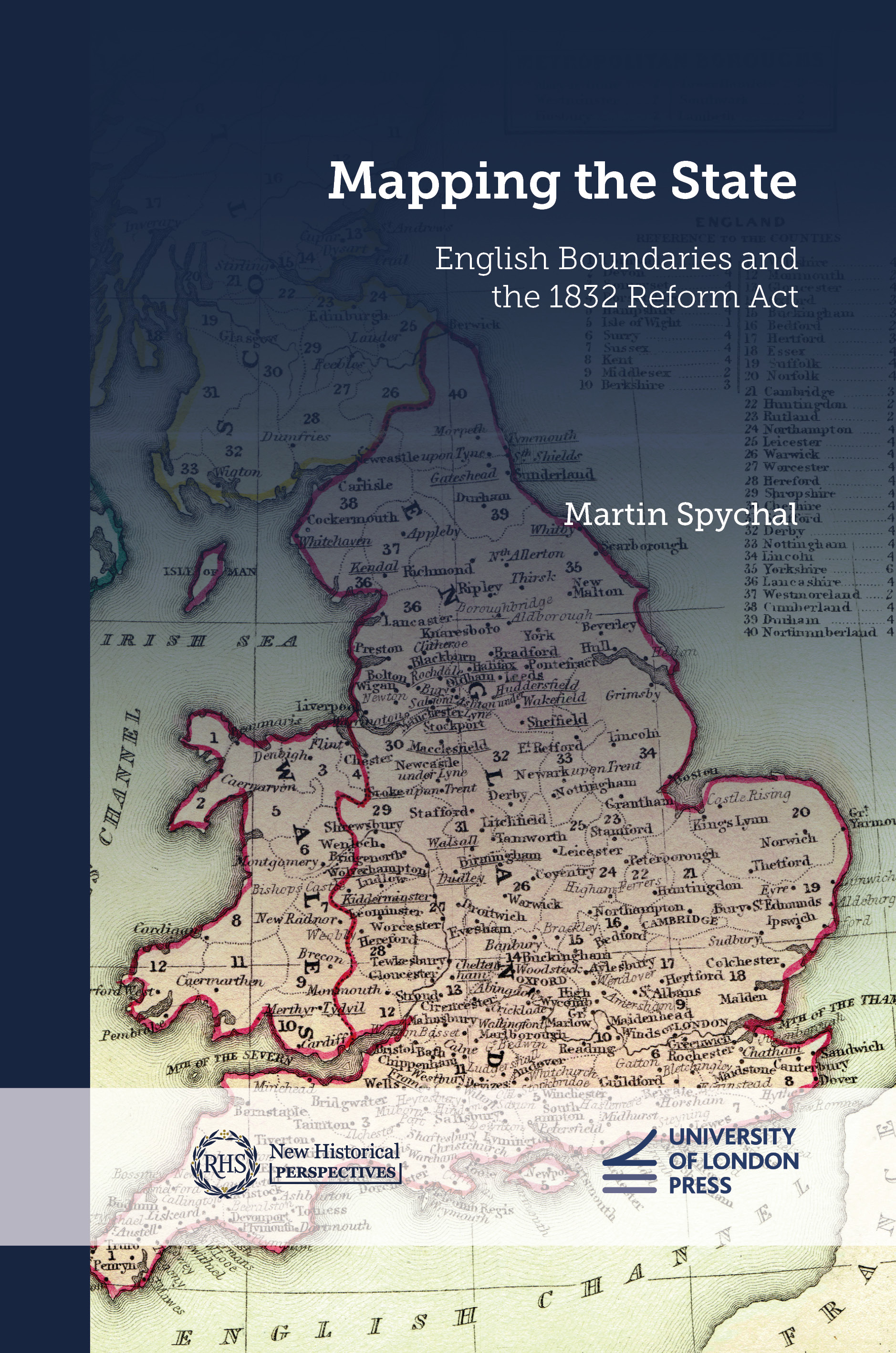
| Title | Mapping the State |
|---|---|
| Subtitle | English Boundaries and the 1832 Reform Act |
| Contributor | Martin Spychal (author) |
| DOI | https://doi.org/10.14296/mpgh8387(opens in new tab) |
| Landing page | https://uolpress.co.uk/book/mapping-the-state/(opens in new tab) |
| License | https://creativecommons.org/licenses/by-nc-nd/4.0/(opens in new tab) |
| Copyright | Martin Spychal |
| Publisher | University of London Press |
| Publication place | London, GB |
| Published on | 2024-09-19 |
| Series |
|
| ISBN | 978-1-915249-25-8 (Paperback) |
| 978-1-914477-39-3 (Hardback) | |
| 978-1-915249-26-5 (PDF) | |
| 978-1-914477-75-1 (HTML) | |
| 978-1-915249-27-2 (EPUB) | |
| Short abstract | Mapping the State leads to a fundamental rethinking of the 1832 Reform Act by demonstrating how boundary reform underpinned this turning point in the development of the British political nation. Using significant new archival discovery, digital methods and ‘big data’, it provides a major reassessment of why and how the 1832 Reform Act passed, its impact on reformed politics both at Westminster and in the constituencies, and its significance to the expansion of the modern British state. |
| Long abstract | The 1832 Reform Act was a landmark moment in the development of modern British politics. By overhauling the country’s ancient representative system, the legislation reshaped constitutional arrangements at Westminster, reinvigorated political relationships between the centre and the provinces, and established the political structures and precedents that both shaped and hindered electoral reform over the following century. Mapping the State leads to a fundamental rethinking of the 1832 Reform Act by demonstrating how boundary reform, and the reconstruction of England’s electoral map by the little-known 1831–2 boundary commission, underpinned this turning point in the development of the British political nation. Eschewing traditional approaches to the 1832 Reform Act, it draws from a significant new archival discovery – the working papers of the boundary commission – and a range of innovative quantitative techniques to provide a major reassessment of why and how the 1832 Reform Act passed, its impact on reformed politics both at Westminster and in the constituencies, and its significance to the expansion of the modern British state. |
| Language | English (Original) |
| Dimensions | 156 x 234 mm | 6.14" x 9.21" (Paperback) |
| 160 x 240 mm | 6.31" x 9.44" (Hardback) | |
| Media | 60 illustrations |
| BIC |
|
| BISAC |
|
| Keywords |
|
Contributors
Martin Spychal
(author)Martin Spychal is a historian of modern Britain, specialising in nineteenth-century politics, society and culture. He is a Senior Research Fellow at the History of Parliament working on the House of Commons 1832–1945 project.