
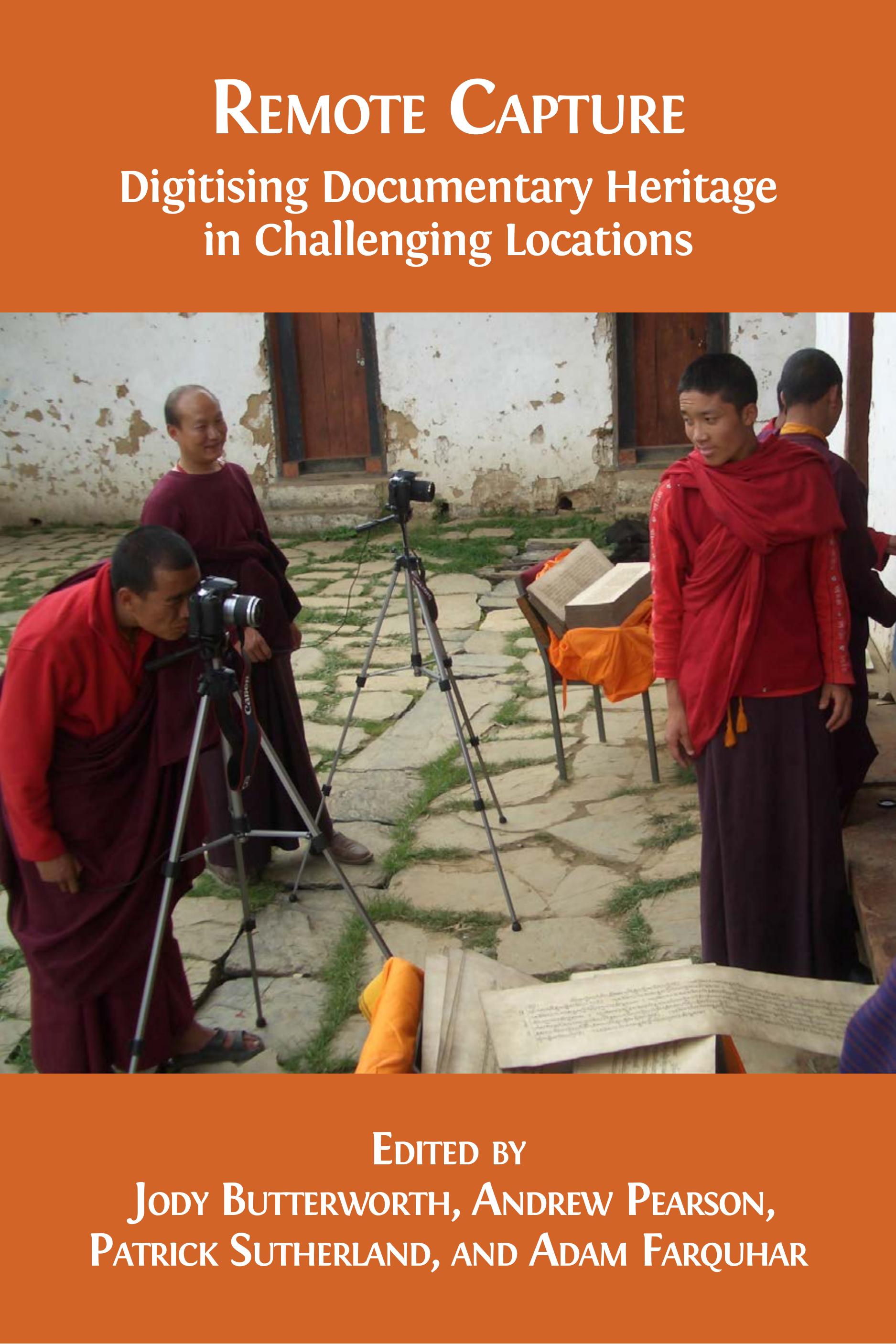
| Title | Remote Capture |
|---|---|
| Subtitle | Digitising Documentary Heritage in Challenging Locations |
| Contributor | Patrick Sutherland (editor) |
| Adam Farquhar(opens in new tab)(editor) | |
| Jody Butterworth (editor) | |
| Andrew Pearson (editor) | |
| DOI | https://doi.org/10.11647/OBP.0138(opens in new tab) |
| Landing page | https://www.openbookpublishers.com/books/10.11647/obp.0138(opens in new tab) |
| License | http://creativecommons.org/licenses/by/4.0/(opens in new tab) |
| Copyright | Jody Butterworth; Andrew Pearson; Patrick Sutherland; Adam Farquhar; Copyright of individual chapters is maintained by the chapter’s authors. |
| Publisher | Open Book Publishers |
| Publication place | Cambridge, UK |
| Published on | 2018-04-16 |
| Series |
|
| ISBN | 978-1-78374-473-2 (Paperback) |
| 978-1-78374-474-9 (Hardback) | |
| 978-1-78374-475-6 (PDF) | |
| 978-1-80064-557-8 (HTML) | |
| 978-1-78374-613-2 (XML) | |
| 978-1-78374-476-3 (EPUB) | |
| 978-1-78374-477-0 (MOBI) | |
| Short abstract | This is a must-read how-to guide if you are planning to embark on a scholarly digitisation project. Tailored to the specifications of the British Library’s EAP (Endangered Archives Programme) projects, it is full of sound, practical advice about planning and carrying out a successful digitisation project in potentially challenging conditions. |
| Long abstract | This is a must-read how-to guide if you are planning to embark on a scholarly digitisation project. Tailored to the specifications of the British Library’s EAP (Endangered Archives Programme) projects, it is full of sound, practical advice about planning and carrying out a successful digitisation project in potentially challenging conditions. From establishing the scope of the project, via practical considerations about equipment, work routines, staffing, and negotiating local politics, to backing up your data and successfully completing your work, Remote Capture walks you through every stage. Bursting with helpful hints, advice and experiences from people who have completed projects everywhere around the globe from Latin America to Africa to Asia, this book offers a taste of the challenges you might encounter and the best ways to find solutions. With a particular focus on the process of digitisation, whether using a camera or a scanner, Remote Capture is invaluable reading for anybody considering such a project. It will be particularly useful to those who apply for an EAP grant, but the advice in these pages is necessary for anyone wondering how to go about digitising an archive. |
| Print length | 192 pages (viii + 184) |
| Language | English (Original) |
| Dimensions | 156 x 10 x 234 mm | 6.14" x 0.41" x 9.21" (Paperback) |
| 156 x 13 x 234 mm | 6.14" x 0.50" x 9.21" (Hardback) | |
| Weight | 619g | 21.83oz (Paperback) |
| 996g | 35.13oz (Hardback) | |
| Media | 48 illustrations |
| 4 tables | |
| OCLC Number | 1037803538 |
| LCCN | 2019452733 |
| BIC |
|
| BISAC |
|
| LCC |
|
| Keywords |
|
Contents
- Adam Farquhar
- Jody Butterworth
- Andrew Pearson
- Patrick Sutherland
- Adam Farquhar
- Jody Butterworth
- Planning the project
- Andrew Pearson
- Equipment and skills for digitising in the field
- Patrick Sutherland
- Image standards
- Elizabeth Hunter
- Collection care and document handling
- Flavio Marzo
- A workflow for digitisation
- Jody Butterworth
- Andrew Pearson
- Patrick Sutherland
- Adam Farquhar
- On the ground
- Jody Butterworth
- Andrew Pearson
- Patrick Sutherland
- Adam Farquhar
- Jody Butterworth
Contributors
Patrick Sutherland
(editor)Patrick Sutherland is an independent photographer and former Professor of Documentary Photography at the University of the Arts London. For over two decades Patrick has been documenting the culturally Tibetan communities of the Spiti Valley in North India. The project has led to numerous exhibitions and two books: Spiti and Disciples of a Crazy Saint. The latter concerns the Buchen, travelling lay religious theatre performers, exorcists, musicians and healers unique to Spiti, whose material culture is the focus of Sutherland's two Endangered Archive Programme grants, EAP548 and EAP749.
Adam Farquhar
(editor)Adam Farquhar directs the Endangered Archives Programme. He is also Head of Digital Scholarship at the British Library, where he and his team focus on establishing services for researchers that take full advantage of the possibilities presented by digital collections and data across all formats and subjects. Adam has led several major research efforts and established the digital preservation and data programmes at the British Library. He was a founding member of the International Image Interoperability (IIIF) Consortium executive committee; founding President of DataCite; and founding President of the Open Preservation Foundation. He has been responsible for the Library's maps, newspaper, photographic, audio and moving image collections. Before joining the Library, he was the knowledge management architect for Schlumberger and research scientist at the Stanford University Knowledge Systems Laboratory.
Jody Butterworth
(editor)Jody Butterworth attended the International School of Geneva with students from 80 different countries and it is very probably this happy experience that has shaped her interests. She has spent seven years living and working across Asia and whilst in Mongolia she became inspired to pursue a career in cultural heritage. Jody became EAP Curator in 2012 and she considers it an incredibly rewarding job.
Andrew Pearson
(editor)Andrew Pearson is a Senior Heritage Consultant with AECOM. He also holds Research Associate status at Brunel University. His doctoral and early-career research focused on Roman Britain, while his current research addresses the historical archaeology of the Atlantic slave trade, with particular reference to the island of St Helena and the Anglophone Caribbean. His projects for the Endangered Archives Programme comprise EAP524 (St Helena), EAP596 (Anguilla), EAP688 and EAP1013 (both St Vincent) and EAP794 (Nevis).