
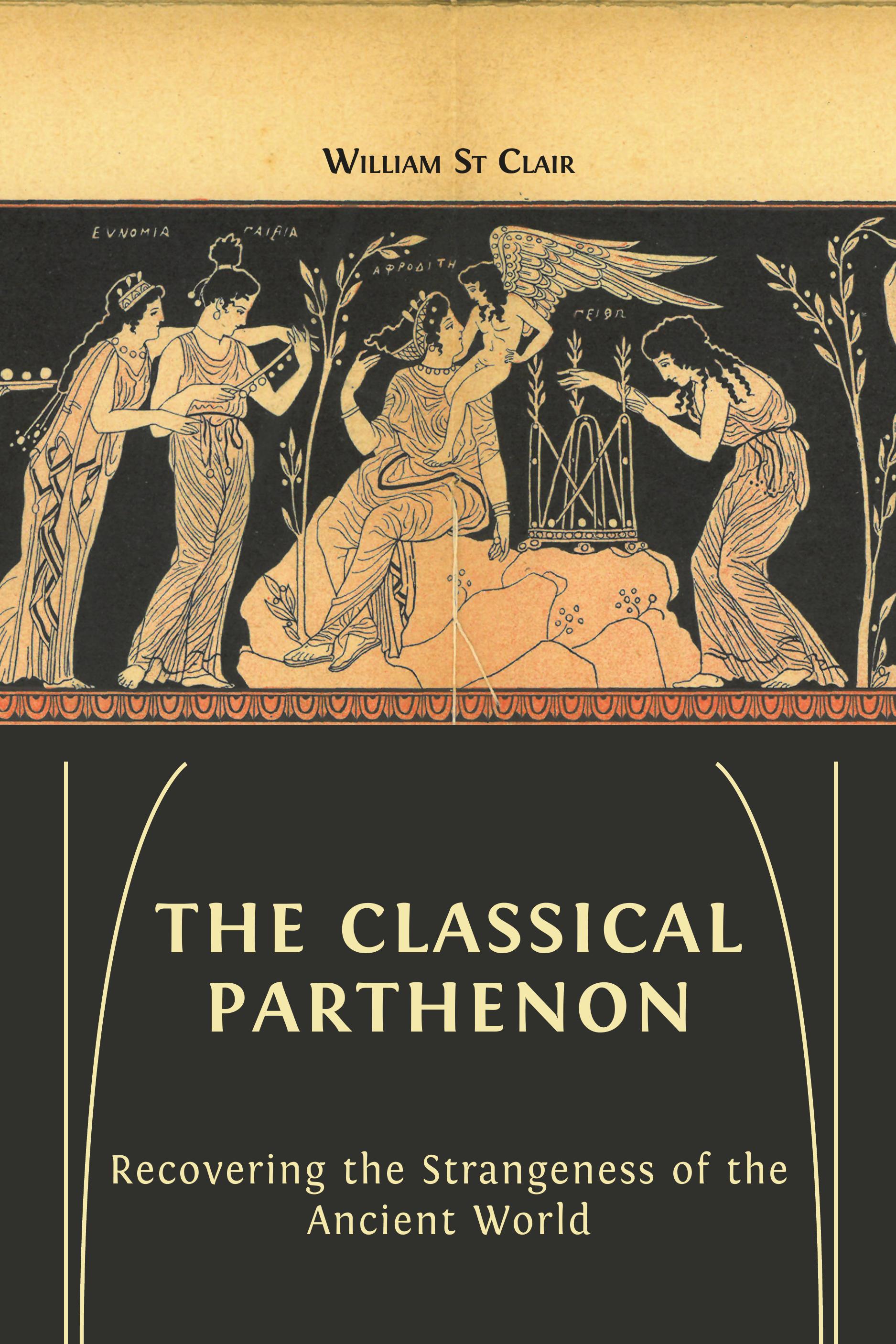
| Title | The Classical Parthenon |
|---|---|
| Subtitle | Recovering the Strangeness of the Ancient World |
| Contributor | William St Clair (author) |
| DOI | https://doi.org/10.11647/OBP.0279(opens in new tab) |
| Landing page | https://www.openbookpublishers.com/books/10.11647/obp.0279(opens in new tab) |
| License | https://creativecommons.org/licenses/by-nc-nd/4.0/(opens in new tab) |
| Copyright | William St Clair |
| Publisher | Open Book Publishers |
| Publication place | Cambridge, UK |
| Published on | 2022-08-24 |
| ISBN | 978-1-80064-344-4 (Paperback) |
| 978-1-80064-345-1 (Hardback) | |
| 978-1-80064-346-8 (PDF) | |
| 978-1-80064-678-0 (HTML) | |
| 978-1-80064-349-9 (XML) | |
| 978-1-80064-347-5 (EPUB) | |
| 978-1-80064-348-2 (AZW3) | |
| Short abstract | Complementing Who Saved the Parthenon? this companion volume sets aside more recent narratives surrounding the Athenian Acropolis, supposedly ‘the very symbol of democracy itself’, instead asking if we can truly access an ancient past imputed with modern meaning. And, if so, how? |
| Long abstract | Complementing Who Saved the Parthenon? this companion volume sets aside more recent narratives surrounding the Athenian Acropolis, supposedly ‘the very symbol of democracy itself’, instead asking if we can truly access an ancient past imputed with modern meaning. And, if so, how? In this book William St Clair presents a reconstructed understanding of the Parthenon from within the classical Athenian worldview. He explores its role and meaning by weaving together a range of textual and visual sources into two innovative oratorical experiments – a speech in the style of Thucydides and a first-century CE rhetorical exercise – which are used to develop a narrative analysis of the temple structure, revealing a strange story of indigeneity, origins, and empire. The Classical Parthenon offers new answers to old questions, such as the riddle of the Parthenon frieze, and provides a framing device for the wider relationship between visual artefacts, built heritage, and layers of accumulated cultural rhetoric. This groundbreaking and pertinent work will appeal across the disciplines to readers interested in the classics, art history, and the nature of history, while also speaking to a general audience that is interrogating the role of monuments in contemporary society. |
| Print length | 344 pages (xiv+330) |
| Language | English (Original) |
| Dimensions | 156 x 23 x 234 mm | 6.14" x 0.91" x 9.21" (Paperback) |
| 156 x 27 x 234 mm | 6.14" x 1.06" x 9.21" (Hardback) | |
| Weight | 654g | 23.07oz (Paperback) |
| 828g | 29.21oz (Hardback) | |
| Media | 39 illustrations |
| OCLC Number | 1342253863 |
| LCCN | 2021386016 |
| BIC |
|
| BISAC |
|
| LCC |
|
| Keywords |
|
Contents
- Recovering the Strangeness
- William St Clair
- ‘How do we set straight our sacred city?’
- William St Clair
- Looking at the Parthenon in Classical Athens
- William St Clair
- A New Answer to an Old Question
- William St Clair
- ‘On the Temple dedicated to the Divine Minerva, vulgarly called the Parthenon’
- William St Clair
- Heritage
- William St Clair
- William St Clair
Contributors
William St Clair
(author)(7 December 1937 – 30 June 2021) was a British historian, senior research fellow at the Institute of English Studies, School of Advanced Study, University of London.