
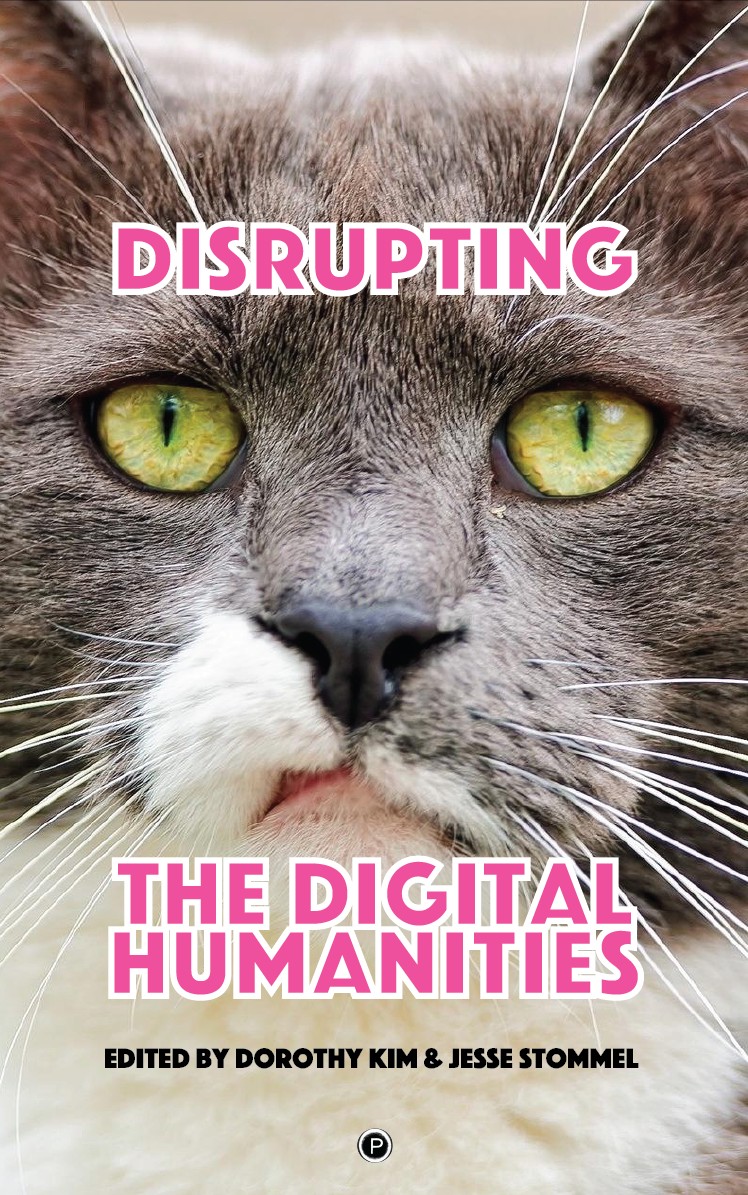
| Title | Disrupting the Digital Humanities |
|---|---|
| Contributor | Dorothy Kim (editor) |
| Jesse Stommel (editor) | |
| DOI | https://doi.org/10.21983/P3.0230.1.00(opens in new tab) |
| Landing page | https://punctumbooks.com/titles/disrupting-the-digital-humanities/(opens in new tab) |
| License | https://creativecommons.org/licenses/by-nc-sa/4.0/(opens in new tab) |
| Copyright | Kim, Dorothy; Stommel, Jesse |
| Publisher | punctum books |
| Publication place | Earth, Milky Way |
| Published on | 2018-11-06 |
| ISBN | 978-1-947447-71-4 (Paperback) |
| 978-1-947447-72-1 (PDF) | |
| Long abstract | All too often, defining a discipline becomes more an exercise of exclusion than inclusion.* Disrupting the Digital Humanities* seeks to rethink how we map disciplinary terrain by directly confronting the gatekeeping impulse of many other so-called field-defining collections. What is most beautiful about the work of the Digital Humanities is exactly the fact that it can’t be tidily anthologized. In fact, the desire to neatly define the Digital Humanities (to filter the DH-y from the DH) is a way of excluding the radically diverse work that actually constitutes the field. This collection, then, works to push and prod at the edges of the Digital Humanities — to open the Digital Humanities rather than close it down. Ultimately, it’s exactly the fringes, the outliers, that make the Digital Humanities both heterogeneous and rigorous. This collection does not constitute yet another reservoir for the new Digital Humanities canon. Rather, its aim is less about assembling content as it is about creating new conversations. Building a truly communal space for the digital humanities requires that we all approach that space with a commitment to: 1) creating open and non-hierarchical dialogues; 2) championing non-traditional work that might not otherwise be recognized through conventional scholarly channels; 3) amplifying marginalized voices; 4) advocating for students and learners; and 5) sharing generously and openly to support the work of our peers. |
| Print length | 514 pages (nulla+514+nulla) |
| Language | English (Original) |
| Dimensions | 127 x 203 mm | 5" x 8" (Paperback) |
| THEMA |
|
| BISAC |
|
| Keywords |
|
Contents
- Dorothy Kim
- Jesse Stommel
- Adeline Koh
- Audrey Watters
- Meg Worley
- Jesse Stommel
- Jonathan Hsy
- Rick Godden
- Angel Nieves
- Annemarie Perez
- Mongrel Coalition Against Gringpo
- Mongrel Coalition Against Gringpo
- Michelle Moravec
- Matt Thomas
- Sean Michael Morris
- Moya Bailey
- Kathi Inman Berens
- Laura Sanders
- Liana Silva Ford
- Spencer D.C. Keralis
- Maha Bali
- Eunsong Kim
- Bonnie Steward
- Edmond Y. Chang
- Kat Lecky
- Robin Wharton
- Chris Friend
- Lee Skallerup Bessette
- Chris Bourg
- Fiona Barnett
- Dorothy Kim
Contributors
Dorothy Kim
(editor)Dorothy Kim is Assistant Professor of English, specializing in medieval literature, at Brandeis University. She was a 2013-2014 Fellow at the University of Michigan’s Frankel Institute of Advanced Judaic Studies where she finished a monograph entitled Jewish/Christian Entanglements: Ancrene Wisse and its Material Worlds (forthcoming from Toronto). She also has two books, Digital Whiteness and Medieval Studies and *Decolonize the Middle Ages (*forthcoming in 2018 with Arc Humanities). She is the co-project director in the NEH-funded Scholarly Editions and Translations project, An Archive of Early Middle English, a database for medieval English manuscripts from 1100–1348. In addition to Disrupting the Digital Humanities, she is also co-editing, with Adeline Koh, Alternative Histories of the Digital Humanities (forthcoming from punctum), which examines the difficult histories of the digital humanities in relation to race, sexuality, gender, disability, and fascism. She has co-written articles on “#GawkingatRapeCulture” and “TwitterEthics,” and has also written articles about “TwitterPanic” and “Social Media and Academic Surveillance” at Model View Culture(opens in new tab). She is the medieval editor for The Orlando Project(opens in new tab) (version 2.0) and can be followed on Twitter @dorothyk98(opens in new tab). She was named by Diverse: Issues in Higher Ed 2015 as an Emerging Scholar under 40.
Jesse Stommel
(editor)Jesse Stommel is Executive Director of the Division of Teaching and Learning Technologies at University of Mary Washington. He is also Director of Hybrid Pedagogy(opens in new tab): An Open-Access Journal of Learning, Teaching, and Technology and Co-founder of the Digital Pedagogy Lab(opens in new tab). Jesse is a documentary filmmaker and teaches courses about digital pedagogy, film, and new media. Jesse experiments relentlessly with learning interfaces, both digital and analog, and works in his research and teaching to emphasize new forms of collaboration. He’s got a rascal pup, Emily, and two clever cats, Loki and Odin. He’s online at jessestommel.com(opens in new tab) and on Twitter @Jessifer(opens in new tab).
References
- (opens in new tab)
- (opens in new tab)
- (opens in new tab)
- (opens in new tab)
- (opens in new tab)
- (opens in new tab)
- (opens in new tab)
- (opens in new tab)
- (opens in new tab)
- (opens in new tab)
- (opens in new tab)
- (opens in new tab)
- (opens in new tab)
- (opens in new tab)
- (opens in new tab)
- (opens in new tab)
- (opens in new tab)
- (opens in new tab)
- (opens in new tab)
- (opens in new tab)
- (opens in new tab)
- (opens in new tab)
- (opens in new tab)
- (opens in new tab)
- (opens in new tab)
- (opens in new tab)
- (opens in new tab)
- (opens in new tab)
- (opens in new tab)
- (opens in new tab)
- (opens in new tab)
- (opens in new tab)
- (opens in new tab)
- (opens in new tab)
- (opens in new tab)