
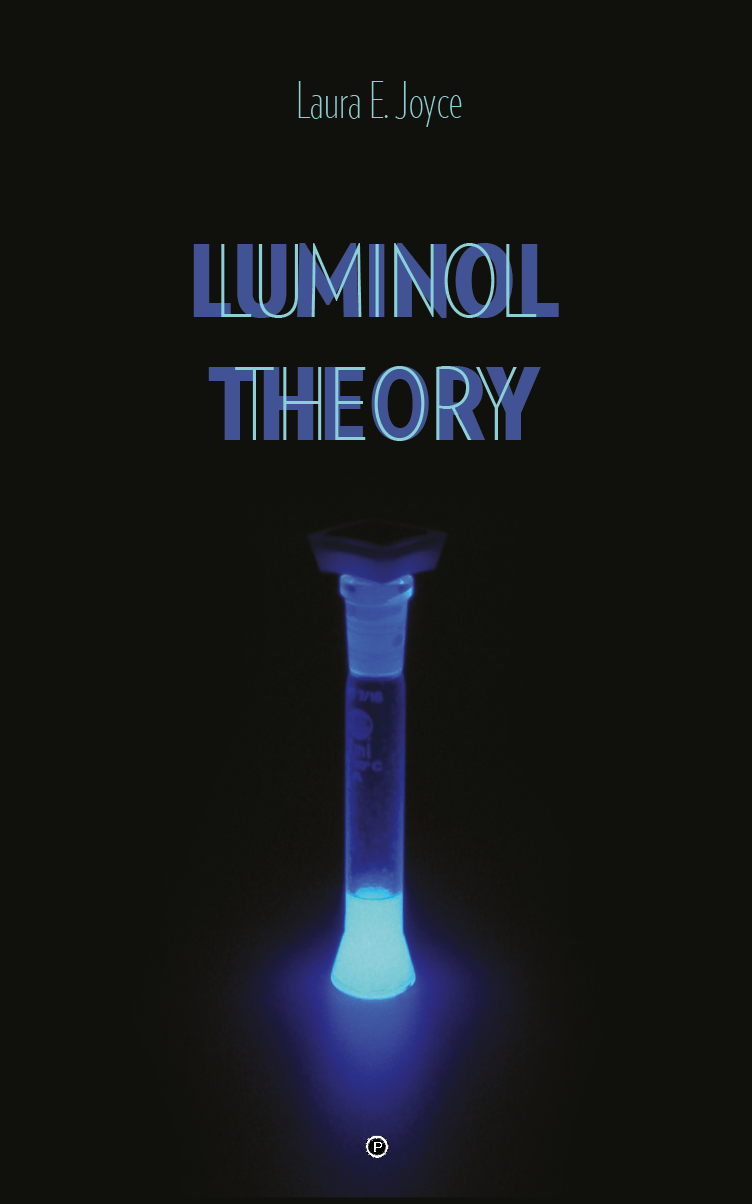
| Title | Luminol Theory |
|---|---|
| Contributor | Laura E. Joyce (author) |
| DOI | https://doi.org/10.21983/P3.0177.1.00(opens in new tab) |
| Landing page | https://punctumbooks.com/titles/luminol-theory/(opens in new tab) |
| License | https://creativecommons.org/licenses/by-nc-sa/4.0/(opens in new tab) |
| Copyright | Joyce, Laura E. |
| Publisher | punctum books |
| Publication place | Earth, Milky Way |
| Published on | 2017-08-24 |
| ISBN | 978-1-947447-12-7 (Paperback) |
| 978-1-947447-13-4 (PDF) | |
| Long abstract | Representations of forensic procedures saturate popular culture in both fiction and true crime. One of the most striking forensic tools used in these narratives is the chemical luminol(opens in new tab), so named because it glows an eerie greenish-blue when it comes into contact with the tiniest drops of human blood. Luminol is a deeply ambivalent object: it is both a tool of the police, historically abused and misappropriated, and yet it offers hope to families of victims by allowing hidden crimes to surface. Forensic enquiry can exonerate those falsely accused of crimes, and yet the rise of forensic science is synonymous with the development of the deeply racist ‘science’ of eugenics. Luminol Theory investigates the possibility of using a tool of the state in subversive, or radical, ways. By introducing luminol as an agent of forensic inquiry, Luminol Theory approaches the exploratory stages that a crime scene investigation might take, exploring experimental literature as though these texts were ‘crime scenes’ in order to discover what this deeply strange object can tell us about crime, death, and history, to make visible violent crimes, and to offer a tangible encounter with death and finitude. At the luminol-drenched crime scene, flashes of illumination throw up words, sentences, and fragments that offer luminous, strange glimpses, bobbing up from below their polished surfaces. When luminol shines its light, it reveals, it is magical, it is prescient, and it has a nasty allure. |
| Print length | 138 pages |
| Language | English (Original) |
| Dimensions | 127 x 203 mm | 5" x 8" (Paperback) |
| LCCN | 2017951816 |
| THEMA |
|
| BISAC |
|
| Keywords |
|
Contributors
Laura E. Joyce
(author)Laura E. Joyce has published a novel The Museum of Atheism (Salt, 2012) and an experimental poetry collection The Luminol Reels (Calamari Press, 2014). Her forthcoming critical books are Domestic Noir (Palgrave Macmillan, 2018), and Ovid’s Locus Terribilis in Contemporary Crime Drama (Bloomsbury, 2019). She was project co-ordinator for the Global Queer Cinema network from 2012–13. She currently teaches Creative Writing at the University of East Anglia. She can be found at lauraellenjoyce.com(opens in new tab).