
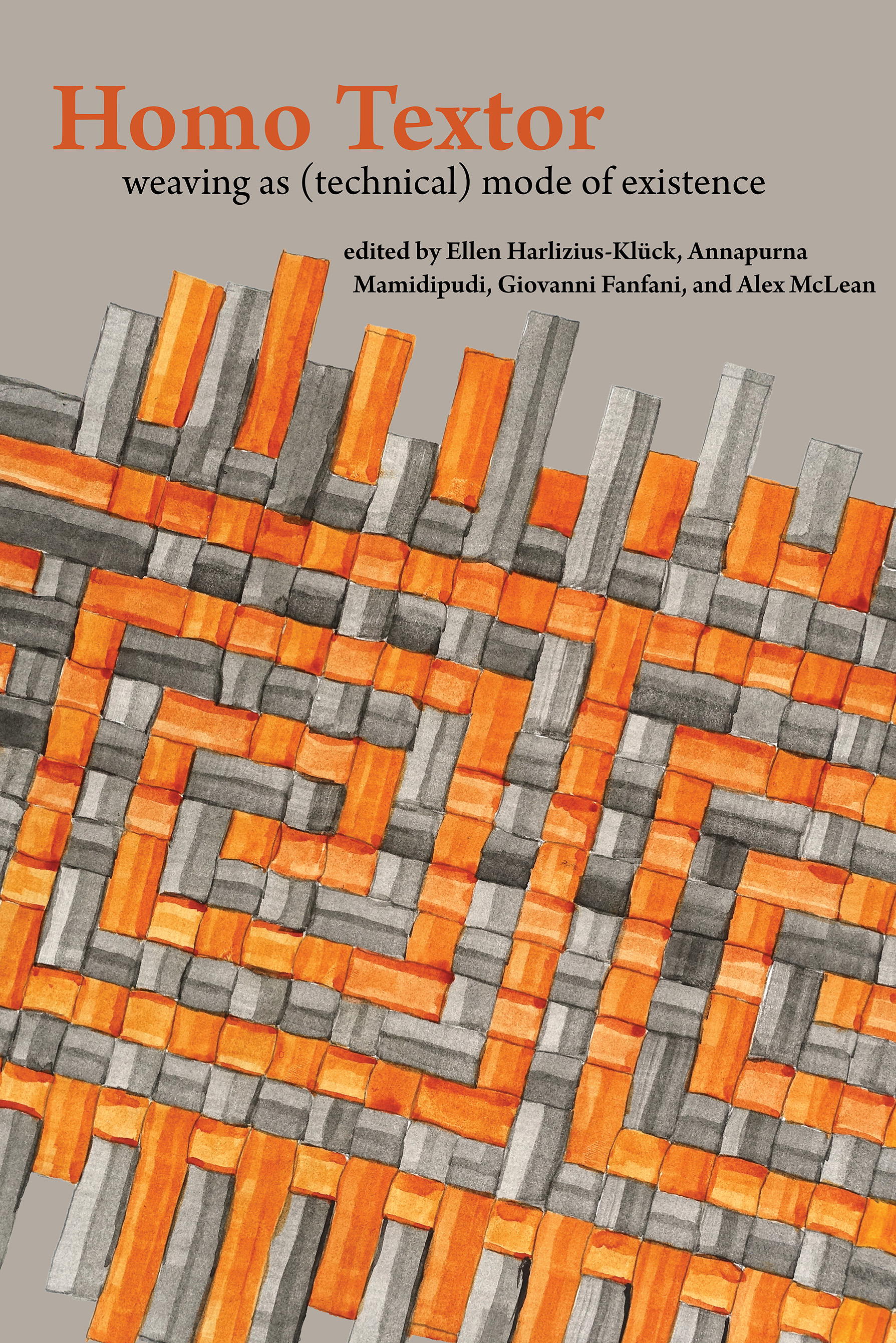
| Title | Homo Textor |
|---|---|
| Subtitle | Weaving As (Technical) Mode of Existence |
| Contributor | Ellen Harlizius-Klück(opens in new tab)(editor) |
| Annapurna Mamidipudi(opens in new tab)(editor) | |
| Giovanni Fanfani(opens in new tab)(editor) | |
| Alex McLean(opens in new tab)(editor) | |
| DOI | https://doi.org/10.28938/9781912729425(opens in new tab) |
| Landing page | https://www.matteringpress.org/books/homo-textor(opens in new tab) |
| License | https://creativecommons.org/licenses/by-nc-sa/4.0/(opens in new tab) |
| Copyright | Ellen Harlizius-Klück, Annapurna Mamidipudi, Giovanni Fanfani, Alex McLean |
| Publisher | Mattering Press |
| Published on | 2026-06-29 |
| ISBN | 978-1-912729-42-5 (Paperback) |
| 978-1-912729-40-1 (PDF) | |
| 978-1-912729-41-8 (HTML) | |
| 978-1-912729-39-5 (EPUB) | |
| Short abstract | Homo Textor aims to exemplify how weaving as a (technical) mode of existence provides concepts that help to rethink Homo faber and the way the Moderns talk about technology. It shows weaving as histomorphism, a generative process where intelligible forms grow out of the loom-weaver-threads system |
| Long abstract | Homo Textor aims to exemplify how weaving as a (technical) mode of existence provides concepts that help to rethink Homo faber and the way the Moderns (as described by Latour) talk about technology. Contradicting a hylomorphic schema where an actor gives form to matter, the characteristic weaving mode is histomorphism, a generative process where intelligible forms grow out of the loom-weaver-threads system. As the contributions in this book show, histomorphism is not a technical mode restricted to the craft of weaving, but a concept providing a complex type of order that humans/actors trace across social, formal, cosmological, digital, and philosophical dimensionsThis book extends the possibilities opened up by the ‘Inquiry into Modes of Existence’ project of Bruno Latour, and engages Ingold’s notion that making should be seen as a modality of weaving. It provides case studies, performances, technical tools, speculative analyses, ethnographic studies, and philosophical meditations that reveal something about weaving that otherwise remains invisible when presented according to common disciplinary boundaries.The contributions form clusters and connect with each other around (Part I) challenges of referencing terminology, technology, and form, (Part II) explorations of patterns as knowledge of order, and (Part III) stories about missing and seizing textile opportunities. The first part addresses established paradigms of production and making, such as the superimposition of form to matter (hylemorphism), the opposition of (extrinsic) structure and (intrinsic) substance, and the search for exact correspondences between terms and objects to which weaving poses a radical challenge. The papers in part II look at what weavers do and know and how this knowledge travels to other types of objects and beings as well as their relation to each other, the world in which they live, and how it is ordered. Part III brings together chapters demonstrating that considering seriously not only the textile object as outcome of a textile production process, but also the production process itself with its social relations and movements can take us to new perspectives not only in art, but also in coding and the development of new technologies. |
| Print length | 400 pages (nulla+400+nulla) |
| Language | English (Original) |
| Media | 102 illustrations |
| THEMA |
|
| BIC |
|
| Keywords |
|
Contents
- Ellen Harlizius-Klück
- Annapurna Mamidipudi
- Giovanni Fanfani
- Alex McLean
- Ellen Harlizius-Klück
- Julian Rohrhuber
- Giovanni Fanfani
- Anthony Tuck
- Cole Reilly
- Cinzia Presti
- Joseph Capozzi
- Lars Hallnäs
- Kalliope Sarri
- Adeline Grand-Clément
- Annapurna Mamidipudi
- Denise Y. Arnold
- Ebru Kurbak
- Alex McLean
- Caroline Radcliffe
- Victoria Mitchell
- David Griffiths