
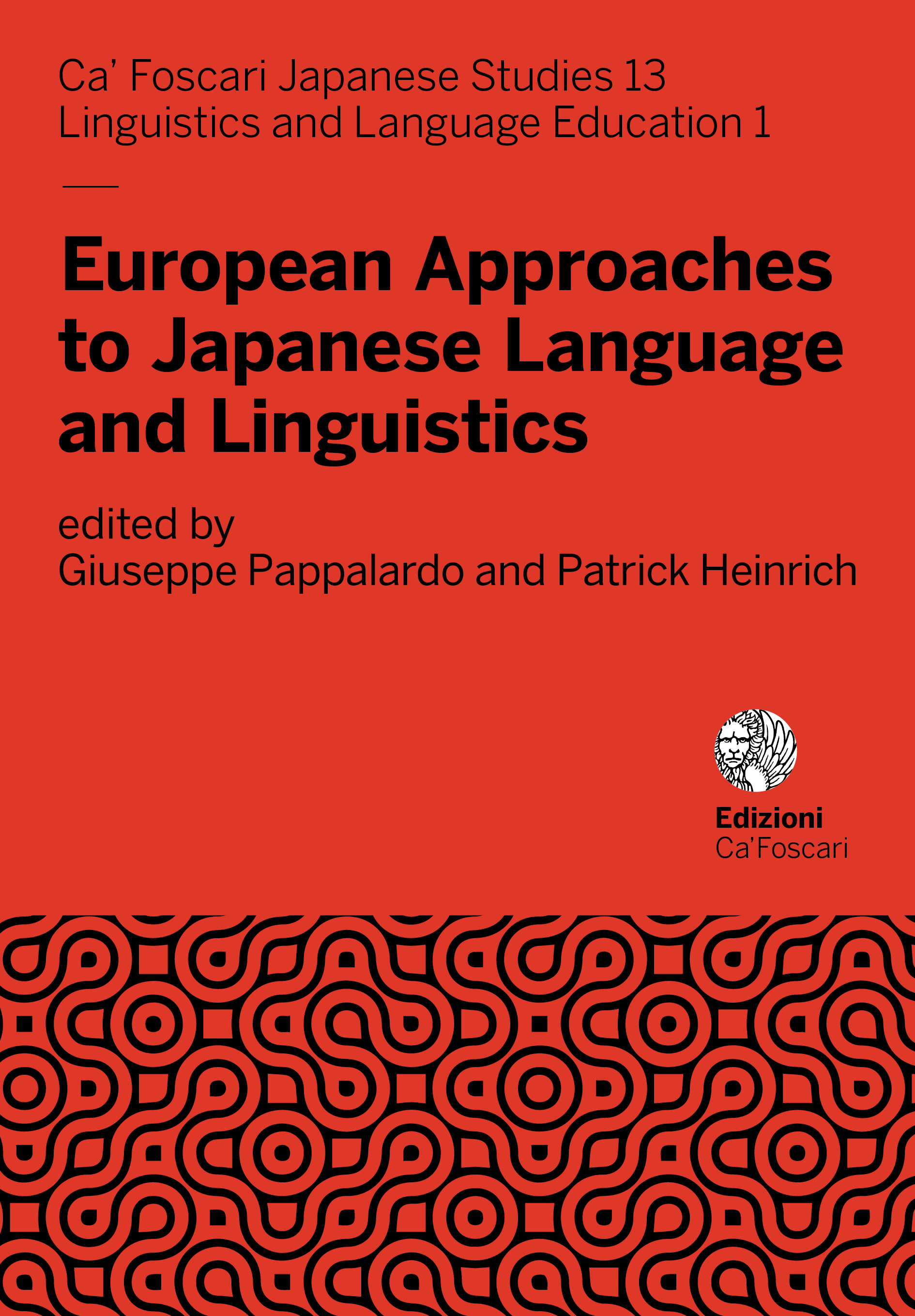
| Title | European Approaches to Japanese Language and Linguistics |
|---|---|
| Contributor | Giuseppe Pappalardo (editor) |
| Patrick Heinrich(opens in new tab)(editor) | |
| DOI | https://doi.org/10.30687/978-88-6969-428-8(opens in new tab) |
| Landing page | https://edizionicafoscari.it/en/edizioni4/libri/978-88-6969-429-5/(opens in new tab) |
| License | https://creativecommons.org/licenses/by/4.0/(opens in new tab) |
| Copyright | Patrick Heinrich, Giuseppe Pappalardo |
| Publisher | Edizioni Ca’ Foscari – Venice University Press |
| Publication place | Venice, Italy |
| Published on | 2020-07-03 |
| Series |
|
| ISBN | 978-88-6969-428-8 (Paperback) |
| 978-88-6969-428-8 (PDF) | |
| Short abstract | In this volume European specialists of Japanese language present new and original research into Japanese over a wide spectrum of topics which include descriptive, sociolinguistic, pragmatic and didactic accounts. The articles share a focus on contemporary issues and adopt new approaches to the study of Japanese that often are specific to European traditions of language study. The articles address an audience that includes both Japanese Studies and Linguistics. They are representative of the wide range of topics that are currently studied in European universities, and they address scholars and students alike. |
| Long abstract | In this volume European specialists of Japanese language present new and original research into Japanese language over a wide spectrum of topics which include descriptive, sociolinguistic, pragmatic and didactic accounts. The articles share a focus on contemporary issues and adopt new approaches to the study of Japanese that often are specific to European traditions of language study. The articles address an audience that includes both Japanese Studies and Linguistics. They are representative of the wide range of topics that are currently studied in European universities, and they address scholars and students alike. |
| Print length | 252 pages |
| Language | Italian (Original) |
| THEMA |
|
| BISAC |
|
| Keywords |
|