
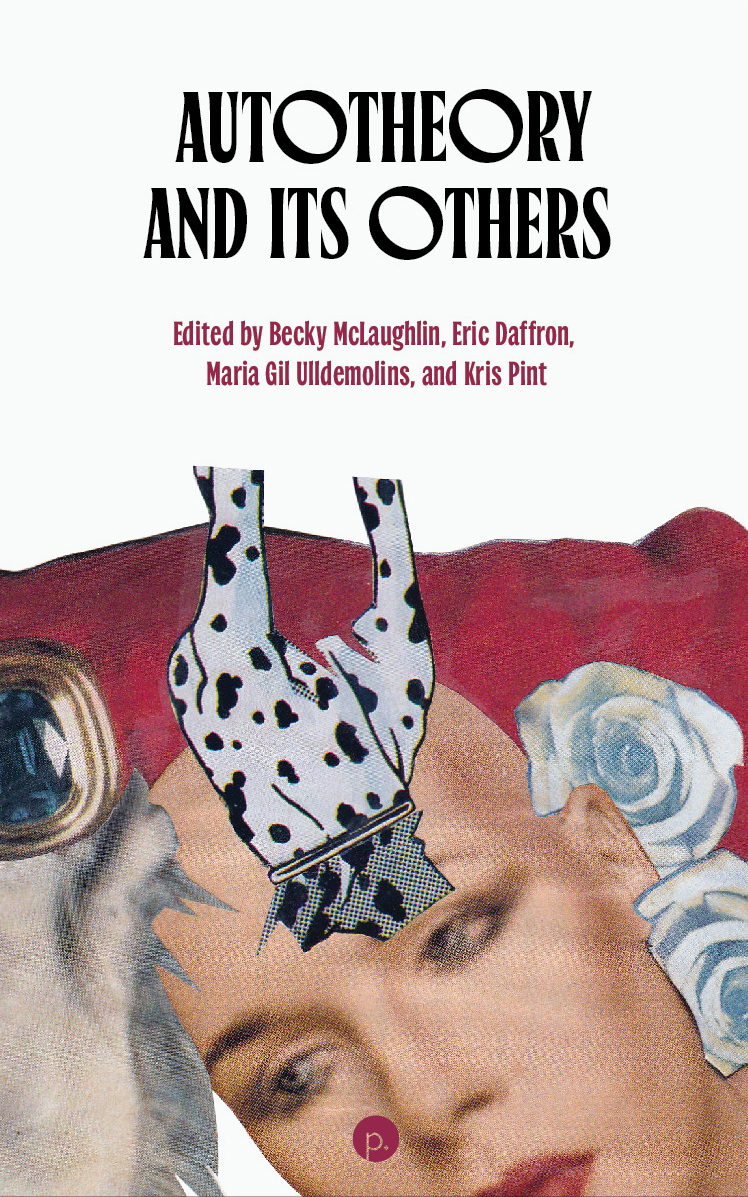
| Title | Autotheory and Its Others |
|---|---|
| Contributor | Becky McLaughlin (editor) |
| Eric Daffron (editor) | |
| Maria Gil Ulldemolins(opens in new tab)(editor) | |
| Kris Pint (editor) | |
| DOI | https://doi.org/10.53288/0530.1.00(opens in new tab) |
| Landing page | https://punctumbooks.com/titles/autotheory-and-its-others/(opens in new tab) |
| License | https://creativecommons.org/licenses/by-nc-sa/4.0/(opens in new tab) |
| Copyright | Becky McLaughlin, Eric Daffron, Maria Gil Ulldemons, and Kris Pint |
| Publisher | punctum books |
| Publication place | Earth, Milky Way |
| Published on | 2026-07-22 |
| ISBN | 978-1-68571-327-0 (Paperback) |
| 978-1-68571-328-7 (PDF) | |
| 978-1-68571-329-4 (EPUB) | |
| Long abstract | Ever since Maggie Nelson’s Argonauts gave the word fresh currency a decade ago, autotheory has infiltrated scholarly, literary, and artistic practices. Autotheory and Its Others contributes to this nascent metacritical conversation. An inclusive discourse, autotheory embraces its uncanny double, allotheory, and, thus, this collection invites to the table a host of uncanny others: psychoanalysis, queer theory, and crip theory as well as art writing, postcriticism, and autofiction, among other genres and discourses. Bringing together four editors and thirteen contributors from both sides of the Atlantic, this collection of critical and creative-critical essays grapples with what it means to couple the personal with the theoretical. The volume’s chapters feature geographical settings as far-flung as New Zealand, Iran, and Mississippi and its wide-ranging topics include anecdotal theory and dialogia–theoria, the bodymind and illness, artificial intelligence and experimentation, accident and fantasy, collages and fragments, unlearning and autopractices, unknowing and the unconscious, uncertainty and art writing, narcissus and trauma, kudzu and pedagogy, memory and legend, autofabulation and religion, and lo-fi critique and academia. Ultimately, Autotheory and Its Others showcases this emergent genre’s diversity while also charting its multivalent future directions. |
| Print length | 440 pages (nulla+440+nulla) |
| Language | English (Original) |
| Dimensions | 127 x 25.40 x 203.20 mm | 5" x 1" x 8" (Paperback) |
| Weight | 431g | 15.20oz (Paperback) |
| LCCN | 2026943283 |
| THEMA |
|
| BISAC |
|
| Keywords |
|
Contents
- Becky McLaughlin
- Eric Daffron
- Jane Gallop
- Eric Daffron
- Becky McLaughlin
- Andrew David King
- Jeremy Stewart
- Emilio Williams
- Hannah Van Hove
- Paige Sweet
- poupeh missaghi
- Selah Saterstrom
- Cat Auburn
- Alexandra Wood
- Joshua Peter Foley
- Laura Davidson
- Joanna Walsh
- Kris Pint
- Maria Gil Ulldemolins
Contributors
Becky McLaughlin
(editor)Becky McLaughlin is Professor of English at the University of South Alabama, where she teaches critical theory, early American literature, film, and gender studies. She has published essays on a wide range of topics—amputee wannabes, auto-ethnography, epistemological trauma, feminine jouissance, rock music, sexual fantasy, and the voice, to name a few—across a wide range of periods and genres such as medieval literature, Restoration comedy, modern poetry, contemporary film, and the fairy tale. She has also published autotheory pieces based on her childhood in the Belgian Congo, her cousin’s suicide in a Memphis jail cell, the death of an aerobatic pilot in the Arkansas Delta, her first marriage and its annulment, and the panic attack as hysterical symptom. Her fiction and poetry have appeared in journals such as Intelligent Erotica, Transverse, Westview, and Zizzle Literary. Two of her longer publications include The Body in Theory: Essays after Lacan and Foucault (McFarland, 2021), co-edited with Eric Daffron, and Hysteria, Perversion, and Paranoia in The Canterbury Tales (Medieval Institute Publications, 2020). She is currently completing a textbook entitled American Fanatics, Heretics, and Rebels: Hot Protestants and Religious Strife in Early American Literature, 1620–1865.
Eric Daffron
(editor)Eric Daffron is a professor of Literature at Ramapo College of New Jersey. Early in his career, he published widely on early British Gothic literature and other topics, including his book Romantic Doubles: Sex and Sympathy in British Gothic Literature, 1790–1830 (AMS Press, 2002). More recently, he has explored topics as diverse as masturbation, sex clubs, pornography, COVID-19, and masks. With Becky R. McLaughlin, he edited The Body in Theory: Essays after Lacan and Foucault (McFarland, 2021) and he has also written travel memoirs about Morocco and creative-critical essays inspired by Roland Barthes. That work has been published or is forthcoming in Moving across the Landscape in Search of an Idea (Air and Nothingness Press, 2024) and Synthesis: An Anglophone Journal of Comparative Literary Studies, European Journal of Life Writing, L’Esprit Literary Review, The AutoEthnographer, Impost: A Journal of Creative and Critical Work, Text: Journal of Writing and Writing Courses, and Panorama: The Journal of Travel, Place, and Nature.
Maria Gil Ulldemolins
(editor)Maria Gil Ulldemolins is Assistant Professor of Creative-Critical Research Methods in the Architecture and Art Faculty of Hasselt University, Belgium. Her work uses academic-performative writing in order to generate meaning through unexpected, and often anachronistic, encounters. She is particularly concerned with citational and referential practices in the overlap of interiority, interior architecture, and language. She is one of the co-founders of the research line and peer-reviewed journal Passage(opens in new tab).
Kris Pint
(editor)Kris Pint is Associate Professor of Cultural Theory at the Faculty of Architecture and Arts at Hasselt University. His research focuses on how creative (non-)fiction can be used in artistic research and how literature, interior architecture, and visual arts help propose alternative forms of living, dwelling, and knowing. In addition to a series of articles published on these topics, and several books in Dutch, he is also the author of The Perverse Art of Reading: On the Phantasmatic Semiology in Roland Barthes’ Cours au Collège de France (Brill, 2010).
References
- (opens in new tab)
- (opens in new tab)
- (opens in new tab)
- (opens in new tab)
- (opens in new tab)
- (opens in new tab)
- (opens in new tab)
- (opens in new tab)
- (opens in new tab)
- (opens in new tab)
- (opens in new tab)
- (opens in new tab)
- (opens in new tab)
- (opens in new tab)
- (opens in new tab)
- (opens in new tab)
- (opens in new tab)
- (opens in new tab)
- (opens in new tab)
- (opens in new tab)
- (opens in new tab)
- (opens in new tab)
- (opens in new tab)
- (opens in new tab)
- (opens in new tab)
- (opens in new tab)
- (opens in new tab)
- (opens in new tab)
- (opens in new tab)
- (opens in new tab)
- (opens in new tab)
- (opens in new tab)
- (opens in new tab)
- (opens in new tab)
- (opens in new tab)
- (opens in new tab)
- (opens in new tab)
- (opens in new tab)
- (opens in new tab)
- (opens in new tab)
- (opens in new tab)