
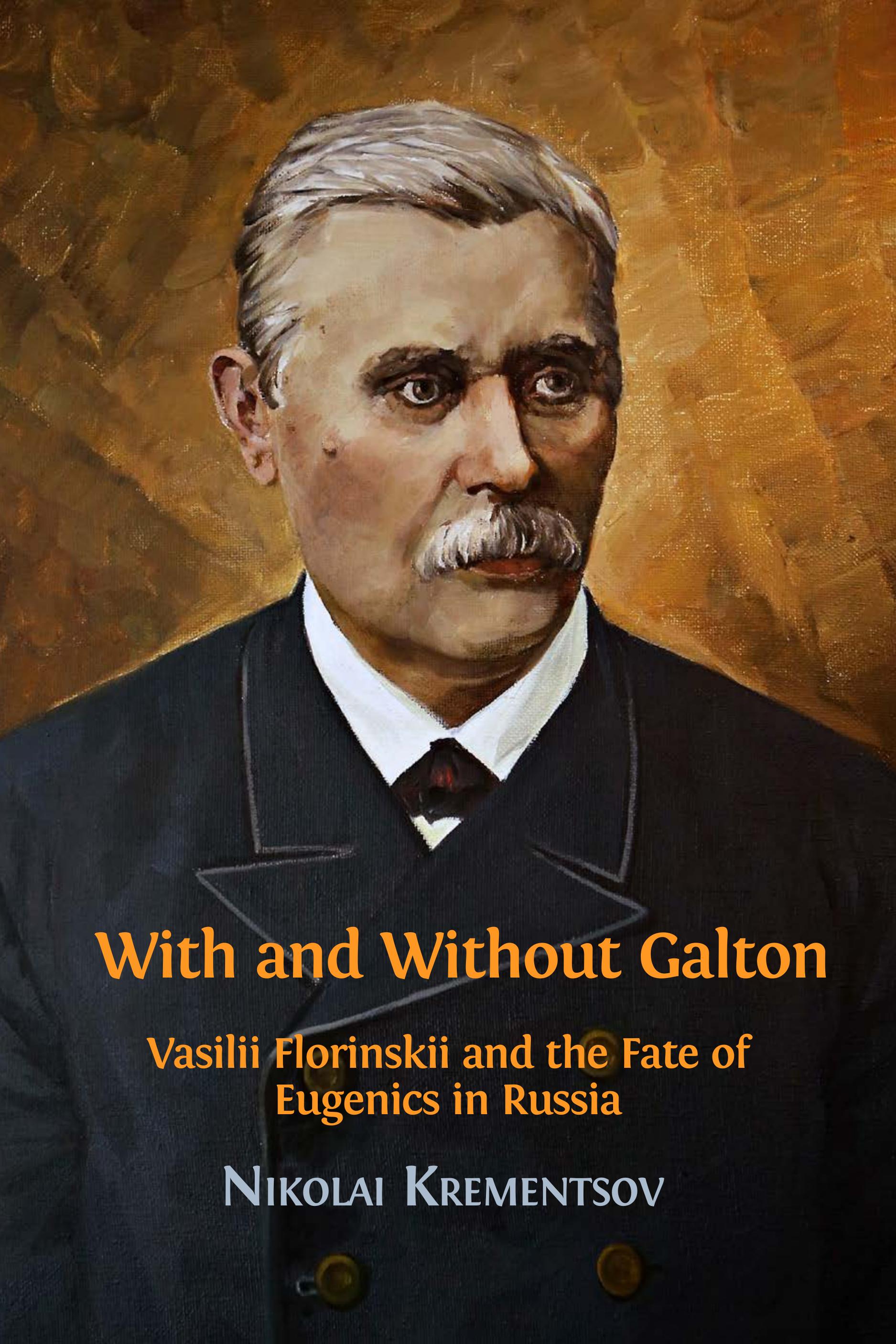
| Title | With and Without Galton |
|---|---|
| Subtitle | Vasilii Florinskii and the Fate of Eugenics in Russia |
| Contributor | Nikolai Krementsov(opens in new tab)(author) |
| DOI | https://doi.org/10.11647/OBP.0144(opens in new tab) |
| Landing page | https://www.openbookpublishers.com/books/10.11647/obp.0144(opens in new tab) |
| License | http://creativecommons.org/licenses/by/4.0/(opens in new tab) |
| Copyright | Nikolai Krementsov |
| Publisher | Open Book Publishers |
| Publication place | Cambridge, UK |
| Published on | 2018-09-24 |
| ISBN | 978-1-78374-511-1 (Paperback) |
| 978-1-78374-512-8 (Hardback) | |
| 978-1-78374-513-5 (PDF) | |
| 978-1-80064-563-9 (HTML) | |
| 978-1-78374-621-7 (XML) | |
| 978-1-78374-514-2 (EPUB) | |
| 978-1-78374-515-9 (MOBI) | |
| Short abstract | In 1865, British polymath Francis Galton published his initial thoughts about the scientific field that would become ‘eugenics.’ The same year, Russian physician Vasilii Florinskii addressed similar issues in a sizeable treatise, entitled Human Perfection and Degeneration. Initially unheralded, Florinskii’s book would go on to have a remarkable afterlife in twentieth- and twenty-first-century Russia. In this lucid and insightful work, Nikolai Krementsov argues that the concept of eugenics brings together ideas, values, practices, and fears energised by a focus on the future. |
| Long abstract | In 1865, British polymath Francis Galton published his initial thoughts about the scientific field that would become ‘eugenics.’ The same year, Russian physician Vasilii Florinskii addressed similar issues in a sizeable treatise, entitled Human Perfection and Degeneration. Initially unheralded, Florinskii’s book would go on to have a remarkable afterlife in twentieth- and twenty-first-century Russia. In this lucid and insightful work, Nikolai Krementsov argues that the concept of eugenics brings together ideas, values, practices, and fears energised by a focus on the future. It has proven so seductive to different groups over time because it provides a way to grapple with fundamental existential questions of human nature and destiny. With and Without Galton develops this argument by tracing the life-story of Florinskii’s monograph from its uncelebrated arrival amid the Russian empire’s Great Reforms, to its reissue after the Bolshevik Revolution, its decline under Stalinism, and its subsequent resurgence: first, as a founding document of medical genetics, and most recently, as a manifesto for nationalists and racial purists. Krementsov’s meticulously researched ‘biography of a book’ sheds light not only on the peculiar fate of eugenics in Russia, but also on its convoluted transnational history, elucidating the field’s protean nature and its continuing and contested appeal to diverse audiences, multiple local trajectories, and global trends. It is required reading for historians of eugenics, science, medicine, education, literature, and Russia, and it will also appeal to the general reader looking for a deeper understanding of this challenging subject. |
| Print length | 694 pages (xxvi + 668) |
| Language | English (Original) |
| Dimensions | 156 x 35 x 234 mm | 6.14" x 1.39" x 9.21" (Paperback) |
| 156 x 38 x 234 mm | 6.14" x 1.50" x 9.21" (Hardback) | |
| Weight | 2117g | 74.68oz (Paperback) |
| 2524g | 89.03oz (Hardback) | |
| Media | 49 illustrations |
| OCLC Number | 1056677315 |
| LCCN | 2019452974 |
| BIC |
|
| BISAC |
|
| LCC |
|
| Keywords |
|
| Funding |
Contents
- The Author: Vasilii Florinskii
- Nikolai Krementsov
- The Publisher: Grigorii Blagosvetlov
- Nikolai Krementsov
- The Book: Darwinism and Social Hygiene
- Nikolai Krementsov
- The Hereafter: Words and Deeds
- Nikolai Krementsov
- Rebirth: Eugenics and Marxism
- Nikolai Krementsov
- Resonance: Euphenics, Medical Genetics, and Rassenhygiene
- Nikolai Krementsov
- Afterlife: Medical Genetics and “Racial” Eugenics
- Nikolai Krementsov
- Science of the Future: With and Without Galton
- Nikolai Krementsov
- Nikolai Krementsov
- Nikolai Krementsov
- Nikolai Krementsov
Contributors
Nikolai Krementsov
(author)Nikolai Krementsov is a Professor at the Institute for the History and Philosophy of Science and Technology, University of Toronto (Canada). He has published several monographs and numerous articles on various facets of the history of science, medicine, and literature in Russia and the Soviet Union. His latest publications include A Martian Stranded on Earth: Alexander Bogdanov, Blood Transfusions, and Proletarian Science (2011), Revolutionary Experiments: The Quest for Immortality in the Bolshevik Science and Fiction (2014), and The Lysenko Controversy as a Global Phenomenon (2017), 2 vols. (co-edited with William deJong-Lambert).