
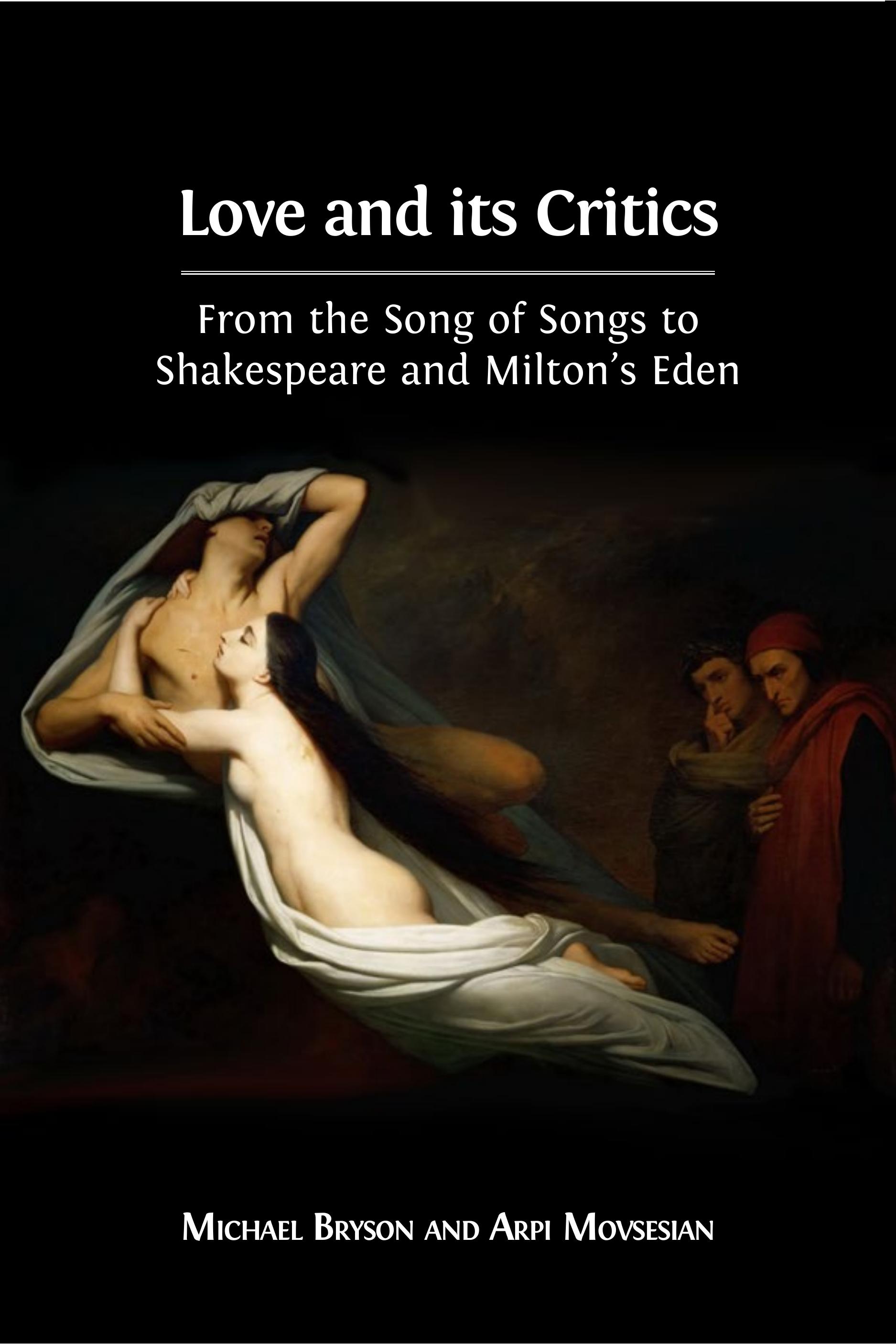
| Title | Love and its Critics |
|---|---|
| Subtitle | From the Song of Songs to Shakespeare and Milton’s Eden |
| Contributor | Michael Bryson(opens in new tab)(author) |
| Arpi Movsesian (author) | |
| DOI | https://doi.org/10.11647/OBP.0117(opens in new tab) |
| Landing page | https://www.openbookpublishers.com/books/10.11647/obp.0117(opens in new tab) |
| License | http://creativecommons.org/licenses/by/4.0/(opens in new tab) |
| Copyright | Michael Bryson; Arpi Movsesian |
| Publisher | Open Book Publishers |
| Publication place | Cambridge, UK |
| Published on | 2017-07-10 |
| ISBN | 978-1-78374-348-3 (Paperback) |
| 978-1-78374-349-0 (Hardback) | |
| 978-1-78374-350-6 (PDF) | |
| 978-1-80064-536-3 (HTML) | |
| 978-1-78374-616-3 (XML) | |
| 978-1-78374-351-3 (EPUB) | |
| 978-1-78374-352-0 (MOBI) | |
| Short abstract | This book is a history of love and the challenge love offers to the laws and customs of its times and places, as told through poetry from the Song of Songs to John Milton’s Paradise Lost. It is also an account of the critical reception afforded to such literature, and the ways in which criticism has attempted to stifle this challenge. |
| Long abstract | This book is a history of love and the challenge love offers to the laws and customs of its times and places, as told through poetry from the Song of Songs to John Milton’s Paradise Lost. It is also an account of the critical reception afforded to such literature, and the ways in which criticism has attempted to stifle this challenge. Bryson and Movsesian argue that the poetry they explore celebrates and reinvents the love the troubadour poets of the eleventh and twelfth centuries called fin’amor: love as an end in itself, mutual and freely chosen even in the face of social, religious, or political retribution. Neither eros nor agape, neither exclusively of the body, nor solely of the spirit, this love is a middle path. Alongside this tradition has grown a critical movement that employs a 'hermeneutics of suspicion', in Paul Ricoeur’s phrase, to claim that passionate love poetry is not what it seems, and should be properly understood as worship of God, subordination to Empire, or an entanglement with the structures of language itself – in short, the very things it resists. The book engages with some of the seminal literature of the Western canon, including the Bible, the poetry of Ovid, and works by English authors such as William Shakespeare and John Donne, and with criticism that stretches from the earliest readings of the Song of Songs to contemporary academic literature. Lively and enjoyable in its style, it attempts to restore a sense of pleasure to the reading of poetry, and to puncture critical insistence that literature must be outwitted. It will be of value to professional, graduate, and advanced undergraduate scholars of literature, and to the educated general reader interested in treatments of love in poetry throughout history. |
| Print length | 576 pages (x + 566) |
| Language | English (Original) |
| Dimensions | 156 x 30 x 234 mm | 6.14" x 1.17" x 9.21" (Paperback) |
| 156 x 32 x 234 mm | 6.14" x 1.25" x 9.21" (Hardback) | |
| Weight | 1765g | 62.26oz (Paperback) |
| 2164g | 76.33oz (Hardback) | |
| Media | 16 illustrations |
| OCLC Number | 1004188258 |
| LCCN | 2019452599 |
| BIC |
|
| BISAC |
|
| LCC |
|
| Keywords |
|
| Funding |
Contents
- Love and Authority: Love Poetry and its Critics
- Michael Bryson
- Arpi Movsesian
- Channeled, Reformulated, and Controlled: Love Poetry from the Song of Songs to Aeneas and Dido
- Michael Bryson
- Arpi Movsesian
- Love and its Absences in Late Latin and Greek Poetry
- Michael Bryson
- Arpi Movsesian
- The Troubadours and Fin’amor: Love, Choice, and the Individual
- Michael Bryson
- Arpi Movsesian
- Fin’amor Castrated: Abelard, Heloise, and the Critics who Deny
- Michael Bryson
- Arpi Movsesian
- The Albigensian Crusade and the Death of Fin’amor in Medieval French and English Poetry
- Michael Bryson
- Arpi Movsesian
- The Ladder of Love in Italian Poetry and Prose, and the Reactions of the Sixteenth-Century Sonneteers
- Michael Bryson
- Arpi Movsesian
- Shakespeare: The Return of Fin’amor
- Michael Bryson
- Arpi Movsesian
- Love and its Costs in Seventeenth-Century Literature
- Michael Bryson
- Arpi Movsesian
- Paradise Lost: Love in Eden, and the Critics who Obey
- Michael Bryson
- Arpi Movsesian
- Michael Bryson
- Arpi Movsesian
Contributors
Michael Bryson
(author)Arpi Movsesian
(author)References
- Abelard, Peter, and Heloise d’Argenteuil. Magistri Petri Abaelardi epistola quae est Historia calamitatum: Heloissae et Abaelardi epistolae, ed. by Johann Caspar von Orelli. Turici: Officina Ulrichiana, 1841, https://archive.org/details/magistripetriaba00abel
- Abels, Richards and Ellen Harrison. “The Participation of Women in Languedocian Catharism”. Mediaeval Studies, 41 (1979), 215–51, https://doi.org/10.1484/J.MS.2.306245(opens in new tab)
- Adorno, Theodore. “Studies in the Authoritarian Personality”. In T. W. Adorno, Else Frenkel-Brunswik, Daniel J. Levinson, and R. Nevitt Sanford, The Authoritarian Personality, Vol. I of Studies in Prejudice, ed. by Max Horkheimer and Samuel H. Flowerman (Social Studies Series: Publication No. III). New York: Harper & Brothers, 1950, 145–509, https://www.scribd.com/doc/35738019/Adorno-Theodor-W-Studies-in-the-Authoritarian-Personality
- Agrippa, Cornelius. De Nobilitate et Praecellentia Foeminei Sexus. Antwerp: Michael Hillenius, 1529, https://books.google.it/books?id=ZoQNUzFZ5UEC&pg=PT2&redir_esc=y
- Aist, Dietmar von. “Slâfest du, friedel ziere?” In Des minnesangs frühling, ed. by Friedrich Vogt. Leipzig: Verlag von S. Hirzel, 1920, https://books.google.com/books?id=DcQPAAAAMAAJ&pg=PR1
- Alcuin. “Epistola CCVI, Ad Disciplum”. In Patrologiae Cursus Completus, Vol. 100, ed. by Jacques Paul Migne. Paris: Apud Garnier Fratres, 1863, cols. 481–82, https://books.google.com/books?id=-JqsZH3ajIgC&pg=PA12
- —. “Interrogationes et Responsiones in Genesin”. In Patrologiae Cursus Completus, Vol. 100, ed. by Jacques Paul Migne. Paris: Apud Garnier Fratres, 1863, cols. 551–70, https://books.google.com/books?id=-JqsZH3ajIgC&pg=PA12
- —. “Pectus amor nostrum penetravit flamma”. Monumenta Germaniae historica inde ab anno Christi quingentesimo usque ad annum millesimum et quingentesimum, Vol. 1. Berlin: Apud Weidmannos, 1881, https://books.google.com/books?id=U6woAAAAMAAJ&pg=PP10
- Allen, Peter L. The Art of Love: Amatory Fiction from Ovid to the Romance of the Rose. Philadelphia: University of Pennsylvania Press, 1992.
- Allestree, Richard. The Practice of Christian Graces, Or, The Whole Duty of Man Laid down in a Plaine and Familiar Way for the Use of All, but Especially the Meanest Reader: Divided into XVII Chapters. London: Printed by D. Maxwell for T. Garthwait, 1658, https://quod.lib.umich.edu/e/eebo/A23760.0001.001/1:4?rgn=div1;vid=96830;view=fulltext
- Alter, Robert. “Paul de Man Was a Total Fraud”. New Republic. April 5, 2014, https://newrepublic.com/article/117020/paul-de-man-was-total-fraud-evelyn-barish-reviewed
- Altermeyer, Bob. The Authoritarian Specter. Cambridge, MA: Havard University Press, 1996.
- Althusser, Louis. “Idéologie et Appareils Idéologiques d’État” (1970). Les Classiques des Sciences Sociales. Quebec: Université du Québec à Chicoutimi, 1–60, http://classiques.uqac.ca/contemporains/althusser_louis/ideologie_et_AIE/ideologie_et_AIE.pdf
- —. Lire le Capital. Paris: Presses Universitaires de France, 1996.
- Ames, Christine Caldwell. Medieval Heresies: Christianity, Judaism, and Islam. Cambridge: Cambridge University Press, 2015.
- Anderson, W. S. “The Heroides”. In Ovid, ed. by James Wallace Binns. London: Routledge, 1973, 49–83.
- Andreasen, Nancy Jo Coover. John Donne: Conservative Revolutionary. Princeton: Princeton University Press, 1967.
- Andreini, Giambattisti. L’Adamo, ed. by Ettore Allodoli. Lanciano: Carabba, 1913, https://archive.org/details/ladamoand00andruoft
- Arden of Faversham. In A Woman Killed with Kindness and Other Domestic Plays, ed. by Martin Wiggins. Oxford: Oxford University Press, 2008.
- Aucassin et Nicolette, ed. by Francis William Bourdillon. London: Kegan Paul, Trench & Co., 1887, https://archive.org/details/AucassinEtNicoletteALove Story
- Aquinas, Thomas. Summa Theologiae: Vol. 41, Virtues of Justice in the Human Community, ed. by T. C. O’Brien. Cambridge: Cambridge University Press, 2006.
- Arden, Heather. The Romance of the Rose. Boston: Twayne Publishers, 1987.
- Arendt, Hannah. The Origins of Totalitarianism. San Diego: Harcourt, 1968.
- Aries, Philippe. “The Family, Sex and Marriage in England, 1500–1800”. The American Historical Review, 83: 5 (1978), 1221–24, https://doi.org/10.2307/1854694(opens in new tab)
- Aristotle. Nichomachean Ethics I, ed. by H. Rackham. Loeb Classical Library, Cambridge, MA: Harvard University Press, 1926.
- —. Physics, Vol. II, Books 5–8. Ed. and trans. by P. H. Wicksteed and F. M. Cornford. Loeb Classical Library, Cambridge, MA: Harvard University Press, 1934.
- —. Poetics. Ed. and trans. by Stephen Halliwell. In Aristotle: Poetics. Longinus: On the Sublime. Demetrius: On Style. Loeb Classical Library, Cambridge, MA: Harvard University Press, 1995, https://doi.org/10.4159/dlcl.aristotle-poetics.1995(opens in new tab)
- —. Poetics. Trans. by Richard Janko. Indiannapolis: Hackett, 1987.
- —. Politics. Ed. and trans. by Harris Rackham. Loeb Classical Library, Cambridge, MA: Harvard University Press, 1932.
- Armstrong, Rebecca. Ovid and His Love Poetry. London: Bloomsbury Academic, 2005, https://doi.org/10.5040/9781472539977(opens in new tab)
- Astell, Ann W. The Song of Songs in the Middle Ages. Ithaca: Cornell University Press, 1990.
- Aubrey, John. Wiltshire. The Topographical Collections of John Aubrey, 1659–70, ed. by John Edward Jackson. London: Longman, 1862, https://archive.org/details/wiltshiretopogra00aubr
- Auerbach, Erich. Mimesis: Dargestellte Wirklichkeit in Der Abendländischen Literatur. 2nd ed. Bern: A. Francke, 1959.
- Augustine of Hippo. De Civitate Dei. Paris: 1586, https://books.google.com/books?id=pshhAAAAcAAJ&printsec=frontcover&source=gbs_ge_summary_r&cad=0
- Ausonius. “Ad Uxorem”, Epigram 20. In Ausonius: Epigrams. Text with Introduction and Commentary. Ed. and trans. by Nigel M. Kay. London: Duckworth, 2001, 45.
- —. “Attusia Lucana Sabina Uxor”, Parentalia IX. In Ausonius. Vol. I: Books 1–17. Ed. and trans. by Hugh G. Evelyn-White. Loeb Classical Library, Cambridge, MA: Harvard University Press, 1919, 70, 72.
- Austin, R. G. P. Vergili Maronis Aneidos Liber Quartos. Oxford: Clarendon Press, 1955.
- Auweele, Bart Vanden. “The Song of Songs as Normative Text”. In Religion and Normativity, Vol. 1: The Discursive Struggle over Religious Texts in Antiquity, ed. by Anders-Christian Jacobson, Bart Vanden Auweele, and Carmen Cvetkovic. Aarhus: Aarhus University Press, 2009, 157–67.
- Avitus of Vienne (Alcimus Ecdicius Avitus). De Mosaice Historiae Gestis. In S. Aviti, Archiepiscopi Viennensis Opera. Paris, 1643, https://babel.hathitrust.org/cgi/pt?id=dul1.ark:/13960/t1hh95n3b;view=1up;seq=5
- Bagot, Richard. “Letter from Richard Bagot to Richard Broughton, 1587 June 3”. In Papers of the Bagot Family of Blithfield, Staffordshire, 1428–1671 (bulk 1557–1671). Folger MS L.a.68, Folger Shakespeare Library, Washington, http://luna.folger.edu/luna/servlet/workspace/handleMediaPlayer?lunaMediaId=FOLGERCM1~6~6~361296~130605
- Baker, Richard. A Chronicle of the Kings of England (London: Printed by George Sawbridge at the Bible on Ludgate-hill, 1670, https://books.google.com/books?id=BnIVsU0RtzUC&pg=PP12
- Barazzetti, Donatella, Franca Garreffa, and Rosaria Marsico. National Report: Italia. Daphne Project: Proposing New Indicators: Measuring Violence’s Effects. University of Calabria, Rende: Italy, 2007, http://www.surt.org/gvei/docs/national_report_italy.pdf
- Barhaim, Gabriel A. Public-Private Relations in Totalitarian States. London: Transaction Publishers, 2012.
- Barthes, Roland. “La mort de l’auteur”. In Le Bruissement de la Langue. Essais Critiques IV. Paris: Seuil, 1984, 61–69.
- Bell, Ilona. “Gender Matters: The Women in Donne’s Poems”. In The Cambridge Companion to John Donne, ed. by Achsah Guibbory Cambridge: Cambridge University Press, 2006, 201–16, https://doi.org/10.1017/ccol0521832373.013(opens in new tab)
- Bell, Kimberly K., and Julie Nelson Couch. The Texts and Contexts of Oxford, Bodleian Library, Ms Laud Misc. 108: The Shaping of English Vernacular Narrative. Boston: Brill, 2011, https://doi.org/10.1163/ej.9789004192065.i-342(opens in new tab)
- Belsey, Catherine. Desire: Love Stories in Western Culture. Oxford: Oxford University Press, 1994.
- Ben-Zeʼev, Aharon and Ruhama Goussinsky. In the Name of Love: Romantic Ideology and Its Victims. Oxford: Oxford University Press, 2008, https://doi.org/10.1093/acprof:oso/9780198566496.001.0001(opens in new tab)
- Bernays, Edward. Propaganda. New York: Horace Liveright, 1928, https://archive.org/details/EdwardL.BernaysPropaganda
- Berry, Ralph. The Shakespearean Metaphor: Studies in Language and Form. New York: Macmillan, 1978, https://doi.org/10.1007/978-1-349-03563-2(opens in new tab)
- Best, Stephen and Sharon Marcus. “Surface Reading: An Introduction”. Representations, 108: 1 (Fall 2009), 1–21, https://doi.org/10.1525/rep.2009.108.1.1(opens in new tab)
- Biblia Hebraica Stuttgartensia, ed. by Karl Elliger and Willhelm Rudolph. Stuttgart: Deutsche Bibelgesellschaft, 1983.
- Blackwood, Adam. Martyre de la Royne d’Escosse. Edinburgh, 1587, https://books.google.com/books?id=_mZUAAAAcAAJ&printsec=frontcover&source=gbs_ge_summary_r&cad=0
- Blair, Peter Hunter. Ango-Saxon England. New York: Cambridge University Press, 1959.
- Blake, William. The Complete Poetry and Prose of William Blake, ed. by David V. Erdman. Berkeley and Los Angeles: University of California Press, 2008.
- —. The Works of William Blake, ed. by Edwin John Ellis and William Butler Yeats, Vols. 1–3. London: Benard Quartich, 1893, https://archive.org/details/worksofwilliambl02blakrich
- Blanc, Pierre. “Sonnet des origines, origine du sonnet: Giacomo da Lentini”. In Le sonnet a la Renaissance: des origenes au XVIIe siècle, ed. by Yvonne Bellenger. Paris: Aux Amateurs de Livres, 1998, 9–18.
- Blanchot, Maurice. “La Littérature et le droit à la mort”. In La Part de Feu. Paris: Gallimard, 1949, 291–331.
- —. “La Solitude Essentielle”. In L’Espace Littéraire. Paris: Gallimard, 1955, 9–25.
- Blank, Hanne. Virgin: The Untouched History. New York: Bloomsbury, 2007.
- Blasia, Damián E., Søren Wichmannd, Harald Hammarströmb, Peter F. Stadlerc, and Morten H. Christiansen. “Sound-meaning association biases evidenced across thousands of languages”. Proceedings of the National Academy of Sciences (27 September 2016), 113: 39, http://www.pnas.org/content/113/39/10818.full, https://doi.org/10.1073/pnas.1605782113(opens in new tab)
- Blevins, Jacob. Catullan Consciousness and the Early Modern Lyric in England: From Wyatt to Donne. Aldershot: Ashgate, 2004.
- Bloch, Ariel and Chana. The Song of Songs: A New Translation and Commentary. New York: Random House, 1995.
- Bloch, R. Howard, and Stephen G. Nichols. “Introduction”. In Medievalism and the Modern Temper, ed. by R. Howard Bloch and Stephen G. Nichols. Baltimore: Johns Hopkins University Press, 1996, 1–22.
- Bloom, Harold. Shakespeare: The Invention of the Human. New York: Penguin, 1998.
- —. The Western Canon: The Books and School of the Ages. New York: Harcourt Brace, 1994.
- Blumenfeld-Kosinski, Renate. “Jean Gerson and the Debate on the Romance of the Rose”. A Companion to Jean Gerson, ed. by Brian Patrick McGuire. Leiden: Brill, 2006, 317–56.
- Boase, Roger. The Origin and Meaning of Courtly Love: A Critical Study of European Scholarship. Manchester: Manchester University Press, 1977.
- Boccalini, Traiano. I ragguagli di Parnasso: Or, Advertisements from Parnassus. Trans. by Henry, Earl of Monmouth. London, 1674.
- Bogin, Magda, ed. The Women Troubadours. New York: Paddington Press, 1976.
- Bolduc, Michelle. “The Breviari D’Amor: Rhetoric and Preaching in Thirteenth-Century Languedoc”. Rhetorica, 24: 4 (2006), 403–25, https://doi.org/10.1525/rh.2006.24.4.403(opens in new tab)
- Born, Bertan de. The Poems of the Troubadour Bertran De Born, ed. by William D. Paden, Tilde Sankovitch, and Patricia H. Stablein. Berkeley: University of California Press, 1986.
- Boswell, John. Christianity, Social Tolerance, and Homosexuality: Gay People in Western Europe from the Beginning of the Christian Era to the Fourteenth Century. Chicago, University of Chicago Press, 1980.
- Boyd, Barbara Weiden. “The Amores: The Invention of Ovid”. In Brill’s Companion to Ovid, ed. by Barbara Weiden Boyd. Leiden: Brill, 2002, 91–116, https://doi.org/10.1163/9789047400950_004(opens in new tab)
- Boyle, David. Troubadour’s Song: The Capture, Imprisonment and Ransom of Richard the Lionheart. New York: Walker & Co., 2005.
- Brady, Bernard V. Christian Love. Washington: Georgetown University Press, 2003.
- Briffault, Robert. The Troubadours, ed. by Lawrence F. Koons. Bloomington: Indiana University Press, 1965.
- Brogan, Walter A. “The Original Difference”. In Derrida and Différance, ed. by David Wood and Robert Bernasconi. Evanston: Northwestern University Press, 1985, 31–39.
- Brown, Peter, ed. A Companion to Medieval English Literature and Culture, c.1350-c.1500. Malden: Blackwell, 2007, https://doi.org/10.1002/9780470996355(opens in new tab)
- —. Through the Eye of a Needle: Wealth, the Fall of Rome, and the Making of Christianity in the West, 350–550 AD. Princeton: Princeton University Press, 2012, https://doi.org/10.1515/9781400844531(opens in new tab)
- Bruckner, Matilda Tomaryn, Laurie Shepard, and Sarah White, eds. Songs of the Women Troubadours. New York: Garland Publishing, 2000.
- Bruckner, Matilda Tomaryn. “‘Redefining the Center’ Verse and Prose Charrette”. In A Companion to the Lancelot-Grail Cycle, ed. by Carol Dover. Cambridge, UK: Brewer, 2003, 95–106.
- Bryson, Michael. The Atheist Milton. Farnham: Ashgate, 2012, https://doi.org/10.4324/9781315613796(opens in new tab)
- —. The Tyranny of Heaven: Milton’s Rejection of God as King. London: Associated University Presses, 2004.
- Bulgakov, Mikhail. Мастер и Маргарита [Master and Margarita]. Moscow: Olma Media Group, 2005.
- Burckhardt, Jacob. Die Cultur der Renaissance in Italien: Ein Versuch. Basel: Schweighauser, 1860, https://babel.hathitrust.org/cgi/pt?id=gri.ark:/13960/t7fr4fg3z;view=1up;seq=5
- Burden, Dennis H. The Logical Epic: A Study of the Argument of “Paradise Lost’. Cambridge, MA: Harvard University Press, 1967.
- Burgwinkle, William E. Love for Sale: Materialist Readings of the Troubadour Razo Corpus. New York: Garland, 1997.
- —. “The Troubadours: The Occitan Model”. In The Cambridge History of French Literature, ed. by William E. Burgwinkle, Nicholas Hammond, and Emma Wilson. Cambridge: Cambridge University Press, 2011, 20–27, https://doi.org/10.1017/chol9780521897860.004(opens in new tab)
- Burns, E. Jane. Courtly Love Undressed: Reading Through Clothes in Medieval French Culture. Philadelphia: University of Pennsylvania Press, 2002, https://doi.org/10.9783/9780812291247(opens in new tab)
- —. “Courtly Love: Who Needs It? Recent Feminist Work in The Medieval French Tradition”. Signs: Journal of Women in Culture and Society, 27: 1 (2001), 23–57, https://doi.org/10.1086/495669(opens in new tab)
- Buturovic, Amila. “‘Only Women and Writing Can Save Us From Death’: Erotic Empowering in the Poetry of Nizār Qābbanī”. In Tradition, Modernity, and Postmodernity in Arabic Literature: Essays in Honor of Professor Issa J. Boullata, ed. by Kamal Abdel-Malek and Wael Hallaq. Leiden: Brill, 2000, 141–57.
- Byrne, Sister Marie José. Prolegomena to an Edition of the Works of Decimus Magnus Ausonius. New York: Columbia University Press, 1916.
- Callaghan, Dympna. “The Ideology of Romantic Love: The Case of Romeo and Juliet”. In The Weyward Sisters: Shakespeare and Feminist Politics, ed. by Dympna Callaghan, Lorraine Rae Helms, and Jyotsna Singh, Cambridge, MA: Blackwell, 1994, 59–101.
- —. Shakespeare’s Sonnets. Malden: Blackwell, 2007, https://doi.org/10.1002/9780470774878(opens in new tab)
- Calvin, Jean. Institutio Christianae Religionis. Geneva: Oliua Roberti Stephani, 1559, https://books.google.com/books?id=6ysy-UX89f4C&printsec=frontcover&source=gbs_ge_summary_r&cad=0
- Cameron, Alan. Claudian: Poetry and Propaganda at the Court of Honorius. Oxford: Clarendon Press, 1970.
- Campbell, Joseph. The Masks of God: Creative Mythology. New York: Viking Press, 1968.
- —. The Power of Myth, ed. by Betty Sue Flowers. New York: Doubleday, 1988.
- Camproux. Charles. Le “joy d’amor” des troubadours. Jeu et joie d’amour. Montpellier: Causse et Castelnau, 1965.
- Camus, Albert. “L’été à Alger”. In his Noces suivi de L’été. Paris: Gallimard, 1959, 33–52.
- Capellanus, Andreas. De Amore Libri Tres: Von Der Liebe. Drei Bücher. Berlin and Boston: De Gruyter, 2006.
- —. The Art of Courtly Love. Trans. by John Jay Perry. New York: W. W. Norton & Co., 1941.
- Carmina Burana: Lateinische und Deutsche Lieder und Gedichte einer Handschrift des XIII Jahihunderts aus Benedictbeuern auf der K. Bibliothek gu München, ed. by Johann Andreas Schmeller. Stuttgart: Literarischen Vereins, 1847, https://books.google.com/books?id=0XN3YW-EqacC&pg=PP1
- Carroll, Lewis. Through the Looking Glass: and What Alice Found There. Philadelphia: Henry Altemus Company, 1897.
- Casali, Sergio. “The Art of Making Oneself Hated: Rethinking (Anti-)Augustanism in Ovid’s Ars Amatoria”. In The Art of Love: Bimillennial Essays on Ovid’s Ars Amatoria and Remedia Amoris, ed. by Roy Gibson, Steven Green, and Alison Sharrock. Oxford: Oxford University Press, 2006, 216–34, https://doi.org/10.1093/acprof:oso/9780199277773.003.0011(opens in new tab)
- —. “The Bellum Civile as an Anti-Aeneid”. Brill’s Companion to Lucan, ed. by Paolo Asso. Leiden: Brill, 2011, 81–109, https://doi.org/10.1163/9789004217096_006(opens in new tab)
- Castiglione, Baldassarre. Il Libro del Cortegiano. Milano: Giovanni Silvestri, 1822, https://archive.org/details/illibrodelcorteg00cast
- Castor, Helen. She-Wolves: The Women Who Ruled England before Elizabeth. London: Faber and Faber, 2010.
- Catullus, Gaius Valerius. Catullus. Tibullus. Pervigilium Veneris. Ed. and trans. by. F. W. Cornish. Loeb Classical Library, Cambridge, MA: Harvard University Press, 1913.
- Cazelles, Brigitte. The Lady as Saint: A Collection of French Hagiographic Romances of the Thirteenth Century. University Park: University of Pensylvannia Press, 1991.
- Chaucer, Geoffrey. The Canterbury Tales: Complete, ed. by Larry Dean Benson. Boston: Houghton Mifflin, 2000.
- Cheyette, Fredric L. Ermengard of Narbonne and the World of the Troubadours. Ithaca: Cornell University Press, 2001.
- Chomsky, Noam. “Beyond a Domesticating Education: A Dialogue”. In Noam Chomsky, Chomsky on Miseducation. Lanham: Rowman & Littlefield, 2004, 15–37.
- —. LBBS, Z-Magazine’s Left On-Line Bulletin Board. Online discussion posted at rec.arts.books, 13 November 1995, 03:21:23, http://bactra.org/chomsky-on-postmodernism.html
- —. “Noam Chomsky on French Intellectual Culture & Post-Modernism [3/8]”. Interview conducted at Leiden University, in March 2011 (posted March 15, 2012), https://www.youtube.com/v/2cqTE_bPh7M&feature=youtu.be&start=409&end=451 [6:49–7:31].
- —. The Common Good (Berkeley: Odonian Press, 1998).
- Chrétien de Troyes. Le Chevalier de la Charrette, ed. by Alfred Foulet and Karl D. Uitti. Paris: Classiques Garnier, 1989.
- Cicero. De Finibus Bonorum et Malorum. In Cicero, On Ends, ed. by H. Rackham. Loeb Classical Library, Cambridge, MA: Harvard University Press, 1914.
- Cirlot, Victoria, ed. Antología de textos románicos medievales: siglos XII–XIII. Barcelona: Edicions Universitat Barcelona, 1984.
- Clark, Alice V. “From Abbey to Cathedral and Court: Music Under the Merovingian, Carolingian and Capetian Kings in France until Louis IX”. The Cambridge Companion to French Music. Cambridge: Cambridge University Press, 2015, 3–20, https://doi.org/10.1017/cco9780511843242.003(opens in new tab)
- Clark, David. Between Medieval Men: Male Friendship and Desire in Early Medieval English Literature. Oxford: Oxford University Press, 2009, https://doi.org/10.1093/acprof:oso/9780199558155.001.0001(opens in new tab)
- Claudian (Claudius Claudianus). Claudian: Vol. II. Ed. and trans. by Maurice Platnauer. Loeb Classical Library, Cambridge, MA: Harvard University Press, 1998.
- Clements, Ronald. E. Ezekiel. Louisville: Westminster John Knox Press, 1996.
- Cohen, Elizabeth S. and Thomas V. Cohen. Daily Life in Renaissance Italy. Westport: Greenwood Press, 2001.
- Cohen, Gerson D. “The Song of Songs and the Jewish Religious Mentality”. In Studies in the Variety of Rabbinic Cultures. Philadelphia: Jewish Publication Society, 1991, 3–17.
- Cohen, Thomas V. Love and Death in Renaissance Italy. Chicago: University of Chicago Press, 2004, https://doi.org/10.7208/chicago/9780226112602.001.0001(opens in new tab)
- Coleridge, Samuel Taylor. The Literary Remains of Samuel Taylor Coleridge, Vol. 1, ed. by Henry Nelson Coleridge. London: William Pickering, 1836, https://archive.org/details/literaryremainso01coleuoft
- Coltman, Rod. “Hermeneutics: Literature and Being”. The Blackwell Companion to Hermeneutics, ed. by Niall Keane and Chris Lawn. Chichester: John Wiley & Sons, 2016, 548–56, https://doi.org/10.1002/9781118529812.ch67(opens in new tab)
- Constans, Léopold Eugène. “Séquence de Sainte Eulalie”. In Chrestomathie de l’ancien français (IXe-XVe siécles). Paris and Lepzig: H. Welter, 1906, https://archive.org/details/chrestomathiede00cons
- Cox, Catherine S. Gender and Language in Chaucer. Gainesville: University Press of Florida, 1997.
- Crane, Susan. Gender and Romance in Chaucer’s Canterbury Tales. Princeton: Princeton University Press, 1994, https://doi.org/10.1515/9781400863754(opens in new tab)
- Cudini, Piero, ed. Poesia Italiana del Duecento. Milan: Lampi Di Stampa, 1999.
- Curtius, Ernst Robert. Europäische Literatur und Lateinisches Mittelalter. Berlin: A. Francke AG Verlag, 1948.
- Daniel, Arnaut. Les Poesies D’Arnaut Daniel, ed. by René Lavaud. Toulouse: Edouard Privat, 1910, https://archive.org/details/lesposiesdarna00arna
- Danielson, Dennis. “Through the Telescope of Typology: What Adam Should Have Done”. Milton Quarterly, 23: 3 (1989), 121–27, https://doi.org/10.1111/j.1094-348x.1989.tb00770.x(opens in new tab)
- Dante (Dante Alighieri). The Canzoniere of Dante Alighieri, ed. by Charles Lyell. London: James Bohn, 1840.
- —. La Divina Commedia. Inferno, ed. by Ettore Zolesi. Rome: Armando, 2009.
- —. La Divina Commedia. Purgatorio, ed. by Ettore Zolesi. Rome: Armando, 2003.
- Davis, P. J. “Ovid’s Amores: A Political Reading”. Classical Philology, 94: 4 (1999), 431–49, https://doi.org/10.1086/449457(opens in new tab)
- Davis, Robert Con and Ronald Schleifer. Criticism and Culture: The Role of Critique in Modern Literary Theory. New York: Longman, 1991.
- Dawson, David. Allegorical Readers and Cultural Revision in Ancient Alexandria [Los Angeles: University of California Press, 1992.
- Day, Linda. “Rhetoric and Domestic Violence In Ezekiel 16”. Biblical Interpretation: A Journal of Contemporary Approaches, 8: 3 (2000), 205–30, https://doi.org/10.1163/156851500750096327(opens in new tab)
- Debating the Roman de la Rose: A Critical Anthology, ed. by Christine McWebb. London: Routledge, 2007.
- De Graef, Ortwin. “Silence to be Observed: A Trial for Paul de Man’s Inexcusable Confessions”. In (Dis)continuities: Essays on Paul de Man, ed. by Luc Herman, Kris Humbeeck, and Geert Lernout. Amsterdam: Rodopi, 1989, 51–73.
- Deleuze, Gilles. “Un manifeste de moins”. Superpositions. Paris: Éditions de Minuit, 1979, 87–131.
- De Man, Paul. Allegories of Reading: Figural Language in Rousseau, Nietzsche, Rilke, and Proust. New Haven: Yale University Press, 1979.
- —. Blindness and Insight: Essays in the Rhetoric of Contemporary Criticism. New York: Oxford University Press, 1971.
- —. The Paul de Man Notebooks, ed. by Martin McQuillan. Edinburgh: Edinburgh University Press, 2014, https://doi.org/10.3366/edinburgh/9780748641048.001.0001(opens in new tab)
- —. The Rhetoric of Romanticism. New York: Columbia University Press, 1984.
- Derrida, Jacques. De la Grammatologie. Paris: Éditions de Minuit, 1967.
- —. L’Ecriture et la Différence. Paris: Seuil, 1967.
- De Sanctis, Francesco. Storia della letteratura italiana, Vol. 1. Neaples: Morano, 1870.
- Desmond, Marilynn. Reading Dido: Gender, Textuality, and Medieval Aeneid. Minneapolis: University of Minnesota Press, 1994.
- Dillon, Martin C. Merleau-Ponty’s Ontology. Evanston: Northwestern University Press, 1997.
- Dilthey, Wilhelm. Der Aufbau der geschichtlichen Welt in den Geisteswissenschaften. Frankfurt am Main: Suhrkamp, 1970.
- Dinshaw, Carolyn. Chaucer’s Sexual Poetics. Madison, WI: University of Wisconsin Press, 1989.
- Dionysius the Carthusian. Epistolarum ac Euangeliorum. Cologne: Petrus Quentell, 1537, https://books.google.com/books?id=CqP4kICSulwC&pg=PP5
- Dodd, William George. Courtly Love in Chaucer and Gower. Gloucester: Peter Smith, 1959.
- Doggett, Frank. “Donne’s Platonism”. The Sewanee Review, 42: 3 (1934), 274–92.
- Donne, John. John Donne: The Complete English Poems, ed. by A. J. Smith. London: Penguin, 1986.
- —. L.b.526: Letter from John Donne, The Savoy, London, to Sir George More, 1601/1602 February 2. Early Modern Manuscripts Online, http://emmo.folger.edu/view/Lb526/semiDiplomatic
- Doss-Quinby, Eglal, ed. Songs of the Women Trouvères. New Haven: Yale University Press, 2001.
- Dostoevsky, Fyodor. Братья Карамазовы [Brothers Karamazov]. St. Petersburg: A. F. Marx, 1895.
- —. Бесы [Demons]. St. Petersburg: Azbuka, 2008.
- —. Идиот [The Idiot]. St. Petersburg: A. Suvorin, 1884.
- Dratyon, Michael. Idea. In Daniel’s Delia and Drayton’s Idea, ed. by Arundell Esdaile. London: Chatto & Windus, 1908, 67–141, https://books.google.com/books?id=mOiobc0PmsgC&printsec=frontcover&source=gbs_ge_summary_r&cad=0
- Dreher, Diane. Domination and Defiance: Fathers and Daughters in Shakespeare. Lexington: University Press of Kentucky, 1986.
- Dronke, Peter. The Medieval Poet and His World. Rome: Edizioni di Storia e Letteratura, 1984.
- Duffell, Martin J. A New History of English Metre. London: Modern Humanities Research Association and Maney Publishing, 2008.
- Dümmler, Nicola Nina. “Musaeus, Hero and Leander: Between Epic and Novel”. In Brill’s Companion to Greek and Latin ‘epyllion’ and Its Reception, ed. by Manuel Baumbach and Silvio Bär. Leiden: Brill, 2012, 411–446, https://doi.org/10.1163/9789004233058_019(opens in new tab)
- Dunstan, William E. Ancient Rome. Lanham: Rowman & Littlefield, 2011.
- Eagleton, Terry. Literary Theory: An Introduction. Oxford: Blackwell, 1983.
- East, W. G. “This Body of Death: Abelard, Heloise and the Religious Life”. In Medieval Theology and the Natural Body, ed. by Peter Biller and Alastair J. Minnis. Woodbridge, Suffolk: Boydell & Brewer, 1997, 43–59.
- Easthope, Antony. Poetry and Phantasy. Cambridge: Cambridge University Press, 1989.
- Eckhart, Meister. “Qui audit me, non confundetur”. Deutsche Mystiker des Vierzehnten Jahrhunderts: Meister Eckhart. Erste Abtheilung, ed. by Franz Pfeiffer. Leipzig: G. J. Göschen, 1857, 309–12, https://books.google.com/books?id=-78FAAAAQAAJ&printsec=frontcover&source=gbs_ge_summary_r&cad=0
- Edmondson, Paul, and Stanley Wells. Shakespeare’s Sonnets. Oxford: Oxford University Press, 2004.
- Edwards, Catharine. Death in Ancient Rome. New Haven: Yale University Press, 2007.
- Edwards, David L. John Donne: Man of Flesh and Spirit. New York: Continuum, 2001.
- Egan, Gabriel. Shakespeare and Marx. Oxford: Oxford University Press, 2004.
- Eliot, T. S. “Donne in Our Time”. In A Garland for John Donne, 1631–1931, ed. by Theodore Spencer. Cambridge, MA: Harvard University Press, 1931, 3–19.
- Ellis, F. S., trans. The Romance of the Rose. 3 Vols. London: J. M. Dent, 1900.
- Empson, William. Milton’s God. Norfolk, CT: New Directions, 1961.
- —. “Rescuing Donne”. In Essays on Renaissance Literature, ed. by John Charles Robert Haffenden. Cambridge: Cambridge University Press, 1993, 159–99, https://doi.org/10.1017/cbo9780511627477.006(opens in new tab)
- —. Some Versions of Pastoral. London: Chatto & Windus, 1935.
- Epstein, Isidore, ed. Tractate Sanhedrin. In Hebrew English Edition of the Babylonian Talmud, Vol. 19. London: Socino Press, 1969.
- Epstein, Stephen. “The Education of Daphnis: Goats, Gods, the Birds and the Bees”. Phoenix, 56: 1–2 (2002), 25–39, https://doi.org/10.2307/1192468(opens in new tab)
- Ermengaud, Matfré. Le Breviari D’Amor, ed. by Gabriel Azaïs. Béziers: Secrétariat de la Société Archéologique, Scientifique et Littéraire de Béziers, 1862, https://archive.org/details/lebreviaridamor01ermeuoft, https://archive.org/details/lebreviaridamor02ermeuoft
- Eschenbach, Wolfram von. Werke, ed. by Karl Lachmann. Berlin: G. Reimer, 1879, https://books.google.com/books?id=-rwFAAAAQAAJ&pg=PR1
- Essam, Bacem A. “Nizarre Qabbani’s Original Versus Translated Pornographic Ideology: A Corpus-Based Study”. Sexuality and Culture, 20 (2016), 965–986, https://doi.org/10.1007/s12119-016-9369-7(opens in new tab)
- Eusebius, Bishop of Caesarea. Ecclesiastical History. Ed. and trans. by J. E. L. Oulton. Loeb Classical Library, Cambridge, MA: Harvard University Press, 1932.
- Eve, Martin Paul. Literature Against Criticism. Cambridge: Open Book Publishers, 2016, https://doi.org/10.11647/OBP.0102(opens in new tab)
- Everson, Jane E. The Italian Romance Epic in the Age of Humanism: The Matter of Italy and the World of Rome. Oxford: Oxford University Press, 2001, https://doi.org/10.1093/acprof:oso/9780198160151.001.0001(opens in new tab)
- Falck, Colin. Myth, Truth, and Literature: Towards a True Post-modernism. Cambridge: Cambridge University Press, 1989.
- Falconer, Rachel. “A Reading of Wyatt’s ‘Who so List to Hunt’”. In A Companion to English Renaissance Literature and Culture, ed. by Michael Hattaway. Oxford: Blackwell, 2003, 176–86, https://doi.org/10.1002/9780470998731.ch14(opens in new tab)
- Fay, Elizabeth A. Romantic Medievalism History and the Romantic Literary Ideal. New York: Palgrave, 2002, https://doi.org/10.1057/9781403913616(opens in new tab)
- Febvre, Lucien. The Problem of Unbelief in the Sixteenth Century, the Religion of Rabelais. Trans. by Beatrice Gottlieb. Cambridge, MA: Harvard University Press, 1985.
- Felski, Rita. The Limits of Critique. Chicago: University of Chicago Press, 2015, https://doi.org/10.7208/chicago/9780226294179.001.0001(opens in new tab)
- —. “Suspicious Minds”. Poetics Today, 32: 2 (Summer 2011), 215–34, https://doi.org/10.1215/03335372-1261208(opens in new tab)
- Fernie, Ewan. The Demonic: Literature and Experience. New York: Routledge, 2013.
- Ferrari, G. R. F. “Plato and Poetry”. In The Cambridge History of Literary Criticism, Vol. 1: Classical Criticism, ed. by George Alexander Kennedy. Cambridge: Cambridge University Press, 1989, 92–148.
- Fessler, Ignatius Aurelius. Abälard und Heloisa, Vol. 2. Berlin, 1806.
- Feuerbach, Ludwig. Das Wesen des Christentums, ed. by Werner Schuffenhauer. Berlin: De Gruyter, 2006, https://doi.org/10.1524/9783050085456(opens in new tab)
- Fichte, Johann Gottlieb. Johann Gottlieb Fichte: Fichtes Reden an die Deutsche Nation, ed. by Samantha Nietz. Hamburg: Severus, 2013.
- Fields, Weston. “Early and Medieval Interpretation of the Song of Songs”. Grace Theological Journal, 1: 2 (1980), 222–33, https://biblicalstudies.org.uk/pdf/gtj/01-2_221.pdf
- Findlay, John Niemeyer. Plato: The Written and Unwritten Doctrines. New York: Routledge, 1974.
- Firenzuola, Agnolo. “Belleza delle Donne”. In Prose di M. Agnolo Firenzuola Fiorentino. Florence: Bernardo Guinta, 1548, 55–109.
- Fish, Stanley Eugene. How Milton Works. Cambridge, MA: Belknap Press of Harvard University Press, 2001.
- —. “Masculine Persuasive Force: Donne and Verbal Power”. In Soliciting Interpretation: Literary Theory and Seventeenth-Century English Poetry, ed. by Elizabeth D. Harvey and Katharine Eisaman Maus. Chicago: University of Chicago Press, 1990, 223–52.
- —. Surprised by Sin: The Reader in “Paradise Lost”. 2nd ed. Cambridge, MA: Harvard University Press, 1998.
- Fleming, Bruce. What Literary Studies Could Be, And What It Is. Lanham: University Press of America, 2008.
- Fortunatus (Venantius Fortunatus). Venanti Honori Clementiani Fortunati Presbyteri Italici Opera Poetica, ed. by Frederick Leo. Berlin: Apud Weidmannos, 1881, https://archive.org/details/venantihonoricl00unkngoog
- Foucault, Michel. Histoire de la sexualité, Vol. 1: la volonté de savoir. Paris: Gallimard, 1976.
- —. Les mots et les choses: Une archéologie sciences humaines. Paris: Gallimard, 1966.
- —. “Le retour de la morale”. In his Dits et écrits, 1954–1988. Vol. IV: 1980–1988. Paris: Gallimard, 1994, 696–707, https://doi.org/10.14375/np.9782070739899(opens in new tab)
- —. “Le sujet e le pouvoir”. In his Dits et écrits. Vol. IV: 222–43, https://doi.org/10.14375/np.9782070739899(opens in new tab)
- —. “Qu’est-ce qu’un auteur?” In his Dits et écrits. Vol. I: 1954–1975, 789–821, https://doi.org/10.14375/np.9782070738441(opens in new tab)
- —. “Sur les façons d’écrire l’Histoire” [interview with Raymond Bellour]. Les Lettres françaises, 1187 (15–21 juin 1967), 6–9. Reprinted in his Dits et Écrits. Vol. I, 585–600, https://doi.org/10.14375/np.9782070738441(opens in new tab)
- —. Surveiller et Punir: Naissance de la Prison. Paris: Gallimard, 1975.
- Frantzen, Allen J. Before the Closet: Same-Sex Love from “Beowulf” to “Angels in America”. Chicago: University of Chicago Press, 1998, https://doi.org/10.4324/9781315587271(opens in new tab)
- Freeburn, Ryan P. Hugh of Amiens and the Twelfth-Century Renaissance. Farnham: Ashgate, 2011.
- Frelick, Nancy. “Lacan, Courtly Love and Anamorphosis”. In The Court Reconvenes: Courtly Literature Across the Disciplines: Selected Papers from the Ninth Triennial Congress of the International Courtly Literature Society, University of British Columbia, 25–31 July, 1998. Cambridge, UK: Brewer, 2003, 107–14.
- Fuchs, Stephen. Against Essentialism: A Theory of Culture and Society. Cambridge, MA: Harvard University Press, 2009.
- Gábor, Katona. “The Lover’s Education: Psychic Development in Sidney’s ‘Astrophil and Stella’”. Hungarian Journal of English and American Studies, 1: 2 (1995), 3–17.
- Gajowski, Evelyn. The Art of Loving: Female Subjectivity and Male Discursive Traditions in Shakespeare’s Tragedies. Cranbury, NJ: Associated University Presses, 1992.
- Gamel, Mary-Kay. “This Day We Read Further: Feminist Interpretation and the Study of Literature”. Pacific Coast Philology, 22: 1–2 (1987), 7–14.
- Ganze, Alison. “Na Maria, pretz e fina valors”: A New Argument for Female Authorship”. Romance Notes, 49: 1 (2009), 23–33, https://doi.org/10.1353/rmc.2009.0010(opens in new tab)
- Gascoigne, George. The Complete Works of George Gascoigne: Vol. 1, The Posies, ed. by John W. Cunliffe. Cambridge: Cambridge University Press, 1907, https://archive.org/details/cu31924013121292
- Gaunt, Simon. “Poetry of Exclusion: A Feminist Reading of Some Troubadour Lyrics”. The Modern Language Review, 85: 2 (1990), 310–29, https://doi.org/10.2307/3731812(opens in new tab)
- —. “The Châtelain De Couci”. In The Cambridge Companion to Medieval French Literature, ed. by Simon Gaunt and Sarah Kay. Cambridge: Cambridge University Press, 2008, 95–108, https://doi.org/10.1017/ccol9780521861755.007(opens in new tab)
- Gaunt, Simon, and Sarah Kay. “Introduction”. In The Troubadours: An Introduction, ed. by Simon Gaunt and Sarah Kay. Cambridge: Cambridge University Press, 1999, 1–7.
- Gide, André. Les Nourritures terrestres. Paris: Gallimard, 1921.
- Gigot, Francis E., and Charles G. Herbermann. “Glosses, Scriptural-I. Etymology and Principal Meanings”. In The Catholic Encyclopedia: An International Work of Reference on the Constitution, Doctrine, Discipline, and History of the Catholic Church: Father to Gregory, ed. by Charles G. Herbermann et al. New York: Robert Appleton Company, 1909, Vol. 6, 588, https://archive.org/details/07470918.6.emory.edu
- Gilead, Sarah. “Ungathering ‘Gather Ye Rosebuds’: Herrick’s Misreading of Carpe Diem”. Criticism, 27: 2 (1985), 133–53.
- Giles of Rome. Librum Solomonis qui Cantica Canticorum Inscribitur Commentaria D. Aegidii Romani. Rome: Antonium Bladum, 1555, https://books.google.com/books?id=ZcjIK13ZCXAC&pg=PP4
- Gillis, John R. “Affective Individualism and the English Poor”. Journal of Interdisciplinary History, 10: 1 (1979), 121–28.
- Gingrich, Andre. “Conceptualising Identities: Anthropological Alternatives to Essentialising Difference and Moralizing about Othering”. Grammars of Identity/Alterity: A Structural Approach, ed. by Gerd Baumann and Andre Gingrich. New York: Berghahn Books, 2004, 3–17.
- Giroux, Henry. Neoliberalism’s War on Higher Education. Chicago: Haymarket Books, 2014.
- Glancy, Ruth F. Thematic Guide to British Poetry. Westport: Greenwood Press, 2002.
- Goebbels, Joseph. “Rede vor der Presse über die Errichtung des Reichspropagandaministeriums”. In Joseph Goebbels, Revolution der Deutschen: 14 Jahre Nationalsozialismus. Oldenburg: Gerhard Stalling, 1933, 135–50.
- Goethe, Johann Wolfgang von. Faust, Part I, ed. by Walter Kaufmann. New York: Anchor Books, 1990.
- Golb, Norman. The Jews in Medieval Normandy: A Social and Intellectual History. New York: Cambridge University Press, 1998.
- Golden, Mark. “Demography and the Exposure of Girls at Athens”. Phoenix, 35: 4 (1981), 316–31, https://doi.org/10.2307/1087926(opens in new tab)
- Goldin, Frederick. The Mirror of Narcissus and the Courtly Love Lyric. Ithaca: Cornell University Press, 1967.
- Goldstien, Neal L. “Love’s Labour’s Lost and the Renaissance Vision of Love”. In Shakespeare and the Literary Tradition, ed. by Stephen Orgel and Sean Kellen, London: Routledge, 1999, 201–16.
- Goold, C. P. “The Cause of Ovid’s Exile”. Illinois Classical Studies, 8: 1 (1983), 94–107, http://hdl.handle.net/2142/11861
- Gramsci, Antonio. Quarderi del carcere, Vol. I: Quaderni 1–5, ed. by Valentino Gerratana. Turin: Einaudi, 1977.
- Gratian. Corpus Iuris Canonici, Vol. 1: Decretum Magistri Gratiani. Leipzig: Bernhard Tauchnitz, 1879, http://www.columbia.edu/cu/lweb/digital/collections/cul/texts/ldpd_6029936_001/index.html
- Greaves, Richard L. Society and Religion in Elizabethan England. Minneapolis: University of Minnesota Press, 1981.
- Greek New Testament, ed. by Barbara Aland. Stuttgart: Deutsche Bibelgesellschaft, 2014.
- Greenblatt, Stephen. Renaissance Self-Fashioning: From More to Shakespeare. Chicago: University of Chicago Press, 1980.
- —. Shakespearean Negotiations: The Circulation of Social Energy in Renaissance England. Berkeley and Los Angeles: University of California Press, 1998.
- —. The Swerve: How the World Became Modern. New York: W. W. Norton & Co., 2011.
- Greenstein, Edward L. “Medieval Bible Commentaries”. In Back to the Sources: Reading the Classic Jewish Texts, ed. by Barry W. Holtz. New York: Simon & Schuster, 2006, 213–59.
- Grégoire, Henri. Rapport sur la nécessité et les moyens d’anéantir le patois, et d’universaliser l’usage de la langue française. Paris: Imprimerie Nationale, 1794, https://books.google.co.uk/books?id=8PB2RBNrLZYC&pg=PA1
- Greville, Fulke. The Tragedy of Mustapha. London: Printed for Nathaniel Butler, 1609, https://archive.org/details/tragedyofmustaph00grev
- Grollman, Eric Anthony. “Gender Policing in Academe”. Inside Higher Education, https://www.insidehighered.com/advice/2016/07/29/academy-polices-gender-presentation-scholars-essay
- Grotius, Hugo. Hugonis Groth Sacra in quibus Adamus exul tragoedia. Hague: Alberti Henrici, 1601, https://books.google.com/books?id=pRY_AAAAcAAJ&pg=PP11
- Guibbory, Achsah. “Erotic Poetry”. In The Cambridge Companion to John Donne, ed. by Achsah Guibbory. Cambridge: Cambridge University Press, 2006, 133–48, https://doi.org/10.1017/ccol0521832373.009(opens in new tab)
- —. “‘Oh, Let Mee Not Serve So’: The Politics of Love in Donne’s Elegies”. English Literary History, 57: 4 (1990), 811–33, https://doi.org/10.2307/2873086(opens in new tab)
- —. Returning to John Donne. Farnham: Ashgate, 2015, https://doi.org/10.4324/9781315606170(opens in new tab)
- Guilhem de Tudela and Anonymous. Historie de la Croisade contre les Hérétiques Alibgeois, ed. by M. C. Fauriel. Paris: Imprimerie Royale, 1837, https://archive.org/details/histoiredelacroi00guil
- Guilhem IX (Guillaume IX, Duc D’Aquitaine). Les Chansons De Guillaume IX, Duc d’Aquitaine (1071–1127), ed. by Alfred Jeanroy. Paris: Honoré Champion, 1913, https://archive.org/details/leschansonsdegui00willuoft
- Guinizelli, Guido. The Poetry of Guido Guinizelli, ed. by Robert Edwards. New York: Garland Publishing, 1987.
- Guynn, Noah D. Allegory and Sexual Ethics in the High Middle Ages. New York: Palgrave Macmillan, 2007, https://doi.org/10.1057/9780230603660(opens in new tab)
- Hagstrum, Jean H. Esteem Enlivened by Desire: The Couple from Homer to Shakespeare. Chicago: University of Chicago Press, 1992.
- Hallissy, Margaret. A Companion to Chaucer’s Canterbury Tales. Westport: Greenwood Press, 1995.
- Hara, Diana. Courtship and Constraint: Rethinking the Making of Marriage in Tudor England. Manchester: Manchester University Press, 2000.
- Hardin, Richard F. Love in a Green Shade: Idyllic Romances Ancient to Modern. Lincoln: University of Nebraska Press, 2000.
- Hartman, Geoffrey H. Criticism in the Wilderness: The Study of Literature Today. New Haven: Yale University Press, 1980.
- Haskins, Charles Homer. The Renaissance of the Twelfth Century. Cambridge, MA: Harvard University Press, 1927.
- Haslam, Alexander S., and Stephen. D. Reicher. “Contesting the ‘Nature’ of Conformity: What Milgram and Zimbardo’s Studies Really Show”. PLoS Biology, 10: 11 (2012), https://doi.org/10.1371/journal.pbio.1001426(opens in new tab)
- Hawkes, David. John Milton, A Hero of Our Time. Berkeley: Counterpoint Press, 2009.
- Hayyim, Yaakov Ben, ed. Mikraot Gedolot (מקראות גדולות), Vol. 4. Printed by Daniel Bomberg: Venice, 1524, https://archive.org/stream/The_Second_Rabbinic_Bible_Vol_4/4#page/n262
- Hegel, Georg Wilhelm Friedrich. Vorlesungen über die Aesthetik, Vol. 1. Berlin: Dunder und Humblot, 1835.
- Heidegger, Martin. “Der Ursprung des Kunstwerkes”. Holzwege: Gesamtusgabe, Vol. V. Frankfurt am Main: Vittorio Klostermann, 1977, 1–74.
- —. Grundfragen der Philosophie. Ausgewählte “Probleme” der “Logik”. Gesamtausgabe. II. Abteilung: Vorlesungen 1923–1944. Band 45. Frankfurt am Main: Vittorio Klostermann, 1984.
- —. Sein und Zeit. Tübingen: Max Niemeyer, 1967.
- Heisterbacences, Caesarii. Dialogus Miraculorum, ed. by Josephus Strange, Vol. 1. Cologne: H. Lempertz, 1851, https://archive.org/details/caesariiheister00stragoog
- Heller-Roazen, Daniel. Fortune’s Faces: The Roman de la Rose and the Poetics of Contingency. Baltimore: Johns Hopkins University Press, 2003.
- Hengel, Martin. “Mors Turpissima Crucis: Die Kreuzigung in der Antiken Welt und die ‘Toheit’ des Wortes vom Kreuz”. In Rechtfertigung: Festschrift für Ernst Käsemann zum 70 Geburtstag, ed. by Johannes Friederich, Wolfgang Pöhlmann, and Peter Stuhlmacher. Tübingen: J. C. B. Mohr, 1976, 125–184.
- Herman, Edward S., and Noam Chomsky. Manufacturing Consent: The Political Economy of the Mass Media. New York: Knopf Doubleday, 2011.
- Herman, Peter C. Destabilizing Milton: “Paradise Lost” and the Poetics of Incertitude. New York: Palgrave MacMillan, 2005.
- Herrick, Robert. The Complete Poems of Robert Herrick, 3 Volumes, ed. by Alexander Balloch Grosart. London: Chatto & Windus, 1876.
- Vol. 1: https://books.google.com/books?id=n14JAAAAQAAJ
- Vol. 2: https://books.google.com/books?id=l_c7AQAAMAAJ
- Vol. 3: https://books.google.com/books?id=wM0qAQAAIAAJ
- Herzman, Ronald B., Graham Drake, and Eve Salisbury, eds. Four Romances of England: King Horn, Havelok the Dane, Bevis of Hampton, Athelston. Kalamazoo, MI: Medieval Institute Publications, Western Michigan University, 1999.
- Highet, Gilbert. The Classical Tradition: Greek and Roman Influences on Western Literature. New York and Oxford: Oxford University Press, 1949.
- Hilarius (Hilary the Englishman). Versus et Ludi Epistolae. Mittellateinische Studien und Texte, Vol. 16, ed. by Walther Bulst und M. L. Bulst-Thiele. Leiden and New York: Brill, 1989.
- Hill, Christopher. Milton and the English Revolution. London: Faber and Faber, 1977.
- Hjelmslev, Louis. Omkring Sprogteoriens Grundlæggelse. Copenhagen: Bianco Lunos Bogtrykkeri, 1943.
- Hobbes, Thomas. Leviathan: Or, The Matter, Forme & Power of a Commonwealth, Ecclesiasticall and Civill (London: Andrew Crooke, 1651), https://books.google.com/books?id=L3FgBpvIWRkC&pg=PP19
- Holmes, Nigel. “Nero and Caesar: Lucan 1.33–66”. Classical Philology, 1999, 75–81, https://doi.org/10.1086/449419(opens in new tab)
- Holmes, Olivia. Assembling the Lyric Self Authorship from Troubadour Song to Italian Poetry Book. Minneapolis: University of Minnesota Press, 2000.
- Hölkeskam, Karl-J. Reconstructing the Roman Republic: An Ancient Political Culture and Modern Research. Princeton: Princeton University Press, 2010, https://doi.org/10.1515/9781400834907(opens in new tab)
- Homer. Odyssey, Vol. I: Books 1–12. Ed. and trans. by A. T. Murray. Loeb Classical Library, Cambridge, MA: Harvard University Press, 1919.
- —. Odyssey, Vol. I: Books 13–24. Ed. and trans. by A. T. Murray.
- Horace. Horace: Epodes and Odes, ed. by Daniel H. Garrison. Norman: University of Oklahoma Press, 1998.
- Horstmann, Carl, ed. The Early South English Legendary or Lives of Saints. London: N. Trubner, 1887, https://archive.org/details/earlysouthenglis00hors
- Horváth, I. K. “Impius Aeneas”. Acta Antiqua Academiae Scientiarum Hungaricae, 3–4 (1958), 385–93, http://real-j.mtak.hu/441/1/ACTAANTIQUA_06.pdf
- Houlbrooke, Ralph A., ed. English Family Life: 1576–1716: An Anthology from Diaries. Oxford: Blackwell, 1988.
- Hughes, Merritt Y. “The Lineage of ‘The Extasie’”. The Modern Language Review, 27: 1 (1932), 1–5.
- Hult, David F. “Gaston Paris and the Invention of Courtly Love”. In Medievalism and the Modernist Temper, ed. by R. Howard Bloch and Stephen G. Nichols. Baltimore: Johns Hopkins University Press, 1996, 192–224.
- —. “Jean de Meun’s Continuation of Le Roman de la Rose”. In A New History of French Literaure, ed. by Denis Hollier. Cambridge, MA: Harvard University Press, 1989, 97–103.
- —. “The Roman de la Rose, Christine de Pizan, and the querelle des femmes”. In The Cambridge Companion to Medieval Women’s Writing, ed. by Carolyn Dinshaw and David Wallace, 184–194. Cambridge: Cambridge University Press, 2003, https://doi.org/10.1017/ccol052179188x.013(opens in new tab)
- Hume, David. “Of the First Principles of Government”. In Essays, Literary, Moral, and Political. London: Ward, Lock & Co., 1870, 23–25, https://catalog.hathitrust.org/Record/007662825
- Huppé, Bernard F. A Reading of the Canterbury Tales. Albany: State University of New York Press, 1964.
- “If Adam was Perfect, How Was It Possible for Him to Sin?” The Watchtower, 129: 19 (October 1, 2008), 27, https://wol.jw.org/en/wol/d/r1/lp-e/2008733
- Isaacson, Walter. Benjamin Franklin: An American Life. New York: Simon & Schuster, 2003.
- Jackson, W. T. H. “Faith Unfaithful—The German Reaction to Courtly Love”. In The Meaning of Courtly Love, ed. by Francis X. Newman, 55–76. Albany: State University of New York Press, 1969.
- Jacobson, Howard. Ovid’s Heroidos. Princeton: Princeton University Press, 1974.
- Jameson, Frederic. The Political Unconscious: Narrative as a Socially Symbolic Act. Ithaca: Cornell University Press, 1981.
- Jang, Jin-sung. Dear Leader: My Escape from North Korea. Trans. by Shirley Lee. New York: Simon & Schuster, 2014.
- Japhet, Sara. “Rashi’s Commentary on the Song of Songs: The Revolution of the Peshat and Its Aftermath”. In Mein Haus Wird Ein Bethaus Für Alle Völker Genannt Werden. Festschrift Für Thomas Wille Sum 75. Gerburgstag, ed. by J. Männchen and T. Reiprich. Neukirchen: Neukirchener Verlag, 2007, 199–219.
- Jeanjean, Henri. “Flamenca: A Wake for a Dying Civilization?”, Parergon, 16: 1 (July 1998), http://ro.uow.edu.au/cgi/viewcontent.cgi?article=2958&context=artspapers
- Jerome. Contra Jovinianum. Vienna: Joannes Singrenius, 1516, https://books.google.com/books?id=SUZRAAAAcAAJ&pg=PP7
- Jewell, Helen M. Women in Medieval England. Manchester: Manchester University Press, 1996.
- Johnson, Samuel. The Lives of the Most Eminent English Poets, with Critical Observations on Their Works, Vol. 1. London: J. Fergusson, 1819, https://books.google.com/books?id=e_sTAAAAQAAJ&pg=PP9
- Jones, Michael K., and Malcolm G. Underwood. The King’s Mother: Lady Margaret Beaufort, Countess of Richmond and Derby. Cambridge: Cambridge University Press, 1993.
- Justinus, Marcus Junianus. Epitoma Historiarum Philippicarum Pompei Trogi. Leipzig: B. G. Teubner, 1886, https://babel.hathitrust.org/cgi/pt?id=uiug.30112023680843;view=1up;seq=7
- Kauffman, Linda S. Discourses of Desire: Gender, Genre, and Epistolary Fictions. Ithaca: Cornell University Press, 1986.
- Kaplan, David M. Ricoeur’s Critical Theory. Albany: State University of New York Press, 2003.
- Kates, Joshua. “Literary Criticism”. In The Routledge Companion to Phenomenology. Ed. by Sebastian Luft. New York: Routledge, 2012, 644–54.
- Katz, Joseph. “Development of Mind”. In Scholars in the Making: The Development of Graduate and Professional Students, ed. by Joseph Katz and Rodney T. Hartnett. Cambridge, MA, Ballinger, 1976, 107–26.
- Kay, Sarah. “Courts, Clerks, and Courtly Love”. In The Cambridge Companion to Medieval Romance, ed. by Roberta L. Krueger. Cambridge: Cambridge University Press, 2000, 81–97, https://doi.org/10.1017/ccol0521553423.006(opens in new tab)
- —. Parrots and Nightingales: Troubadour Quotations and the Development of European Poetry. Philadelphia: University of Pennsylvania Press, 2013, https://doi.org/10.9783/9780812208382(opens in new tab)
- —. Subjectivity in Troubadour Poetry. Cambridge: Cambridge University Press, 1990, https://doi.org/10.1017/cbo9780511519550(opens in new tab)
- —. The Place of Thought: The Complexity of One in Late Medieval French Didactic Poetry. Philadelphia: University of Pennsylvania Press, 2007.
- Kelley, Maurice. “The Provenance of John Milton’s Christian Doctrine: A Reply to William B. Hunter”. Studies in English Literature, 1500-1900, 34 (1994), 153–63, https://doi.org/10.2307/450791(opens in new tab)
- Kemp, Theresa D. Women in the Age of Shakespeare. Santa Barbara: Greenwood Press, 2010.
- Kennedy, Elspeth. “The Rewriting and Re-reading of a Text: The Evolution of the Prose Lancelot”. In The Changing Face of Arthurian Romance: Essays on Arthurian Prose Romances in Memory of Cedric E. Pickford: A Tribute by the Members of the British Branch of the International Arthurian Society, ed. by Alison Adams, Armel H. Diverres, and Karen Stern. Cambridge, UK: Brewer, 1986, 1–9.
- Kennedy, William J. “European Beginnings and Transmissions: Dante Petrarch, and the Sonnet Sequence”. In The Cambridge Companion to the Sonnet, ed. by A. D. Cousins and Peter Horwarth, 84–104. Cambridge: Cambridge University Press, 2011, https://doi.org/10.1017/ccol9780521514675.006(opens in new tab)
- Kerrigan, William. “Kiss Fancies in Robert Herrick”. George Herbert Journal, 14: 1–2 (1990), 155–71, https://doi.org/10.1353/ghj.1990.0014(opens in new tab)
- King, Margaret L. “Children in Judaism and Christianity”. In The Routledge History of Childhood in the Western World, ed. by Paula S. Fass. London: Routledge, 2013, 39–60.
- Klein. Richard. “The Future of Literary Criticism”. PMLA, 125: 4 (October 2010), 920–23, https://doi.org/10.1632/pmla.2010.125.4.920(opens in new tab)
- Kleinman, Scott. “Animal Imagery and Oral Discourse in Havelok’s First Fight”, Viator: Medieval and Renaissance Studies, 35 (2004), 311–27, https://doi.org/10.1484/j.viator.2.300201(opens in new tab)
- Knox, Peter E. “The Heroides: Elegaic Voices”. In Brill’s Companion to Ovid, ed. by Barbara Weiden Boyd. Leiden: Brill, 2002, 117–40, https://doi.org/10.1163/9789047400950_005(opens in new tab)
- Köhler, Erich. “Zum ‘Trobar Clus’ Der Trobadors”. Romanische Forschungen, 64: 1–2 (1952), 71–101.
- —. “Observations historiques et sociologiques sur la poésie des troubadours”. Cahiers de civilisation médiévale, 7: 25 [1964], pp. 27–51, http://www.persee.fr/doc/ccmed_0007-9731_1964_num_7_25_1296
- Krass, Andreas. “Saying It with Flowers: Post-Foucauldian Literary History and the Poetics of Taboo in a Premodern German Love Song”. In After the History of Sexuality: German Genealogies with and Beyond Foucault, ed. by Scott Spector, Helmut Puff, and Dagmar Herzog. New York: Berghahn Books, 2012, 63–75.
- Kristeva, Julia. Histoires d’amour. Paris: Denoël, 1983.
- Krueger, Paul, Theodor Mommsen, Rudolf Schoell, and Whilhelm Kroll, eds. Corpus Iuris Civilis, Vol. 2. Berlin: Apud Weidmannos, 1892, https://books.google.com/books?id=2hvTAAAAMAAJ&printsec=frontcover&source=gbs_ge_summary_r&cad=0
- Labé, Louise. Oeuvres De Louise Labé, ed. by Prosper Blancheman. Paris: Librarie des Bibliophiles, 1875, https://books.google.com/books?id=w_fl8BM3_SUC&printsec=frontcover&source=gbs_ge_summary_r&cad=0
- La Boétie, Étienne de. Discours de la Servitude Volontaire [1576]. Paris: Editions Bossard, 1922, https://fr.wikisource.org/wiki/Livre:La_Boétie_-_Discours_de_la_servitude_volontaire.djvu
- Lacan, Jacques. “Discours de Jacques Lacan”. La Psychanalyse, 1 (1956), 202–11, 242–55.
- —. Écrits. Paris: Seuil, 1966.
- —. Le Séminaire de Jacques Lacan, Livre III: Les Psychoses: 1955–1956, ed. by Jacques Alain Miller. Paris: Seuil, 1981.
- —. Le Seminiare de Jacques Lacan. Livre VII. L’Éthique de la Psychanalyse: 1959–1960, ed. by Jacques Alain Miller. Paris: Seuil, 1986.
- —. Le Séminaire de Jacques Lacan, Livre XVII: L’envers de la Psychanalyse: 1969–1970, ed. by Jacques Alain Miller. Paris: Seuil, 1991.
- Lagerlund, Henrik. “The Assimilation of Aristotelian and Arabic Logic up to the Later Thirteenth Century”. In Mediaeval and Renaissance Logic, ed. by Dov M. Gabbay and John Woods. Amsterdam: Elsevier, 2008, 281–346, https://doi.org/10.1016/s1874-5857(08)80026-x(opens in new tab)
- Landrum, David. “Robert Herrick and the Ambiguities of Gender”. Texas Studies in Literature and Language, 49: 2 (2007), 181–207, https://doi.org/10.1353/tsl.2007.0012(opens in new tab)
- Lane, Joan. Apprenticeship in England: 1600–1914. London: UCL Press, 1996.
- Lanham, Richard A. The Motives of Eloquence: Literary Rhetoric in the Renaissance. New Haven: Yale University Press, 1976.
- Larson, Deborah Aldrich. John Donne and Twentieth-century Criticism. London: Associated University Presses, 1989.
- Layton, Richard A. “Hearing Love’s Language: The Letter of the Text in Origen’s Commentary on the Song of Songs”. In The Reception and Interpretation of the Bible in Late Antiquity: Proceedings of the Montréal Colloquium in Honour of Charles Kannengiesser, 11–13 October 2006, ed. by Lorenzo DiTommaso and Lucian Turcescu. Leiden: Brill, 2008, 287–315, https://doi.org/10.1163/ej.9789004167155.i-608.75(opens in new tab)
- Lazar, Moshe. “Cupid, the Lady, and the Poet: Modes of Love at Eleanor of Aquitaine’s Court”. In Eleanor of Aquitaine: Patron and Politician, ed. by William W. Kibler. Austin: University of Texas Press, 1976, 35–60.
- —. “Fin’amor”. In A Handbook of the Troubadours, ed. by F. R. P. Akehurst and Judith M. Davis. Berkeley: University of California Press, 1995, 61–100.
- Lazda-Cazers, Rasma. “Oral Sex in the Songs of Oswald von Wolkenstein: Did it Really Happen?” In Sexuality in the Middle Ages and Early Modern Times: New Approaches to a Fundamental Cultural-Historical and Literary-Anthropological Theme, ed. by Albrecht Classen. Berlin: De Gruyter, 2008, 579–98, https://doi.org/10.1515/9783110209402.579(opens in new tab)
- Lea, Henry Charles. A History of the Inquisition of the Middle Ages, Vol. 1. New York: Macmillan, 1906.
- Leggatt, Alexander. Shakespeare’s Political Drama: The History Plays and the Roman Plays. New York: Routledge, 2003.
- Léglu, Catherine, Rebecca Rist, and Claire Taylor. The Cathars and Albigensian Crusade: A Sourcebook. New York: Routledge, 2014.
- Le Goff, Jacques, ed. The Medieval World. Trans. by Lydia G. Cochrane. London: Collins & Brown, 1990.
- Leishman, J. B. Themes and Variations in Shakespeare’s Sonnets. London: Routledge, 1961.
- Lentini, Giacomo da. A Critical Edition of the Poetry of Giacomo da Lentini, ed. by Stephen Popolizio. Ph.D. dissertation, Indiana University, 1975; Ann Arbor: University Microfilms, 1980.
- Leonard, John. Faithful Labourers: A Reception History of Paradise Lost, 1667–1970, Vol. 2. Interpretive Issues. Oxford: Oxford University Press, 2013.
- Levi-Strauss, Claude. “Introduction à l’œuvre de Marcel Mauss”. In Marcel Mauss, Sociologie et Anthropologie. Paris: Presses Universitaires de France, 1950, xxiv–xl.
- —. Les Structures Élémentaires de la Parenté. Berlin: De Gruyter, 2002.
- Lewis, C. S. A Preface to Paradise Lost. London: Oxford University Press, 1942.
- —. The Allegory of Love: A Study in Medieval Tradition. London: Oxford University Press, 1936.
- Lille, Alain de. Alani de Insulis doctoris universalis opera omnia. In Patrologiae Cursus Completus, Vol. 210, ed. by Jacques Paul Migne. Paris: Apud Garnier Fratres, 1855, https://books.google.com/books?id=c10k8WCYMBoC&pg=PA7
- Livy (Titus Livius Patavinus). Titi Livi Ab vrbe condita libri praefatio, liber primvs, Vol. 1, ed. by H. J. Edwards. Cambridge: Cambridge University Press, 1912, https://books.google.com/books?id=gsNEAAAAIAAJ&printsec=frontcover&source=gbs_ge_summary_r&cad=0
- Locke, John. Concerning Civil Government, Second Essay, ed. by Robert Maynard Hutchins. Great Books of the Western World, Vol. 35. Chicago: Encyclopedia Britannica, 1952.
- Longus. Daphnis and Chloe. Ed. and trans. by Jeffrey Henderson. Loeb Classical Library, Cambridge, MA: Harvard University Press, 2009, https://doi.org/10.4159/dlcl.longus-story_daphnis_chloe.2009(opens in new tab)
- Longxi, Zhang. “The Letter or the Spirit: The Song of Songs, Allegoresis, and the Book of Poetry”. Comparative Literature: 193–217, https://doi.org/10.2307/1770241(opens in new tab)
- Lorris, Guillaume de, and Jean de Meun. Le Roman de la Rose. 3 vols, ed. by Felix Lecoy. Paris: Honoré Champion, 1965.
- —. The Romance of the Rose. Ed. and trans. by Charles Dahlberg. Princeton: Princeton University Press, 1971.
- Love, Heather. “Truth and Consequences: On Paranoid Reading and Reparative Reading”. Criticism, 52: 2 (Spring 2010), 235–241, https://doi.org/10.1353/crt.2010.0022(opens in new tab)
- Lucan (Marcus Annaeus Lucanus). The Civil War (Pharsalia). Ed. and trans. by J. D. Duff. Loeb Classical Library, Cambridge, MA: Harvard University Press, 1962.
- Luft, Joanna. “The Play of Repetition and Resemblance in The Romance of the Rose”. The Romanic Review, 102: 1–2 (2011), 49–63.
- Luther, Martin. Martin Luther. Von Weltlicher Obrigkeit. Berlin: Tredition Classics, 2012, 10.
- —. B. Patris Martini Lutheri Liber de Servo Arbitrio, ed. by Sebastian Schmid. Strasburg: J. R. Dulsseckeri, 1707.
- Macdonald, Aileen Ann. “A Refusal to Be Silenced or to Rejoice in Any Joy That Love May Bring: The Anonymous Old Occitan Canso, ‘Per Ioi Que D’amor M’avegna’”. Dalhousie French Studies, 36 (1996), 3–13.
- MacFarlane, Alan. “Review of the Family, Sex and Marriage in England: 1500–1800, by Lawrence Stone”. History and Theory, 18 (1979), 103–26, https://doi.org/10.2307/2504675(opens in new tab)
- Macfie, Pamela Royston. “Lucan, Marlowe, and the Poetics of Violence”. In Renaissance Papers 2008, ed. by Christopher Cobb and M. Thomas Hester. Rochester, NY: Camden House, 2009, 47–64, https://doi.org/10.1017/upo9781571137494.005(opens in new tab)
- Macrobius. Saturnalia. Ed. and trans. by Robert A. Kaster. Loeb Classical Library, Cambridge, MA: Harvard University Press, 2011.
- Mallarmé, Stéphane. “Crise de Vers”. In Divagations. Paris: Bibliothèque-Charpentier, 1897, 235–49, https://fr.wikisource.org/wiki/Divagations/Texte_entier
- Mann, Jill. Life in Words: Essays on Chaucer, the Gawain-Poet, and Malory. Toronto: University of Toronto Press, 2014.
- Marcabru. Poésies Complètes du Troubadour Marcabru, ed. by Jean Dejeanne. Toulouse: Édouard Privat, 1909, http://gallica.bnf.fr/ark:/12148/bpt6k4240c/f3.item
- Marenbon, John. Medieval Philosophy: An Historical and Philosophical Introduction. London: Routledge, 2007.
- —. The Philosophy of Peter Abelard. Cambridge: Cambridge University Press, 1997.
- Mariaselvam, Abraham. The Song of Songs and Ancient Tamil Love Poems: Poetry and Symbolism. Roma: Editrice Pontificio Istituto Biblico, 1988.
- Marlowe, Christopher. “Hero and Leander”. In Christopher Marlowe: The Complete Poems and Translations, ed. by Stephen Orgel. London: Penguin, 2007.
- Martin, Catherine Gimelli. “The Erotology of Donne’s ‘Extasie’; And The Secret History Of Voluptuous Rationalism”. Studies in English Literature, 1500-1900, 44: 1 (2004), 121–47, https://doi.org/10.1353/sel.2004.0008(opens in new tab)
- Martinez, Ronald. “Italy”. In A Handbook of the Troubadours, ed. by F. R. P. Akehurst and Judith M. Davis. Berkeley: University of California Press, 1995, 279–94.
- Marvin, Laurence W. The Occitan War: A Military and Political History of the Albigensian Crusade, 1209–1218. Cambridge: Cambridge University Press, 2008, https://doi.org/10.1017/cbo9780511496561(opens in new tab)
- Masten, Jeffrey. “The Two Gentlemen of Verona”. In A Companion to Shakespeare’s Works, Vol. III, ed. by Richard Dutton. Malden: Blackwell, 2003, 266–85, https://doi.org/10.1002/9780470996553.ch14(opens in new tab)
- May, Simon. Love: A History. New Haven: Yale University Press, 2011.
- McCloskey, Patrick, and Edward Phinney, Jr. “Ptolemaeus Tyrannus: The Typification of Nero in the Pharsalia”. Hermes, 96 (1968), 80–87.
- McGlynn, Sean. Kill Them All: Cathars and Carnage in the Albigensian Crusade. Stroud, UK: History Press, 2015.
- McGowan, Kate. Key Issues in Critical and Cultural Theory. Buckingham: Open University Press, 2007.
- McGrath, Alister. C. S. Lewis A Life: Eccentric Genius, Reluctant Prophet. Carol Stream, IL: Tyndale House Publishers, 2013.
- McGuckin, John Anthony. “The Scholarly Works of Origen”. The Westminster Handbook to Origen, ed. by John Anthony McGuckin. Louisville: Westminster John Knox Press, 2004, 25–41.
- McWebb, Christine. “Hermeneutics of Irony: Lady Reason and the Romance of the Rose”. Dalhousie French Studies, 69 (2004), 3–13.
- Meaney, Audrey L. “The Ides of the Cotton Gnomic Poem”. Medium Ævum, 48: 1 (1979), 23–39, https://doi.org/10.2307/43628412(opens in new tab)
- Meschini, Marco. “‘Smoking Sword’: Le Meurtre Du Legat Pierre De Castelnau Et La Premiere Croisade Albigeoise”. In La Papauté et les Croisades, ed. by Michel Balard. Farnham: Ashgate, 2011, 67–75.
- Mews, Constant J. Abelard and Heloise. Oxford: Oxford University Press, 2005, https://doi.org/10.1093/0195156889.001.0001(opens in new tab)
- —. “Abelard, Heloise, and Discussion of Love in the Twelfth-Century Schools”. In Rethinking Abelard: A Collection of Critical Essays, ed. by Babette S. Hellemans. Leiden: Brill, 2014, 11–36.
- —. “Accusations of Heresy and Error in the Twelfth Century Schools: The Witness of Gerhoh of Reichersberg and Otto of Freising”. In Heresy in Transition: Transforming Ideas of Heresy in Medieval and Early Modern Europe. London: Routledge, 2016, 43–58.
- —. The Lost Love Letters of Heloise and Abelard. New York: Palgrave MacMillan, 1999.
- Miller, J. Hillis. “The Critic as Host”. Critical Inquiry, 3: 3 (Spring 1977), 439–447, https://doi.org/10.1086/447899(opens in new tab)
- —. “Walter Pater: A Partial Portrait”. Daedalus, In Praise of Books, 105: 1 (Winter 1976), 97–113.
- Miller, Patrick D. “A Fairy Tale Wedding?” In A God so Near: Essays on Old Testament Theology in Honor of Patrick D. Miller, ed. by Brent A. Strawn and Nancy R. Bowen, 53–71. Winona Lake, IN: Eisenbrauns, 2003.
- Milton, John. Areopagitica. London, 1644, https://books.google.com/books?id=tvhAAQAAMAAJ&pg=PA26
- —. A Treatise of Civil Power. London, 1659, http://quod.lib.umich.edu/e/eebo/A50959.0001.001/1:3?rgn=div1;view=fulltext
- —. Complete Poems and Major Prose, ed. by Merritt Hughes. New York: Odyssey Press, 1957.
- —. Eikonoklestes. London, 1650, http://quod.lib.umich.edu/e/eebo/A50898.0001.001/1:2?rgn=div1;view=fulltext
- —. Of Education. London, 1644, https://books.google.com/books?id=7rJDAAAAcAAJ&pg=PP3
- —. The Doctrine & Discipline of Divorce. London, 1644, https://books.google.com/books?id=6oI-AQAAMAAJ&printsec=frontcover&source=gbs_ge_summary_r&cad=0
- —. The Tenure of Kings and Magistrates. London, 1649, http://quod.lib.umich.edu/e/eebo/A50955.0001.001/1:2?rgn=div1;view=fulltext,https://books.google.com/books?id=EIg-AQAAMAAJ&pg=PA1 (1650 edition).
- Minh-ha, Trink T. Woman, Native, Other. Bloomington, IN: Indiana University Press, 1989.
- Minnis, Alastair. Fallible Authors: Chaucer’s Pardoner and Wife of Bath. Philadelphia: University of Pennsylvania Press, 2008, https://doi.org/10.9783/9780812205718(opens in new tab)
- —. Medieval Theory of Authorship: Scholastic Literary Attitudes in the Later Middle Ages. 2nd ed. Philadelphia: University of Pennsylvania Press, 1988.
- Mitchell, Charles. “Donne’s “The Extasie”: Love’s Sublime Knot”. Studies in English Literature, 1500–1900, 8: 1 (1968), 91–101, https://doi.org/10.2307/449412(opens in new tab)
- Monfasani, John. “The Swerve: How the Renaissance Began”. Reviews in History, 1283, http://www.history.ac.uk/reviews/review/1283
- Montahagol, Guilhem. Le Troubadour Guilhem Montanhagol. Par Jules Coulet (Poésies De Guilhem Montanhagol), ed. by Jules Coulet. Toulouse: Imprimerie et Librairie Édouard Privat, 1898, https://archive.org/details/letroubadourguil00guil
- Montaigne, Michel de. “Apologie de Raimond de Sebonde”. In Les Essais de Michel de Montaigne, Vol. 2, ed. by Fortunat Strowski. Bordeaux: Pech, 1906, 140–370, https://archive.org/details/essaispublisda02montuoft
- Montmorency, James Edward Geoffrey. The Progress of Education in England. A Sketch of the Development of English Educational Organization from Early times to the Year 1904. London: Knight & Co., 1904.
- Morris, Colin. The Discovery of the Individual, 1050–1200. New York: Harper & Row, 1972.
- Morrissey, Lee and Will Stockton. “What Swirls around The Swerve”. Exemplaria 25.4 [Winter 2013], 332–36, https://doi.org/10.1179/1041257313Z.00000000036(opens in new tab)
- Musaeus (Musaeus Grammaticus). Hero and Leander, ed. by Thomas Gelzer. Loeb Classical Library, Cambridge, MA: Harvard University Press, 1973, https://doi.org/10.4159/dlcl.musaeus-hero_leander.1973(opens in new tab)
- Musgrove, S. “Is The Devil An Ass?” Review of English Studies, 21 (1945), 302–15.
- Musil, Robert. Der Mann Ohne Eigenschaften. Berlin: Rowohlt Verlag, 1957.
- Nelson, Lowry. Poetic Configurations: Essays in Literary History and Criticism. University Park: Pennsylvania State University Press, 1992.
- Neruda, Pablo. “Puedo escribir los versos más tristes esta noche”. In Veinte Poemas de Amor y una Canción Desesperada. Bogotá and Barcelona: Editorial Norma, 2002, 45–46.
- Nevo, Yehoshafaṭ. פרשנות המקרא הצרפתית: עיונים בדרכי פרשנותם של מפרשי המקרא בצפון צרפת בימי הביניים [French Biblical Interpretation: Studies in the Interpretive Methods of the Bible Commentators in Northern France in the Middle Ages]. Reḥovot: Moreshet Yaʻaḳov, 2004.
- Newman, Barbara. From Virile Woman to WomanChrist: Studies in Medieval Religion and Literature. Philadelphia: University of Pennsylvania Press, 1995, https://doi.org/10.9783/9780812200263(opens in new tab)
- —. Gods and the Goddesses: Vision, Poetry, and Belief in the Middle Ages. Philadelphia: University of Pennsylvania Press, 2003, https://doi.org/10.9783/9780812202915(opens in new tab)
- Niel, Ferdinand. Albigeois et Cathares. Paris: Presses Universitaires de France, 1974.
- Nietzsche, Friedrich Wilhelm. Jenseits Von Gut und Böse: Vorspiel einer Philosophie der Zukunft. Leipzig: C. G. Naumann, 1886.
- —. Die Geburt der Tragödie aus dem Geiste der Musik. Leipzig: C. G. Naumann, 1894, https://books.google.com/books?id=lSk2AQAAMAAJ&pg=PP17
- —. Zur Genealogie der Moral: Eine Streitschrift. Leipzig: C. G. Naumann, 1887.
- —. Zur Genealogie der Moral (1887); Götzen-Dämmerung (1889), ed. by Claus Scheier. Hamburg: F. Meiner Verlag, 2013.
- O’Sullivan, Daniel E. “Na Maria: Courtliness and Marian Devotion in Old Occitan Lyric”. In Shaping Courtliness in Medieval France: Essays in Honor of Matilda Tomaryn Bruckner, ed. by Daniel E. O’Sullivan and Laurie Shepard, Cambridge, UK: Brewer, 2013, 183–200.
- —. “The Man Backing Down from the Lady in Trobairitz Tensos”. In Founding Feminisms in Medieval Studies: Essays in Honor of E. Jane Burns, ed. by Laine E. Doggett and Daniel E. O’Sullivan. Cambridge: Boydell & Brewer, 2016, 45–60.
- Okamura, David Scott. Virgil in the Renaissance. Cambridge, UK: Cambridge University Press, 2010, https://doi.org/10.1017/CBO9780511762581(opens in new tab)
- Olmert, Michael. Milton’s Teeth & Ovid’s Umbrella: Curiouser and Curiouser Adventures in History. New York: Touchstone, 1996.
- Olson, Roger E. The Story of Christian Theology: Twenty Centuries of Tradition & Reform. Downers Grove: InterVarsity Press, 1999.
- Oppenheimer, Paul. The Birth of the Modern Mind: Self, Consciousness, and the Invention of the Sonnet. Oxford: Oxford University Press, 1989.
- —. “The Origin of the Sonnet”. Comparative Literature, 34: 4 (1982), 289–304, https://doi.org/10.2307/1771151(opens in new tab)
- Origen. Origene: Commentaire sur le Cantique des Cantiques, Vol. 1. Texte de la Version Latine de Rufin, ed. by Luc Bresard, Henri Crouzel, and Marcel Borret. Paris: Éditions du Cerf, 1991.
- Outhwaite, R. B. Clandestine Marriage in England, 1500–1850. London: Hambledon Press, 1995.
- Ovid. Amores. In Ovid: Heroides and Amores. Ed. and trans. by Grant Showerman. Loeb Classical Library, Cambridge, MA: Harvard University Press, 1958.
- —. Ars Amatoria. In Ovid: The Art of Love and other Poems. Ed. and trans. by J. H. Mozley. Loeb Classical Library, Cambridge, MA: Harvard University Press, 1962.
- —. Metamorphoses. Berlin: De Gruyter, 1998.
- —. The Art of Love. Trans. by James Michie. Introduction by David Malouf. New York: Modern Library, 2002.
- Paden William D. “Introduction”. In Medieval Lyric: Genres in Historical Context, ed. by William D. Paden. Urbana and Chicago: University of Illinois Press, 2000, 1–17.
- Paden, William D., and Frances Freeman Paden, eds. and trans. Troubadour Poems from the South of France. Cambridge, UK: Brewer, 2007.
- Palmer, Nigel F. “The High and Later Middle Ages (1100–1450)”. In The Cambridge History of German Literature, ed. by Hellen Watanabe-O’Kelly. Cambridge: Cambridge University Press, 1997, 40–90, https://doi.org/10.1017/chol9780521434171.003(opens in new tab)
- Paris, Gaston. “Études sur les romans de la table ronde. Lancelot du lac, I. Le Lanzelet d’Ulrich de Zatzikhoven; Lancelot du Lac, II. Le Conte de la Charrette”. Romania, 12 (1883), 459–534, http://www.persee.fr/doc/roma_0035-8029_1883_num_12_48_6277
- —. La Poesie du Moyen Age. Paris: Librarie Hachette, 1895, https://books.google.com/books?id=LdHs-jMItRQC&pg=PR3
- Parker, John. “The Epicurean Middle Ages”. Exemplaria 25.4 [Winter 2013], 324–29, https://doi.org/10.1179/1041257313Z.00000000036(opens in new tab)
- Parmenides. Die Fragmente der Vorsokratiker, ed. by Hermann Diels. Berlin: Weidmannsche Buchhandlung, 1903, 108–29.
- Paterson, Linda M. The World of the Troubadours: Medieval Occitan Society, C. 1100-c. 1300. Cambridge: Cambridge University Press, 1993.
- Patri, Gabriel Díaz. “Poetry in the Latin Liturgy”. In The Genius of the Roman Rite: Historical, Theological, and Pastoral Perspectives on Catholic Liturgy, ed. by Uwe Michael Lang: Hillenbrand Books, 2010.
- Patterson, Lee. “On the Margin: Postmodernism, Ironic History, and Medieval Studies”. Speculum, 65: 1 (1990), 87–108, https://doi.org/10.2307/2864473(opens in new tab)
- Pearsall, Derek. The Canterbury Tales. New York: Routledge, 2002.
- Pecora, Vincent P. “The Limits of Local Knowledge”. In The New Historicism, ed. by Harold Aram Veeser. New York: Routledge, 1989, 243–76.
- Pegg, Simon. A Most Holy War: The Albigensian Crusade and the Battle for Christian Freedom. Oxford: Oxford University Press, 2008.
- Pelagius. Pelagius: Life and Letters, ed. by B. R. Rees. Woodbridge: Boydell Press, 1998.
- —. Pelagii Sancti et eruditi monachi Epistola ad Demetriadem, ed. by Johann Salomo Semler. Halae Magdeburgicae: Carol Herman Hemmerde, 1775, https://books.google.com/books?id=uw5qbOfGtgoC&pg=PP7
- Peter, John Desmond. A Critique of Paradise Lost. New York: Columbia University Press, 1960.
- Petrarca, Francesco. Il Canzoniere, ed. by Paola Vecchi Galli. Milan: Rizzoli, 1954.
- —. Triunfi, ed. by Cristoforo Pasqualigo. Venezia: Giuseppe Bresciani, 1874, https://books.google.com/books?id=5_0FAAAAQAAJ&printsec=frontcover&source=gbs_ge_summary_r&cad=0
- Pinker, Steven. The Better Angels of Our Nature: Why Violence Has Declined. New York: Viking, 2011.
- Pizan, Christine de. Le Débat sur le Roman de la Rose, ed. by Eric Hicks. Paris: Honoré Champion, 1977.
- Plato. Cratylus. Parmenides. Greater Hippias. Lesser Hippias. Ed. and trans. by Harold North Fowler. Loeb Classical Library, Cambridge, MA: Harvard University Press, 1926.
- —. Republic. Books 6–10. Ed. and trans. by Christopher Emlyn-Jones and William Preddy. Loeb Classical Library, Cambridge, MA: Harvard University Press, 2013.
- —. Symposium. Ed. and trans. by W. R. M. Lamb. Loeb Classical Library, Cambridge, MA: Harvard University Press, 1925.
- Plotinus. Ennead, Vol. V. Ed. and trans. by A. H. Armstrong. Loeb Classical Library, Cambridge, MA: Harvard University Press, 1984.
- Pollock, Linda A. Forgotten Children: Parent-child Relations from 1500 to 1900. Cambridge: Cambridge University Press, 1983.
- Popper, Karl. Conjectures and Refutations: The Growth of Scientific Knowledge. New York: Basic Books, 1963.
- Prudentius. “Hymnus Ante Somnum”. In Patrologiae Cursus Completus, Vol. 59, ed. by Jacques Paul Migne. Paris: Apud Garnier Fratres, 1855, 831–41, https://books.google.com/books?id=jnzYAAAAMAAJ&pg=PA18
- Prynne, William. Histriomastix. London: Printed by E. A. and W. I. for Michael Sparke, 1633, https://archive.org/details/maspla00pryn
- Pushkin, Aleksandr Sergeevich. Cобрание сочинений (Sobranie sochinenii). Collected Works, 10 Vols, ed. by D. D. Blagoi, S. M. Bondi, V. V. Vinogradov and Yu. G. Oksman. Moscow: Khudozhestvennaia literatura, 1959, Vols. 2, 4, http://rvb.ru/pushkin/toc.htm
- Qābbanī, Nizār. “Love Letter 71”. Trans. by Modje Taavon from the Arabic text published in Arabian Love Poems, ed. by Bassam K. Frangieh and Clementia R. Brown. London: Lynne Rienner Publishers, 1999, 134.
- Quaglio, Antonio Enzo. Al di là di Francesca e Laura. Padova: Liviana Editrice, 1973.
- Quchak, Nahapet. Haryur u mek hayren, ed. by Arshak Madoyan and Irina Karumyan. Yerevan: Sovetakan Grokh, 1976.
- Quinones, Richard J. “Dante Aligheiri”. In Medieval Italy: An Encyclopedia, ed. by Christopher Kleinhenz. New York: Routledge, 2004, 278–286.
- Quint, David. Inside Paradise Lost: Reading the Designs of Milton’s Epic. Princeton: Princeton University Press, 2014, https://doi.org/10.1515/9781400850488(opens in new tab)
- Rabelais, Francois. Gargantua et Pantagruel. In Œuvres de Rabelais, Vol. 1. Paris: Dalibon, 1823, https://books.google.com/books?id=4EKEULv3EMkC&printsec=frontcover&source=gbs_ge_summary_r&cad=0
- Raby, F. J. E. A History of Secular Latin Poetry in the Middle Ages. Oxford: Clarendon Press, 1934.
- —. A History of Christian-Latin Poetry: From the Beginnings to the Close of the Middle Ages. Oxford: Clarendon Press, 1927.
- Radice, Betty, ed. The Letters of Abelard and Heloise. London: Penguin, 1974.
- Ram, Widow and Brothers, eds. Mikraot Gedolot: Torah with Forty-Two Commentaries (מקראות גדולות: חמישה חמישי תורה עם שניים וארבעים פרושים), Vol. 3. The Widow and Brothers Ram: Truskavets/Glukhov, Ukraine, 1907, https://books.google.com/books?id=fEUpAAAAYAAJ&pg=PA418
- Ray, Chris. Song of Solomon for Teenagers: And Anyone Else Who Wonders Why They Are Here. Bloomington, IN: AuthorHouse, 2010.
- Reddy, William M. The Making of Romantic Love: Longing and Sexuality in Europe, South Asia, and Japan, 900–1200 CE. Chicago: University of Chicago Press, 2012, https://doi.org/10.7208/chicago/9780226706283.001.0001(opens in new tab)
- Reid, Charles J. Power Over the Body, Equality in the Family: Rights and Domestic Relations in Medieval Canon Law. Grand Rapids: William B. Eerdmans, 2004.
- Reynolds, Barbara. Dante: The Poet, the Political Thinker, the Man. London: I. B. Tauris, 2006.
- Richard of St. Victor. Exposition in Cantica Canticorum. In Patrologiae Cursus Completus: Series Latina, Vol. 196, ed. by Jacques-Paul Migne. Paris, 1855, https://archive.org/stream/patrologiaecurs104unkngoog#page/n271
- Richman, Gerald. “A Third Choice: Adam, Eve, and Abdiel”. Early Modern Literary Studies, 9: 2 (2003), https://extra.shu.ac.uk/emls/09-2/richthir.html
- Richtmeyer, Eric. “Maurice Blanchot: Saboteur of the Writers’ War”. Proceedings of the Western Society for French History, 35 (2007), 247–62.
- Ricoeur, Paul. De l’interprétation. Essai sur Freud. Paris: Seuil, 1965.
- —. Le Conflit des Interprétations: Essais D’Herméneutique. Paris: Seuil, 1969.
- —. Temps et Récit, Vol. 3: Le Temps Raconté. Paris: Seuil, 1985.
- Rieger, Angelica. “Was Bieiris De Romans Lesbian? Women’s Relations with Each Other in the World of the Troubadours”. In The Voice of the Trobairitz: Perspectives on the Women Troubadours, ed. by William D. Paden. Philadelphia: University of Pennsylvania Press, 1989, 73–94, https://doi.org/10.9783/9781512805444-005(opens in new tab)
- Rivarol, Antoine de. Discours de l’Universalité de la langue Française. Berlin, 1784.
- Roberts, John. “John Donne’s Poetry: An Assessment of Modern Criticism”. John Donne Journal, 1 (1982), 55–67.
- Robertson, D. W. “The Concept of Courtly Love”. In The Meaning of Courtly Love, ed. by Francis X. Newman. Albany: State University of New York Press, 1968, 1–18, https://doi.org/10.1086/388953(opens in new tab)
- —. “The Subject of the ‘De Amore’ of Andreas Capellanus”. Modern Philology, 1953, 145–61, https://doi.org/10.1086/388953(opens in new tab)
- Rodríguez de la Cámara, Juan. Triunfo de las Donas. In Obras de Juan Rodríguez de la Cámara: (ó del Padrón), ed. by Antonio Paz y Meliá. Madrid: La Sociodad de Bibliofilos Españoles, 1884, https://archive.org/details/ObrasJuanRodriguezCamara
- Romans, Bietris de. “Na Maria, prètz e fina valors”. In The Women Troubadours, ed. by Meg Bogin. New York: Norton & Co., 1980, 132.
- Rorty, Richard. The Consequences of Pragmatism. Minneapolis: University of Minnesota Press, 1982.
- Roscelin of Compiègne. “Epistola XV: Quae est Roscelini ad P. Abaelardum”. Patrologiae Cursus Completus, Vol. 178, ed. by Jacques Paul Migne. Paris: Apud Garnier Fratres, 1885, 358–72, https://archive.org/details/patrologiaecurs53unkngoog
- Rougemont, Denis de. L’Amour et l’Occident. Paris: Plon, 1939.
- Rousseau, Jean Jacques. Contrat Social. In The Political Writings of Jean-Jacques Rosseau, Vol. 2, ed. by C. E. Vaughan. Cambridge: Cambridge University Press, 1915, 21–134, https://books.google.com/books?id=IqhBAAAAYAAJ&printsec=frontcover&source=gbs_ge_summary_r&cad=0
- —. Discours sur l’Origine et les Fondements de l’Inégalité Parmi les Hommes (1754), 1–99. Les Classiques des Sciences Sociales. Quebec: Université du Québec à Chicoutimi, http://classiques.uqac.ca/classiques/Rousseau_jj/discours_origine_inegalite/discours_inegalite.pdf
- Rutherford, John, ed. The Troubadours: Their Loves and Their Lyrics. London: Smith, Elder, & Co., 1873, https://archive.org/details/troubadoursthei01ruthgoog
- Ryan, Kiernan. “King Lear”. In A Companion to Shakespeare’s Works, ed. by Richard Dutton and Jean E. Howard. Malden: Blackwell Publishing, 2003, 375–92, https://doi.org/10.1002/9780470996539.ch20(opens in new tab)
- Ryang, Sonia. “Biopolitics or the Logic of Sovereign Love—Love’s Wherabouts in North Korea”. In North Korea: Toward a Better Understanding, ed. by Sonia Ryang. Lanham: Lexington Books, 2009.
- Saint Circ, Uc de. Poesies de Uc de Saint-Circ, ed. by Alfred Jeanroy. Toulouse: Édouard Privat, 1913.
- Salandra, Serafino della. Adamo Caduto. Cosenza: Gio. Battista Moio and Francesco Rodella, 1647, https://archive.org/details/bub_gb_fbI8kobTkMQC
- Salter, Elizabeth. “Courts and Courtly Love”. In The Medieval World, ed. by David Daiches and Anthony Thorlby. London: Aldus Books, 407–444.
- Samuel, Irene. “The Dialogue in Heaven: A Reconsideration of Paradise Lost, III. 1–417”. PMLA, 72: 4 (1957), 601–11.
- Sandys, John Edwyn. A History of Classical Scholarship, Vol. I: From the Sixth Century B.C. to the End of the Middle Ages. Cambridge: Cambridge University Press, 1903, https://archive.org/details/historyofclassic00sanduoft
- —. A History of Classical Scholarship, Vol. II: From the Revival of Learning to the End of the Eighteenth Century in Italy, France, England and the Netherlands. Cambridge: Cambridge University Press, 1908, https://archive.org/details/historyofclassic02sandiala
- Sanguineti, Edoardo. Il Realismo di Dante. Florence: Sansoni, 1966.
- Sankovitch, Tilde. “Lombarda’s Reluctant Mirror: Speculum of Another Poet”. In The Voice of the Trobairitz: Perspectives on the Women Troubadours, ed. by William Paden. Philadelphia: University of Philadelphia Press, 1989, 183–93.
- —. “The Trobairitz”. In The Troubadours: An Introduction, ed. by Simon Gaunt and Sarah Kay, 113–26, https://doi.org/10.1017/cbo9780511620508.010(opens in new tab)
- Sappho. Greek Lyric, Vol. I: Sappho and Alcaeus. Ed. and trans. by David A. Campbell. Loeb Classical Library, Cambridge, MA: Harvard University Press, 1982, https://doi.org/10.4159/dlcl.sappho_alcaeus_lyric_poet-fragments.1982(opens in new tab)
- Sartre, Jean-Paul. Qu’est-ce que la littérature? Paris: Gallimard, 1948.
- Saussure, Ferdinand de. Cours de Linguistique Générale, ed. by Tullio de Mauro. Paris: Payot & Rivages, 1967.
- Saville, Jonathan. The Medieval Erotic Alba: Structure as Meaning. New York: Columbia University Press, 1972.
- Sayce, Olive. Exemplary Comparison from Homer to Petrarch. Cambridge, UK: Brewer, 2008, https://doi.org/10.1515/9783110940237.3(opens in new tab)
- Schulman, Nicole M. Where Troubadours Were Bishops. London: Routledge, 2001, https://doi.org/10.4324/9780203412213(opens in new tab)
- Schultz-Gora, Oscar. Die Provenzalischen Dichterinnen. Leipzig: Gustav Fock, 1888.
- Schwartz, Regina. Loving Justice, Living Shakespeare. Oxford: Oxford University Press, 2016, https://doi.org/10.1093/acprof:oso/9780198795216.001.0001(opens in new tab)
- Schwoerer, Lois G. “Seventeenth-Century English Women Engraved in Stone?” Albion: A Quarterly Journal Concerned with British Studies, 16: 4 (1984), 389–403, https://doi.org/10.2307/4049387(opens in new tab)
- Scolnic, Benjamin Edidin. “Why Do We Sing the Song of Songs on Passover?” Conservative Judaism, 1996, 53–72, https://www.rabbinicalassembly.org/sites/default/files/public/jewish-law/holidays/pesah/why-do-we-sing-the-song-of-songs-on-passover.pdf
- Scève, Maurice. The Délie of Maurice Scève, ed. by I. D. McFarlane. Cambridge: Cambridge University Press, 1966.
- Sedgwick, Eve Kosofsky. Between Men: English Literature and Male Homosocial Desire. New York: Columbia University Press, 1985.
- —. Touching Feeling: Affect, Pedagogy, Performativity. Durham and London: Duke University Press, 2003.
- Segal, M. H. “The Song of Songs”. Vetus Testamentum, 12: 4 (October 1962), 470–90, https://doi.org/10.2307/1516936(opens in new tab)
- Sextus Empiricus. Against Logicians. Ed. and trans. by R. G. Bury. Loeb Classical Library, Cambridge, MA: Harvard University Press, 1935.
- Shakespeare, William. Shakespeare’s Sonnets, ed. by Stephen Booth. New Haven: Yale University Press, 1977.
- —. The Complete Works, ed. by Stephen Orgel and A. R. Braunmuller. New York: Pelican, 2002.
- —. The Sonnets; And, A Lover’s Complaint, ed. by John Kerrigan. New York: Penguin, 1986.
- Shapiro, Marianne. Woman Earthly and Divine in the Comedy of Dante. Lexington: University Press of Kentucky, 2015.
- Sharrock, Alison. Seduction and Repetition in Ovid’s Ars Amatoria, 2. Oxford: Clarendon Press, 1994.
- Shaw, George Bernard. “Caesar and Cleopatra”. In Three Plays for Puritans. New York: Brentano’s, 1906, , 87–208, https://babel.hathitrust.org/cgi/pt?id=hvd.32044014213078;view=1up;seq=9
- Shelley, Percy Bysshe. “A Defence of Poetry”. In Essays, Letters from Abroad, ed. by Mary Wollstonecraft Shelley, Vol. 1. London: Moxon, 1852, 1–49, https://babel.hathitrust.org/cgi/pt?id=wu.89000649913;view=1up;seq=7
- Shotter, David. Rome and Her Empire. New York: Routledge, 2014, https://doi.org/10.4324/9781315798394(opens in new tab)
- Sichel-Bazin, Rafëu, Carolin Buthke, and Trudel Meisenburg. “Prosody in Language Contact: Occitan and French”. In Prosody and Language in Contact: L2 Acquisition, Attrition and Languages in Multilingual Situations; [Session Speech Prosody, Shanghai, 2012], ed. by Elisabeth Roussarie, Mathieu Avanzi, and Sophie Herment. Berlin: Springer, 2015, 71–100, https://doi.org/10.1007/978-3-662-45168-7_5(opens in new tab)
- Sidney, Philip. The Defence of Poesie. In The Complete Works of Sir Philip Sidney, Vol. III, ed. by Albert Feuillerat. Cambridge: Cambridge University Press, 1923, 3–46, https://archive.org/details/completeworks03sidnuoft
- —. The Poems of Sir Philip Sidney, ed. by William A. Ringler. Oxford: Clarendon Press, 1962.
- Sidonius (Gaius Sollius Apollinaris). Sidonius Poems and Letters: In Two Volumes. Ed. and trans. by William B. Anderson, Vol. 1. Loeb Classical Library, Cambridge, MA: Harvard University Press, 1963.
- Silvestris, Bernardi. De Mundi Universitate, ed. by Carl Sigmund Barach and Johann Wrobel. Innsbruck: Verlag der Wagnerschen Universitaets-Buchandlung, 1876, https://archive.org/details/bernardisilvest00silvgoog
- Sinfield, Alan. Shakespeare, Authority, Sexuality: Unfinished Business in Cultural Materialism. London: Routledge, 2006, https://doi.org/10.4324/9780203965023(opens in new tab)
- Sklenár, Robert J. “Ausonius” Elegiac Wife: Epigram 20 and the Traditions of Latin Love Poetry”. The Classical Journal, 101: 1 (October-November 2005), 51–62.
- Smythe, Barbara. Trobador Poets: Selections from the Poems of Eight Trobadors. New York: Cooper Square Publishers, 1966.
- Sontag, Susan. Against Interpretation: And Other Essays. New York: Farrar, Straus and Giroux, 2013.
- Spence, Sarah. Texts and the Self in the Twelfth Century. Cambridge: Cambridge University Press, 1996.
- Spiller, Michael R. G. The Development of the Sonnet an Introduction. London: Routledge, 1992, https://doi.org/10.4324/9780203401507(opens in new tab)
- Spivak, Gayatri Chakravorty. “Righting Wrongs”. The South Atlantic Quarterly, 103: 2–3 (Spring/Summer 2004), 523–81, https://muse.jhu.edu/article/169150, https://doi.org/10.1215/00382876-103-2-3-523(opens in new tab)
- Stehling, Thomas. “To Love a Medieval Boy”. In Literary Versions of Homosexuality, ed. by Stuart Kellogg. New York: Haworth Press, 1983, 151–70.
- Steinsaltz, Adin, ed. Tractate Sanhedrin. In The Talmud: The Steinsaltz Edition, vols. New York: Random House, 1996–1999, 15–21.
- Sternberg, Robert. Cognitive Psychology. Belmont: Wadsworth Cengage, 2009.
- Stilling, Roger. Love and Death in Renaissance Tragedy. Baton Rouge: Louisiana State University Press, 1976.
- Stockton, Will. “An Introduction Justifying Queer Ways”. Ed. by Will Stockton and David L. Orvis. Early Modern Culture: An Electronic Seminar, 10: Queer Milton, http://emc.eserver.org/1-10/stockton.html
- Stone, Gregory B. The Death of the Troubadour: The Late Medieval Resistance to the Renaissance. Philadelphia: University of Pennsylvania Press, 1994, https://doi.org/10.9783/9781512807332(opens in new tab)
- Stone, Lawrence. The Family, Sex and Marriage in England, 1500–1800. New York: Harper & Row, 1977.
- Stopka, Krzysztof. Armenia Christiana: Armenian Religious Identity and the Churches of Constantinople and Rome. Krakow: Jagiellonian University Press, 2016.
- Strabo. Geography. Vol. I: Books 1–2, ed. by Horace Leonard Jones. Loeb Classical Library, Cambridge, MA: Harvard University Press, 1917.
- Strayer, Joseph R. Western Europe in the Middle Ages: A Short History. New York: Appleton-Century-Crofts, 1955.
- Strouse, A. W. “Getting Medieval on Graduate Education: Queering Academic Professionalism”. Pedagogy: Critical Approaches to Teaching Literature, Language, Composition, and Culture, 15: 1 (2015), 119–38, https://doi.org/10.1215/15314200-2799260(opens in new tab)
- Strowick, Elisabeth. “Comparative Epistemology of Suspicion: Psychoanalysis, Literature, and the Human Sciences” Science in Context, 18.4 (2005), 649–69, https://doi.org/10.1017/S0269889705000700(opens in new tab)
- Stubbs, John. John Donne: The Reformed Soul. New York: W. W. Norton & Co., 2007.
- Sullivan, Ceri. “The Carpe Diem Topos and the ‘geriatric Gaze’ in Early Modern Verse”. Early Modern Literary Studies, 14: 3, https://extra.shu.ac.uk/emls/14-3/Sullcarp.html
- Surrey, Henry Howard, Earl of. The Poetical Works of Henry Howard, Earl of Surrey, ed. by Robert Bell. Boston: Little, Brown & Co., 1854, https://archive.org/details/poeticalworkshe00vauxgoog
- Swabey, Ffiona. Eleanor of Aquitaine, Courtly Love, and the Troubadours. Westport: Greenwood Press, 2004.
- Symonds, John Addington. Renaissance in Italy, Vol. 4, Part 1. New York: Mith, Elder & Co., 1881, https://books.google.com/books?id=K4sTAQAAIAAJ&pg=PP1
- “Tagelied”. In Princeton Encyclopedia of Poetry and Poetics, ed. by Alex Preminger, Frank J. Warnke, and O. B. Hardison Jr. Princeton: Princeton University Press, 1972, 841–42.
- Tanner, J. Paul. “The History of Interpretation of the Song of Songs”. Bibliotheca Sacra, 154: 513 (1997), 23–46, https://biblicalstudies.org.uk/article_song1_tanner.html or http://paultanner.org/English HTML/Publ Articles/Hist Song of Songs-P Tanner.pdf
- Targoff, Ramie. Posthumous Love: Eros and the Afterlife in Renaissance England. Chicago: University of Chicago Press, 2014, https://doi.org/10.7208/chicago/9780226110462.001.0001(opens in new tab)
- Tarrant, Richard. “Ovid and Ancient Literary History”. In The Cambridge Companion to Ovid, ed. by Philip R. Hardie. Cambridge, UK: Cambridge University Press, 2002, 13–33, https://doi.org/10.1017/ccol0521772818.002(opens in new tab)
- Teskey, Gordon. The Poetry of John Milton. Cambridge, MA: Harvard University Press, 2015, https://doi.org/10.4159/9780674286740(opens in new tab)
- Thibault, John C. The Mystery of Ovid’s Exile. Berkeley: University of California Press, 1964.
- Thomason, T. Katharine. “Plotinian Metaphysics and Donne’s ‘Extasie’”. Studies in English Literature, 1500–1900, 22: 1 (1982), 91–105, https://doi.org/10.2307/450219(opens in new tab)
- Thomsett, Michael C. Heresy in the Roman Catholic Church: A History. Jefferson, NC: McFarland, 2011.
- Toews, John E. The Story of Original Sin. Eugene: Wipf and Stock Publishers, 2013.
- Topsfield, L. T. Troubadours and Love. Cambridge: Cambridge University Press, 1975.
- Traub, Valerie. The Renaissance of Lesbianism in Early Modern England. Cambridge: Cambridge University Press, 2002.
- Tullia d’Aragona. Dialogo della infinità d’amore [1547]. In Della infinita d’amore dialogo di Tullia D’Aragona. Milan: G. Daelli & Co., 1864, https://archive.org/details/bub_gb_1FOekK6PUbsC
- Tyerman, Christopher. God’s War: A New History of the Crusades. Cambridge, MA: Belknap Press of Harvard University Press, 2006.
- Tyutchev, Fyodor. “Silentium”. European Romanticism: A Reader, ed. by Stephen Prickett. London: Bloomsbury, 2010, 638–39.
- Urquhart, Ilona. “Diabolical Evasion of the Censor in Mikhail Bulgakov’s The Master and Margarita”. In Censorship and the Limits of the Literary: A Global View, ed. by Nicole Moore. New York: Bloomsbury Academic, 2015, 133–46.
- Vaux-de-Cernay, Pierre. Historia Albigensium et sacri belli in eos anno MCCIX. Trecis: Venundantur Parisiis, Apud N. Rousset, 1617.
- Veeser, Harold Aram. “Introduction”. In The New Historicism, ed. by Harold Aram Veeser. New York: Routledge, 1989, ix–xvi.
- Vendler, Helen. The Art of Shakespeare’s Sonnets. Cambridge, MA: Belknap Press of Harvard University Press, 1997.
- Ventadorn, Bernart de. Bernart Von Ventadorn: Seine Lieder, Mit Einleitung und Glossar, ed. by Carl Appel. Halle: Max Niemeyer, 1915, https://archive.org/details/bernartvonventad00bern
- Villaverde. Marcelino Agís. Knowledge and Practical Reason: Paul Ricoeur’s Way of Thinking. Berlin: LIT Verlag Münster, 2012.
- Virgil. The Aeneid. In Virgil, 2 vols. Ed. and trans. by H. Rushton Fairclough. Loeb Classical Library, Cambridge, MA: Harvard University Press, 1960.
- —. “Eclogue X”. In Virgil, 2 vols. Ed. and trans. by H. Rushton Fairclough. Loeb Classical Library, Cambridge, MA: Harvard University Press, 1960.
- Vleeschouwers-Van Melkebeek, Monique. “Separation and Marital Property”. In Regional Variations in Matrimonial Law and Custom in Europe, 1150–1600, ed. by Mia Korpiola. Leiden: Brill, 2011, 78–97, https://doi.org/10.1163/9789004211438_005(opens in new tab)
- Vogelweide, Walther von der. Die Gedichte Walthers von der Vogelweide, ed. by Karl Lachmann. Berlin: George Reimer, 1891, https://archive.org/details/diegedichtewalt00lachgoog
- Von Strassburg, Gottfried. Tristan, ed. by Karl Marold. Leipzig, E. Avenarius, 1906, https://archive.org/details/gottfriedvonstr00unkngoog
- Vyvyan, John. Shakespeare and the Rose of Love. London: Shepheard-Walwyn, 1960.
- Waldock, A. J. A. Paradise Lost and its Critics. Cambridge: Cambridge University Press, 1947.
- Walters, Lori J. “‘The Foot on Which He Limps’: Jean Gerson and the Rehabilitation of Jean de Meun in Arsenal 3339”. Digital Philology, 1: 1 (Spring 2012), 110–38, https://doi.org/10.1353/dph.2012.0006(opens in new tab)
- Watkins, John. The Specter of Dido: Spenser and Virgilian Epic. New Haven: Yale University Press, 1995.
- Watson, Lynette. “Representing the Past, Redefining the Future: Sidonius Appolinaris’ Panegyrics of Avitus and Anthemius”. In The Propaganda of Power: The Role of Panegyric in Late Antiquity, ed. by Mary Whitby. Boston: Brill, 1998.
- Warnicke, Retha M. “The Eternal Triangle and Court Politics: Henry VIII, Anne Boleyn, and Sir Thomas Wyatt”. Albion: A Quarterly Journal Concerned with British Studies, 18: 4 (Winter 1986), 565–579, https://doi.org/10.2307/4050130(opens in new tab)
- —. The Rise and Fall of Anne Boleyn: Family Politics at the Court of Henry VIII. Cambridge: Cambridge University Press, 1991.
- Weinrich, Lorenz. “‘Dolorum solatium’: Text und Musik von Abaelards Planctus”. Mittellateinisches Jahrbuch, 5 (1968), 59–78.
- Wetherbee, Winthrop. Geoffrey Chaucer: The Canterbury Tales. Cambridge: Cambridge University Press, 1989.
- White, Peter. “Ovid and the Augustan Mileau”. In Brill’s Companion to Ovid, ed. by Barbara Weiden Boyd. Leiden: Brill, 2002, 1–27.
- Wilde, Oscar. “The Critic as Artist”. In The Complete Works of Oscar Wilde. New York: Barnes & Noble, 1994, 1009–59.
- —. The Soul of Man under Socialism. Portland: Thomas B. Mosher, 1905.
- —. “To the Editor of the Scots Observer”. The Scots Observer, 4: 91, 332–33, https://books.google.com/books?id=94oeAQAAMAAJ&pg=PA332
- Wilhelm, James J. Seven Troubadours: The Creators of Modern Verse. University Park: Pennsylvania State University Press, 1970.
- Wilkins, Ernest Hatch. The Invention of the Sonnet, and Other Studies in Italian Literature. Rome: Edizioni De Storia e Letteratura, 1959.
- Wilkinson, L. P. Ovid Recalled. Cambridge, UK: Cambridge University Press, 1955.
- Wimsatt Jr., W. K. and M. C. Beardsley. “The Intentional Fallacy”. The Sewanee Review, 54: 3 (July-September 1946), 468–488, http://www.jstor.org/stable/27537676
- Winkler, John J. The Constraints of Desire: The Anthropology of Sex and Gender in Ancient Greece. New York: Routledge, 1990.
- Woodbridge, Linda. Vagrancy, Homelessness, and English Renaissance Literature. Urbana: University of Illinois Press, 2001.
- Wollock, Jennifer G. Rethinking Chivalry and Courtly Love. Santa Barbara: Praeger, 2011.
- Woods, Marjorie Curry. “Where’s the Manuscript”. Exemplaria, 25.4 [Winter 2013], 321–24, https://doi.org/10.1179/1041257313Z.00000000036(opens in new tab)
- Wrathall Mark A. Heidegger and Unconcealment: Truth, Language, and History. Cambridge: Cambridge University Press, 2010, https://doi.org/10.1017/cbo9780511777974(opens in new tab)
- Wyatt, Thomas. Sir Thomas Wyatt: The Complete Poems, ed. by R. A. Rebholz. New Haven: Yale University Press, 1978.
- —. The Poetry of Sir Thomas Wyatt, ed. by E. M. W. Tillyard. London: Scholartis Press, 1929.
- Yeats, William Butler. Yeats’s Poetry, Drama, and Prose: Authoritative Texts, Contexts, Criticism, ed. by James Pethica. New York: W. W. Norton & Co., 2000.
- Young, R. V. Doctrine and Devotion in Seventeenth-century Poetry: Studies in Donne, Herbert, Crashaw, and Vaughan. Cambridge: Boydell & Brewer, 2000.
- Ziolowski, Jan M. Letters of Peter Abelard, Beyond the Personal. Washington: The Catholic University Press of America, 2008.
- Zumthor, Paul. Essai de Poétique Médiévale. Paris: Seuil, 1972.