
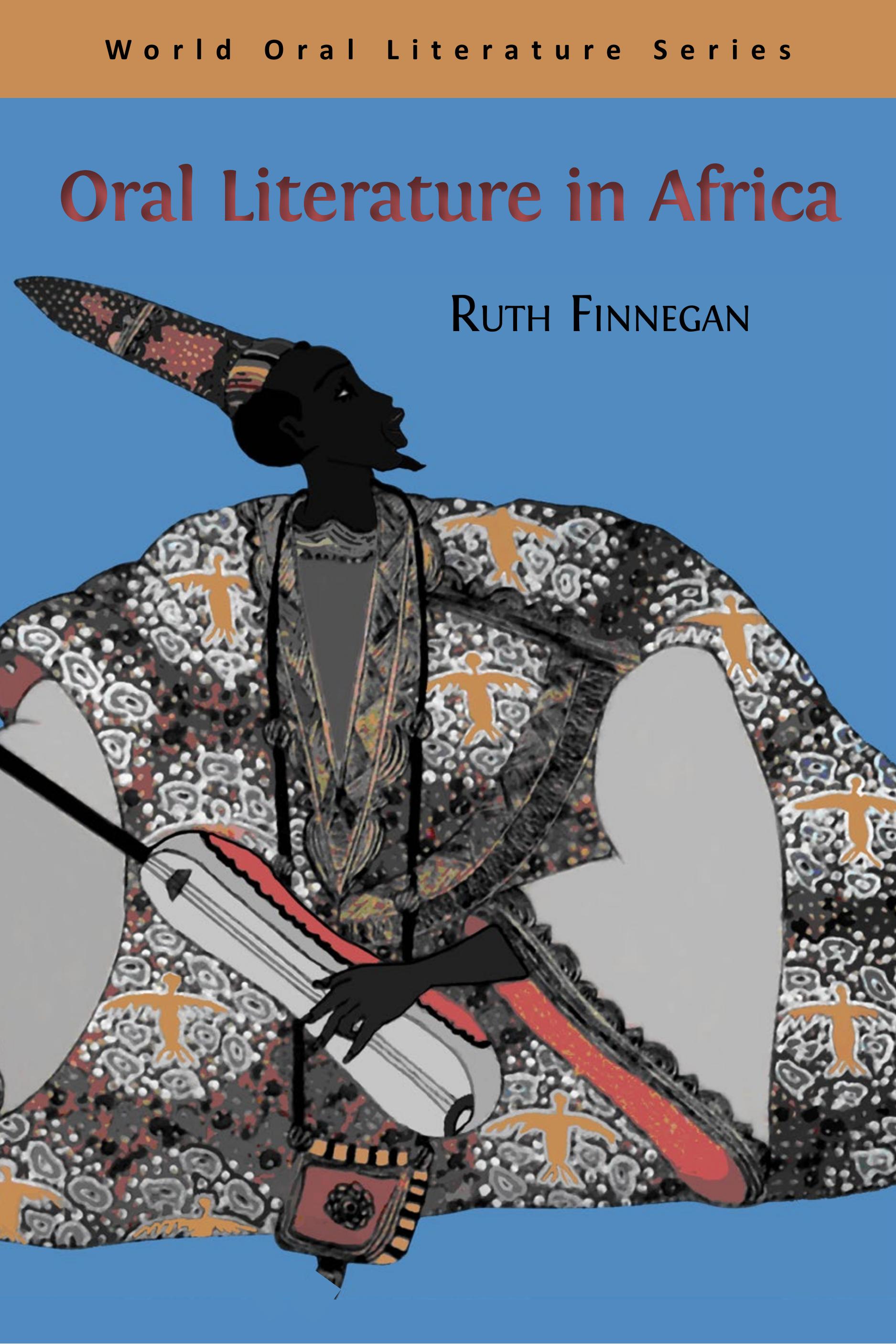
| Title | Oral Literature in Africa |
|---|---|
| Contributor | Ruth Finnegan(opens in new tab)(author) |
| DOI | https://doi.org/10.11647/OBP.0025(opens in new tab) |
| Landing page | https://www.openbookpublishers.com/books/10.11647/obp.0025(opens in new tab) |
| License | http://creativecommons.org/licenses/by/3.0/(opens in new tab) |
| Copyright | Ruth Finnegan |
| Publisher | Open Book Publishers |
| Publication place | Cambridge, UK |
| Published on | 2012-09-17 |
| Series |
|
| ISBN | 978-1-906924-70-6 (Paperback) |
| 978-1-906924-71-3 (Hardback) | |
| 978-1-906924-72-0 (PDF) | |
| 978-1-80064-452-6 (HTML) | |
| 978-1-906924-73-7 (EPUB) | |
| 978-1-906924-74-4 (MOBI) | |
| Short abstract | Ruth Finnegan’s Oral Literature in Africa was first published in 1970, and since then has been widely praised as one of the most important books in its field. Based on years of fieldwork, the study traces the history of storytelling across the continent of Africa. This revised edition makes Finnegan’s ground-breaking research available to the next generation of scholars. It includes a new introduction, additional images and an updated bibliography, as well as its original chapters on poetry, prose, ‘drum language’ and drama, and an overview of the social, linguistic and historical background of oral literature in Africa. |
| Long abstract | Ruth Finnegan’s Oral Literature in Africa was first published in 1970, and since then has been widely praised as one of the most important books in its field. Based on years of fieldwork, the study traces the history of storytelling across the continent of Africa. This revised edition makes Finnegan’s ground-breaking research available to the next generation of scholars. It includes a new introduction, additional images and an updated bibliography, as well as its original chapters on poetry, prose, "drum language" and drama, and an overview of the social, linguistic and historical background of oral literature in Africa. Oral Literature in Africa has been accessed by hundreds of readers in over 60 different countries, including Ethiopia, Kenya, Rwanda and numerous other African countries. The digital editions of this book are free to download thanks to the generous support of interested readers and organisations, who made donations using the crowd-funding website Unglue.it. Oral Literature in Africa is part of our World Oral Literature Series in conjunction with the World Oral Literature Project. |
| Print length | 614 pages (xliv + 570 ) |
| Language | English (Original) |
| Dimensions | 156 x 32 x 234 mm | 6.14" x 1.24" x 9.21" (Paperback) |
| 156 x 33 x 234 mm | 6.14" x 1.31" x 9.21" (Hardback) | |
| Weight | 1879g | 66.28oz (Paperback) |
| 2280g | 80.42oz (Hardback) | |
| Media | 39 illustrations |
| 1 table | |
| OCLC Number | 969711848 |
| LCCN | 2019467807 |
| BIC |
|
| BISAC |
|
| LCC |
|
| Keywords |
|
Contents
- Ruth Finnegan
- Ruth Finnegan
- Ruth Finnegan
- Ruth Finnegan
- Ruth Finnegan
- Ruth Finnegan
- Ruth Finnegan
- Ruth Finnegan
- Ruth Finnegan
- Ruth Finnegan
- Ruth Finnegan
- Ruth Finnegan
- Ruth Finnegan
- Ruth Finnegan
- Ruth Finnegan
- Ruth Finnegan
- Ruth Finnegan
- Ruth Finnegan
- Ruth Finnegan
Contributors
Ruth Finnegan
(author)Ruth Finnegan is a Visiting Research Professor and Emeritus Professor in the Faculty of Social Sciences at the Open University. Her particular interests are in the anthropology/sociology of artistic activity, communication, and performance; debates relating to literacy, 'orality' and multimodality; and amateur and other 'hidden' activities. She has published widely on aspects of communication and expression, especially oral performance, literacy, and music-making. Her publications include Limba Stories and Story-Telling (1967, 1981); Oral Poetry (1977; 2nd edn 1992); Information Technology: Social Issues (joint ed., 1987); Literacy and Orality: Studies in the Technology of Communication (1988); Oral Traditions and the Verbal Arts (1992); Communicating: The Multiple Modes of Human Interconnection (2002); and The Oral and Beyond: Doing Things with Words in Africa (2007). Her most recent book, Why Do We Quote? The Culture and History of Quotation was published in 2011, and, to appear around 2013, an edited study of dreaming and telepathy. Ruth Finnegan was elected a Fellow of the British Academy in 1996 and an Honorary Fellow of Somerville College Oxford in 1997; she was awarded an OBE for services to Social Sciences in 2000. Under the pen name of Catherine Farrar she has also published the first two parts of fantasy-fictional 'The Self Quartet', namely The Little Angel and the Three Wisdoms and Three Ways of Loving; also a collection of short stories, The Wild Thorn Rose. She can be reached at: r.h.finnegan@open.ac.uk
Mark Turin
(foreword by)Mark Turin is a linguist and anthropologist. Before joining the South Asian Studies Council at Yale, he was a Research Associate at the Museum of Archaeology and Anthropology at the University of Cambridge. He has also held research appointments at Cornell and Leipzig universities, and the Namgyal Institute of Tibetology in Sikkim, India. From 2007 to 2008, he served as Chief of Translation and Interpretation at the United Nations Mission in Nepal (UNMIN). Mark Turin is now the director of both the World Oral Literature Project (Cambridge and Yale)—an urgent global initiative to document and make accessible endangered oral literatures before they disappear without record—and the Digital Himalaya Project, a platform to make multi-media resources from the Himalayan region widely available online. He writes and teaches on ethnolinguistics, visual anthropology, digital archives and fieldwork methodology at the Universities of Cambridge and Yale. His publications include Nepali–Thami–English Dictionary (2004); Grounding Knowledge/Walking Land: Archaeological Research and Ethno-historical Identity in Central Nepal (joint, 2009) and A Grammar of Thangmi with an Ethnolinguistic Introduction to the Speakers and their Culture (2012). He can be reached at: mark.turin@ubc.ca