
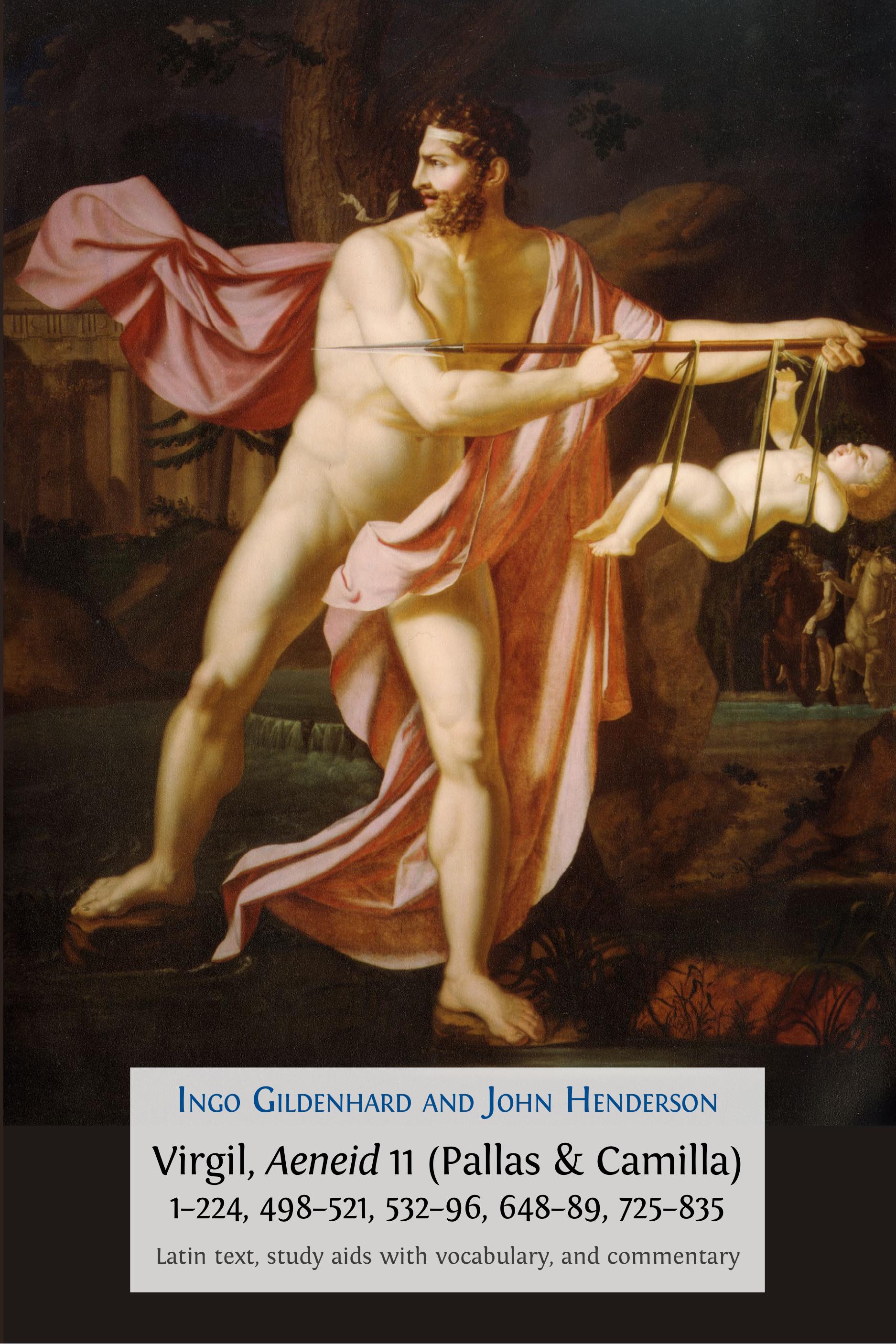
| Title | Virgil, Aeneid 11, Pallas and Camilla, 1–224, 498–521, 532–596, 648–689, 725–835 |
|---|---|
| Subtitle | Latin Text, Study Aids with Vocabulary, and Commentary |
| Contributor | Ingo Gildenhard (author) |
| John Henderson (author) | |
| DOI | https://doi.org/10.11647/OBP.0158(opens in new tab) |
| Landing page | https://www.openbookpublishers.com/books/10.11647/obp.0158(opens in new tab) |
| License | http://creativecommons.org/licenses/by/4.0/(opens in new tab) |
| Copyright | Ingo Gildenhard; John Henderson |
| Publisher | Open Book Publishers |
| Publication place | Cambridge, UK |
| Published on | 2018-12-05 |
| Series |
|
| ISBN | 978-1-78374-600-2 (Paperback) |
| 978-1-78374-601-9 (Hardback) | |
| 978-1-78374-602-6 (PDF) | |
| 978-1-80064-576-9 (HTML) | |
| 978-1-78374-605-7 (XML) | |
| 978-1-78374-603-3 (EPUB) | |
| 978-1-78374-604-0 (MOBI) | |
| Short abstract | This course book offers the original Latin text, vocabulary aids, study questions, and an extensive commentary. Designed to stretch and stimulate readers, Ingo Gildenhard’s volume will be of particular interest to students of Latin studying for A-Level or on undergraduate courses. It extends beyond detailed linguistic analysis to encourage critical engagement with Virgil’s poetry and the most recent scholarly thought. |
| Long abstract | A dead boy (Pallas) and the death of a girl (Camilla) loom over the opening and the closing part of the eleventh book of the Aeneid. Following the savage slaughter in Aeneid 10, the book opens in a mournful mood as the warring parties revisit yesterday’s killing fields to attend to their dead. One casualty in particular commands attention: Aeneas’ protégé Pallas, killed and despoiled by Turnus in the previous book. His death plunges his father Evander and his surrogate father Aeneas into heart-rending despair – and helps set up the foundational act of sacrificial brutality that caps the poem, when Aeneas seeks to avenge Pallas by slaying Turnus in wrathful fury. Turnus’ departure from the living is prefigured by that of his ally Camilla, a maiden schooled in the martial arts, who sets the mold for warrior princesses such as Xena and Wonder Woman. In the final third of Aeneid 11, she wreaks havoc not just on the battlefield but on gender stereotypes and the conventions of the epic genre, before she too succumbs to a premature death. In the portions of the book selected for discussion here, Virgil offers some of his most emotive (and disturbing) meditations on the tragic nature of human existence – but also knows how to lighten the mood with a bit of drag. This course book offers the original Latin text, vocabulary aids, study questions, and an extensive commentary. Designed to stretch and stimulate readers, Ingo Gildenhard’s volume will be of particular interest to students of Latin studying for A-Level or on undergraduate courses. It extends beyond detailed linguistic analysis to encourage critical engagement with Virgil’s poetry and the most recent scholarly thought. King's College, Cambridge, has generously contributed to this publication. |
| Print length | 596 pages (x + 586) |
| Language | English (Original) |
| Dimensions | 156 x 31 x 234 mm | 6.14" x 1.21" x 9.21" (Paperback) |
| 156 x 33 x 234 mm | 6.14" x 1.31" x 9.21" (Hardback) | |
| Weight | 1825g | 64.38oz (Paperback) |
| 2226g | 78.52oz (Hardback) | |
| Media | 17 illustrations |
| OCLC Number | 1083966738 |
| LCCN | 2019467311 |
| BIC |
|
| BISAC |
|
| LCC |
|
| Keywords |
|
| Funding |
|
Contents
- Ingo Gildenhard
- John Henderson
- Ingo Gildenhard
- John Henderson
- Ingo Gildenhard
- John Henderson
- Ingo Gildenhard
- John Henderson